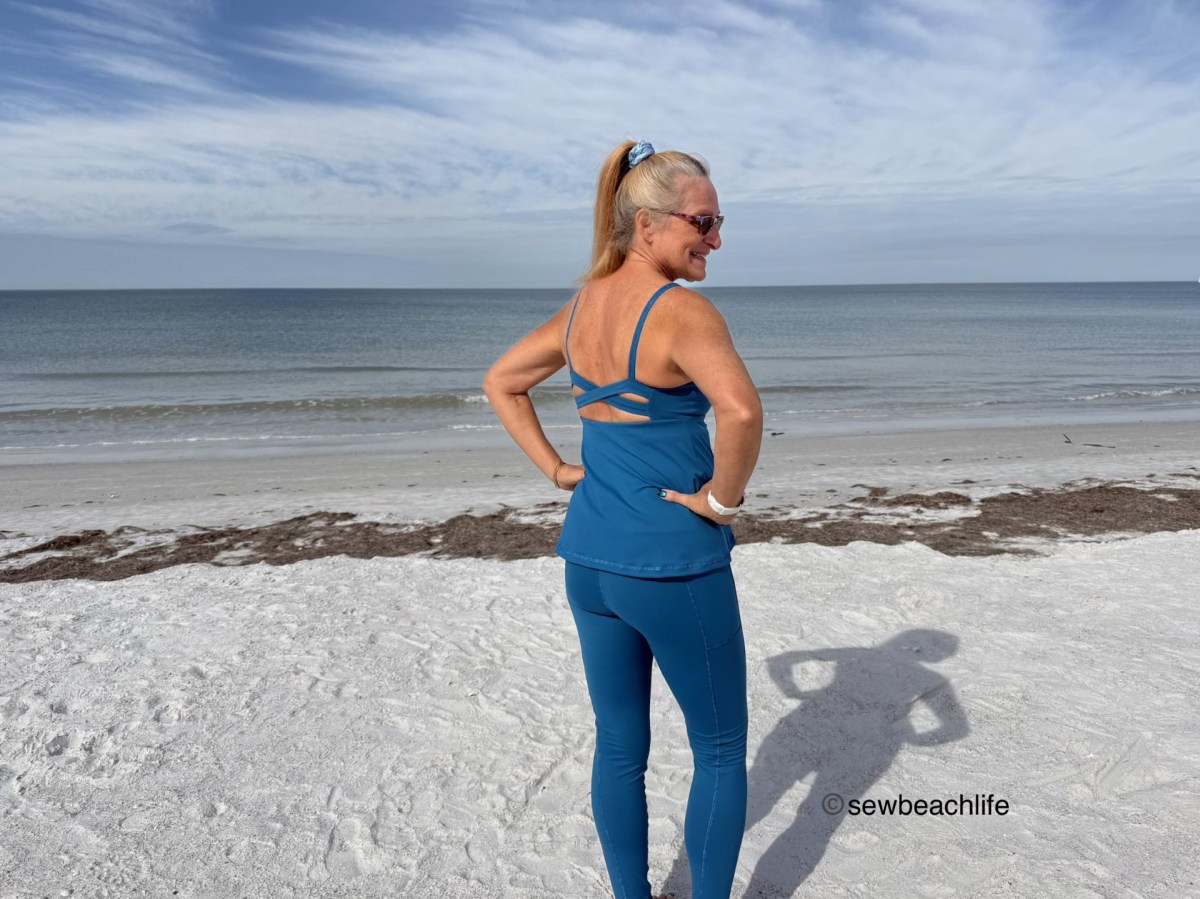
Make It A Workout Top

And Check Out My New Leggings

When you go to the gym five days a week, you need a lot of workout wear. My favorite sports bra patterns tend to get hacked into workout tops because if I love it as a bra, I’ll love wearing it as a top too! I couldn’t wait to make the Greenstyle Delphi Bra into a workout top, and doing something simple wasn’t enough of a challenge for me.

The infinity back on the Delphi is my favorite back option, and I thought it would be fun to make the back infinity straps narrower, with the final back strap width at 1″. So I figured out the strap width, ensuring that when the seam is properly aligned that the back attachment angle would match the original angle, blah, blah, blah. Don’t be like Debora- the pattern is excellent as designed, and it was ridiculous of me to try and over-engineer the back infinity straps. 🙂

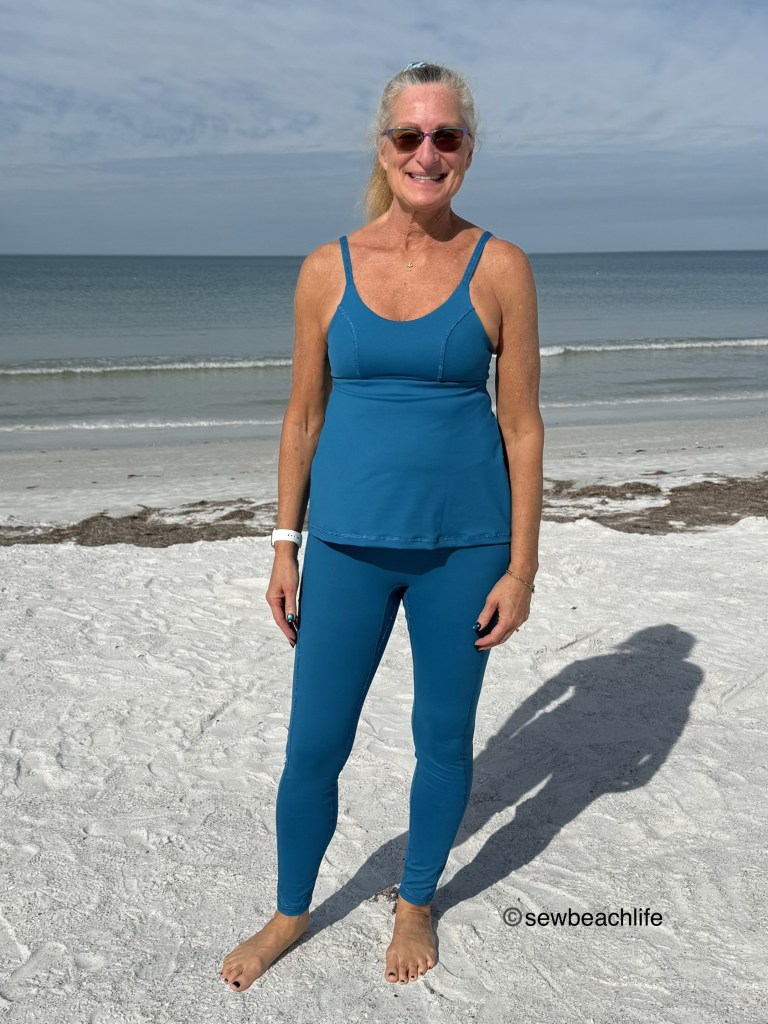
I’ve made numerous workout tops using the Greenstyle Power Sports Bra pattern, and love the front princess seams. So I figured, why not mash the two patterns? The side seams are not the same height, so there was a little bit of adjustment to get them to align. It worked out well to get a fun look in the front and the back, and it gave me more seam lines to reverse triple coverstitch.
Since I make so many workout tops, I had front and back bodice pieces already saved in my Power Sports Bra pattern envelope. (I use 14″ x 18″ manilla jumbo catalog envelopes to store all my .pdf patterns, and they work great. The larger size means that my pattern pieces don’t have to be folded as much.) I’m not sure whether I originally used the bottom of the Staple Tank or Cami Tank to make the bodice, but honestly, whatever tank top pattern fits you well can be used as to get the shape.

I wanted to narrow and shorten my previously traced bodice pieces, so I grabbed my Bobby Brami pattern and went sort of halfway between the two different lengths and widths, as I didn’t want it quite as short and fitted as my Bobby Brami tops. Looking at my photos though, I may have gone a bit too narrow at the ribs, and not quite fitted enough at the waist and hips. I can always take it in a bit later.
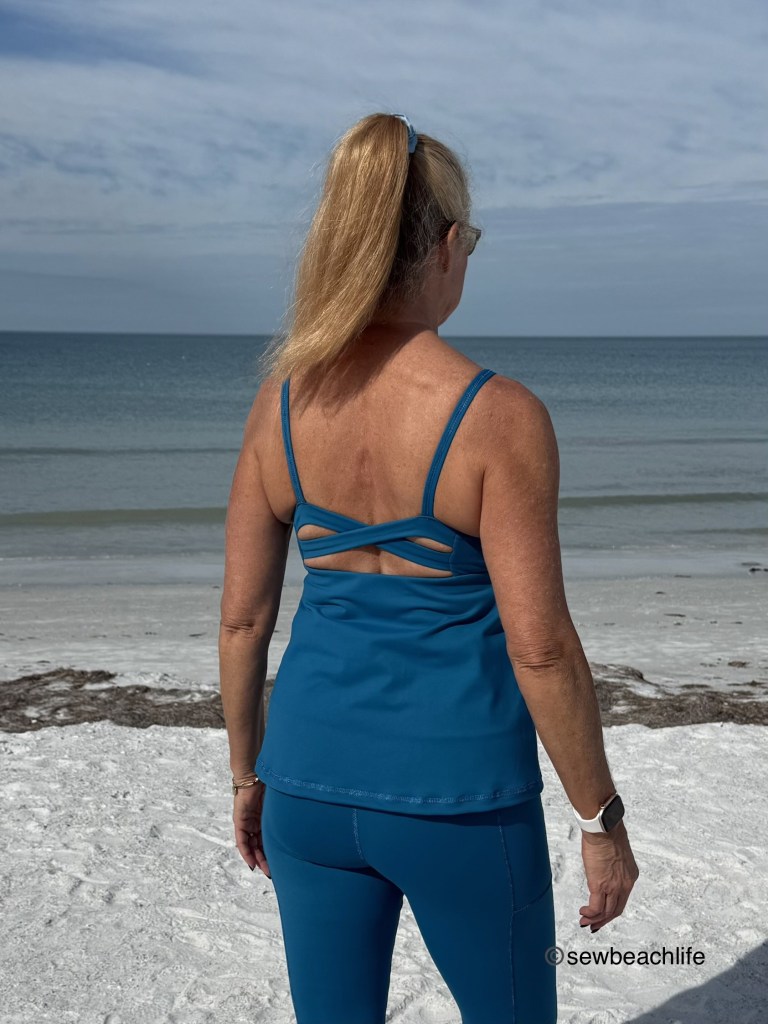
I wanted a super clean finish where the bodice attached to the bra so that the infinity back really stands out. A bra obviously needs a band for compression and support, but I kept it hidden.

For reference, I make a size C1 Delphi Bra, which is where my measurements put me according to the new size chart. My underbust measurement is 30.5″, and I generally use 24″ of 1″ wide knit elastic from Wawak in my bra bands. That’s what feels comfortably snug to me.

To figure out the length you need, wrap your elastic around you under the bust, pulling it as taut as feels comfortable to you, add .5″ for overlap, and cut your elastic and band to that length. Make your band 2.25″ high. This allows you 1″ for the elastic, 1″ to fold it up, and a quarter inch seam allowance to attach it to the bra and bodice. Assemble the bra as per the pattern tutorial, stopping at the point where you would add the band. Sew the bodice front and back together, and hem the bottom. Sew the short ends of the band together, forming a loop and mark the quarter points. Overlap the ends of the elastic and zig zag together forming a loop and mark the quarter points with a pencil. Align the quarter points of the band and elastic, and serge the elastic to the bottom edge of the wrong side of the band.

Take a look at the back band pattern piece of the Delphi Bra, and measure the distance between the two notches. (On my size, that’s around 7.5″) Use a piece of tailor’s chalk or pins to mark this measurement, centering it on what will be the back of your band.
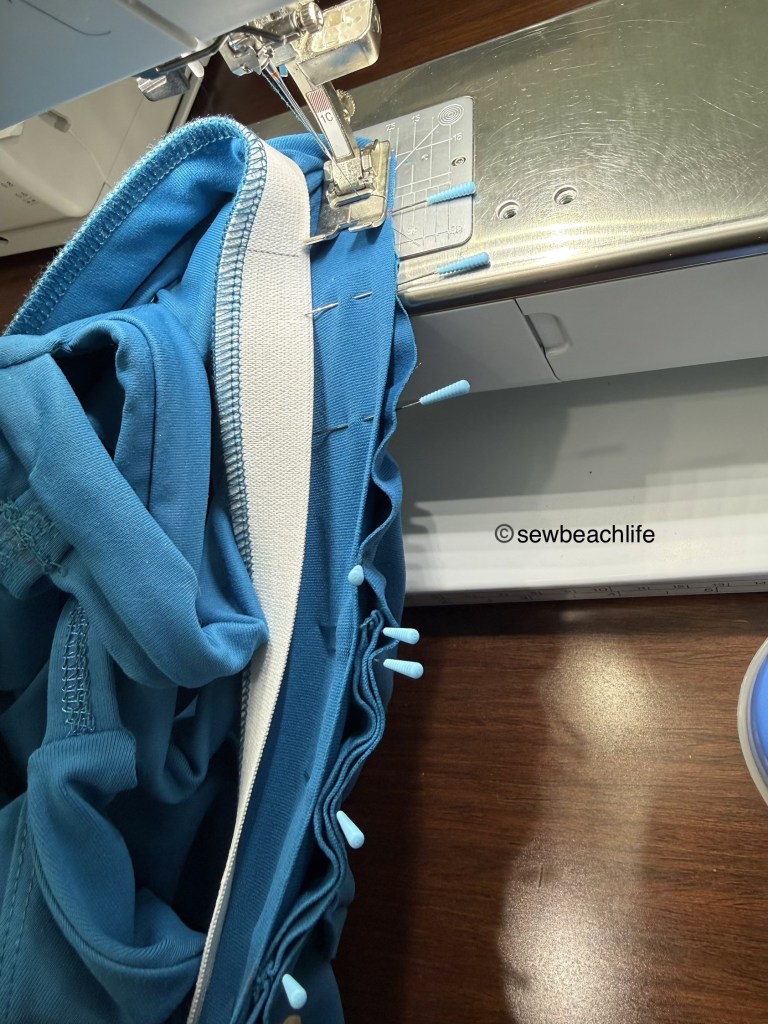
The next part seems tricky, but it’s really not. It’s more a matter of aligning and pinning. 🙂 To sew the band, bra, and bodice together, align the raw edges in this order: right side of band against wrong side of bra. Align the finished back edges of the bra back with the previously made tailor’s chalk marks. Align the center fronts, as well as the side seams and quarter points. Then align the right side of the bodice with the right side of the bra, matching the quarter points. The bra will be sandwiched between the band and bodice. Pin all around and baste all the layers together. Looking at the photo above see how there’s only two layers of fabric where I’m sewing? That’s the band and bodice at the infinity back opening. Near the bottom of the photo you can see the bra sandwiched in there. Having everything basted together will make it easier to serge the seam. You may want to use a hump jumper when you go from two layers of fabric to four.
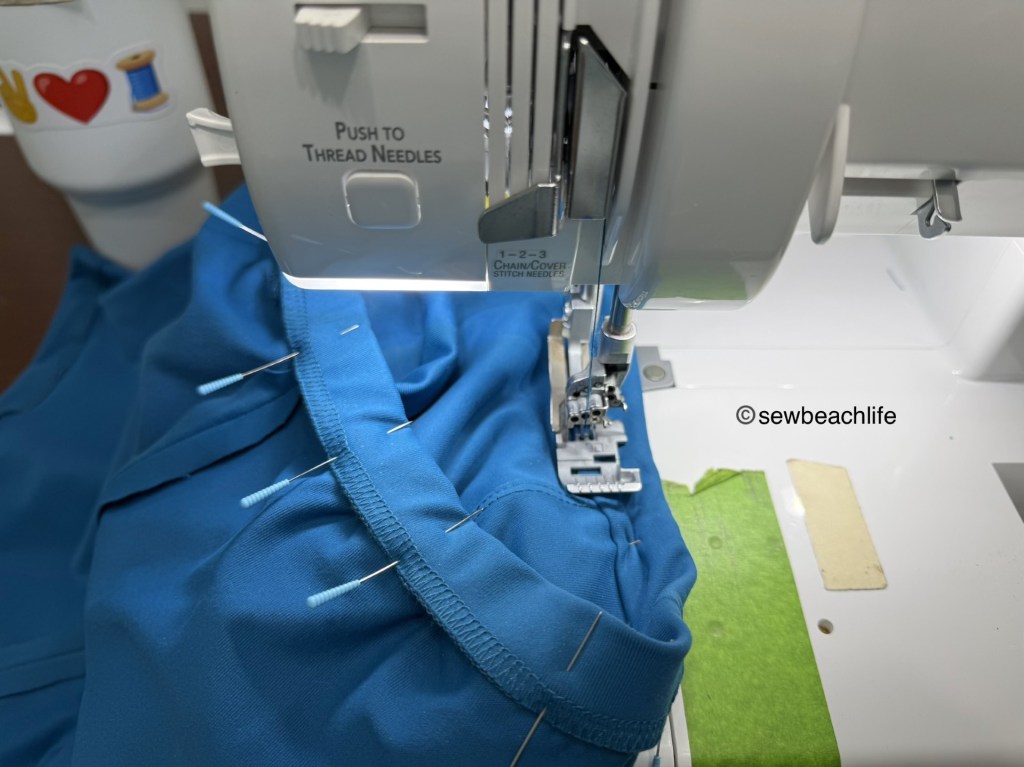
Ignore that I put the pins in from the wrong direction when folding the elastic up. 😉

Get the bra and bodice out of the way, fold the band up so that the elastic is hidden, and pin in place covering but not overhanging the seam allowance. Coverstitch (or topstitch with a stretch stitch or double needle) to complete the band. Press your completed top with your iron set at an appropriate temperature for your fabric.
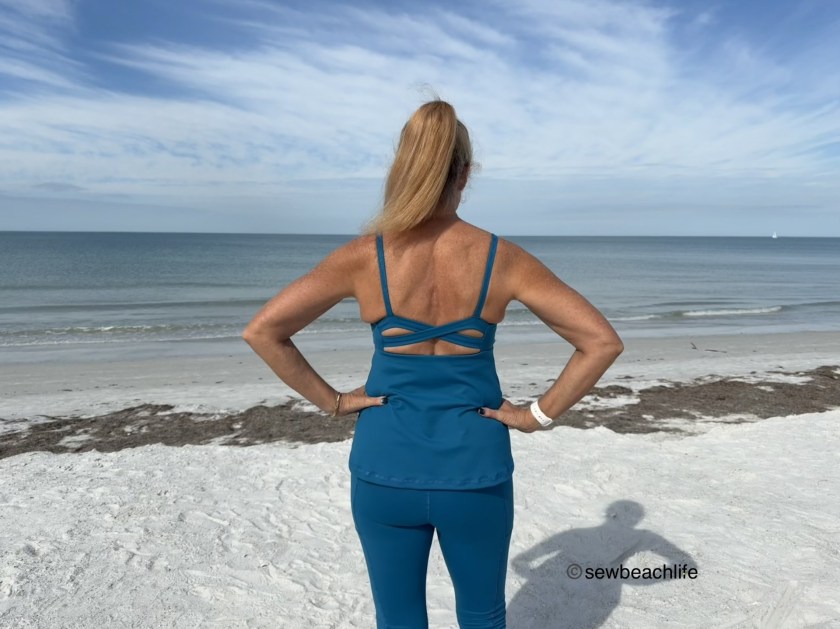
This is the second pair of Sinclair Patterns Glide Leggings that I’ve made. I love that they have pockets and a gusset. It’s nice that they have tall files as well as regular and petite. These are a size 10 tall, and they actually may be about a half inch too long. To see the first pair I made in black supplex, see the previous post. I wore them on my trips to and from Michigan last month. They were comfortable during the flights, long layovers, and walking around in airports.
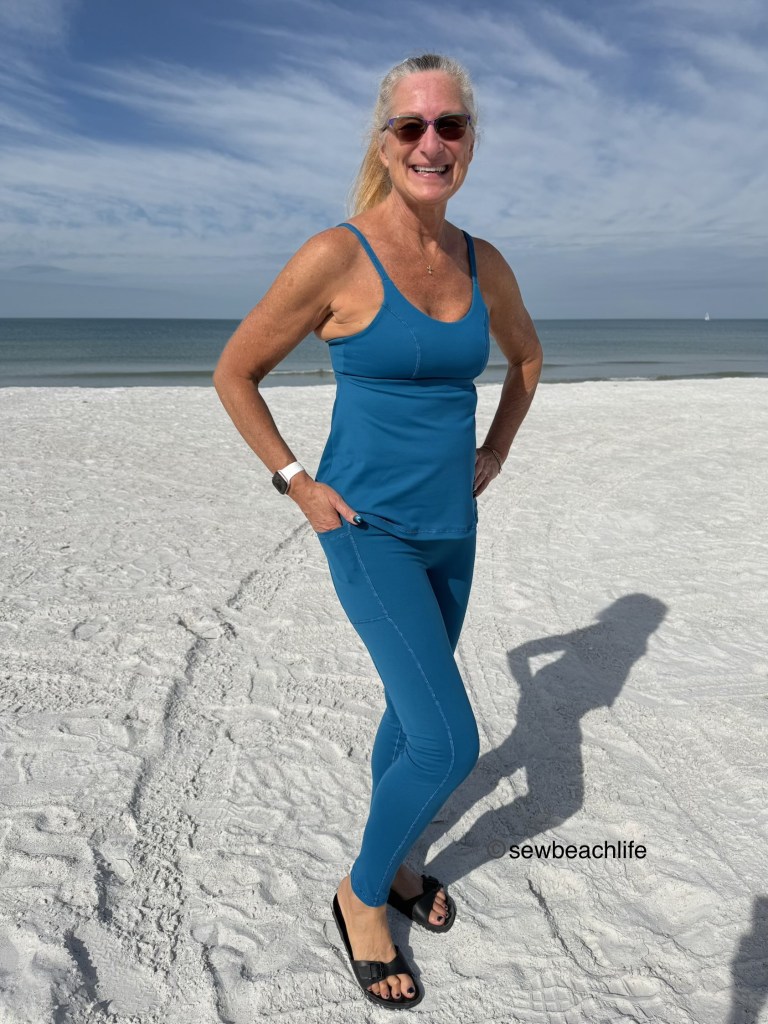
I have strong (large?) calf muscles from growing up on skates, and graded out a little bit for the calves. I’m thinking about adding maybe another quarter inch of width there.

I wore my new workout outfit to Dance Fitness Fusion class and received a couple compliments. Dance class is followed by yoga class, and I had time to play around and asked someone to take a few photos of my headstand.
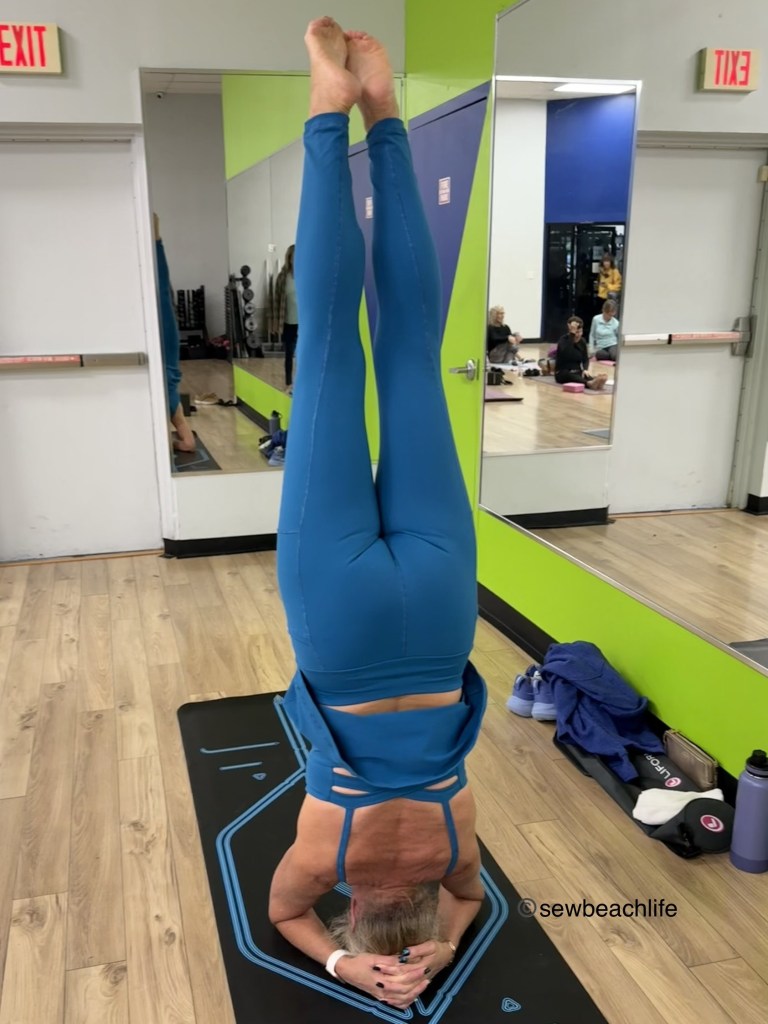
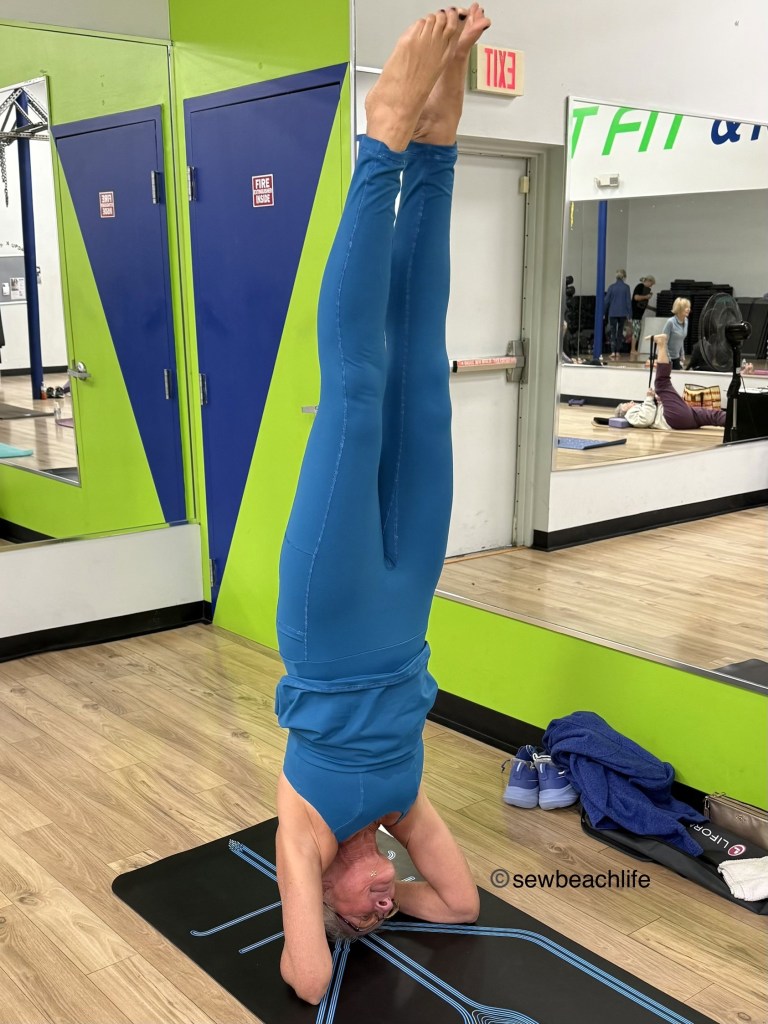
See that perfect triangle formed by my clasped hands, with forearms to elbows pushed firmly down into the floor? That’s the base you need to be able to do a headstand, because the weight of your body isn’t actually on your head, it’s on your base.
It’s interesting to see the look of determination and focus on my face. And lest you think that dance class isn’t really a workout, peep the sweat under my bust. My watch tells me I burn about 400 calories just having fun at dance class. Then I cool down at yoga.

My outfit was reverse triple coverstitched using Superior Threads Fantastico variegated thread #5028 Peacock Plume in the looper. The trickiest seam to complete is that inner leg seam. You’ve just got to remember to go in from the waist (it helps to do it before adding the waistband), scrunch one leg up like you’re putting on pantyhose, and start sewing from the hem of that leg, all the way up to the crotch, continuing down the other leg, pausing to scrunch further and further down the leg to the hem. It’s time consuming, but doable.

The details:

For the top I mashed the Power Sports Bra, Delphi Sports Bra, Cami Tank, and Bobby Brami by Greenstyle Patterns. The bottoms are Glide Leggings by Sinclair Patterns. By playing pattern tetris, I was able to fit all pieces on less than two yards of Greenstyle Align 2 in a teal color. This particular color is no longer available, but I love Align 2 because it is a nylon/spandex blend. I avoid polyester fabrics. I love having a new workout outfit to add to my rotation! Am I likely to make another Delphi Bra workout top? Absolutely!

Thank you for reading and sharing my love of patterns, sewing, fabric, thread, and cute workout wear. The links to GreenStyle may be affiliate links (if I did them properly!) which means that I may earn a few pennies if you use my links without it costing you anything extra. Since this is my blog and represents me, I always give my honest opinion about any patterns, fabric, or supplies that I talk about. I do like knowing whether the time I spend writing posts actually interests people enough that they take a look at the patterns I review, but I write for me. It’s one more creative pursuit that I hope is helpful or interesting to others. I write to share my love of sewing and to encourage others to love it as much as I do! ❤

Sage Top and Cinder Skirt

An Easy, Breezy Summer Outfit

A fitted strappy top or crop (with an optional shelf bra!) is the perfect complement to a light breezy skirt. I love it when Stitch Upon A Time brings an on-trend look to life!

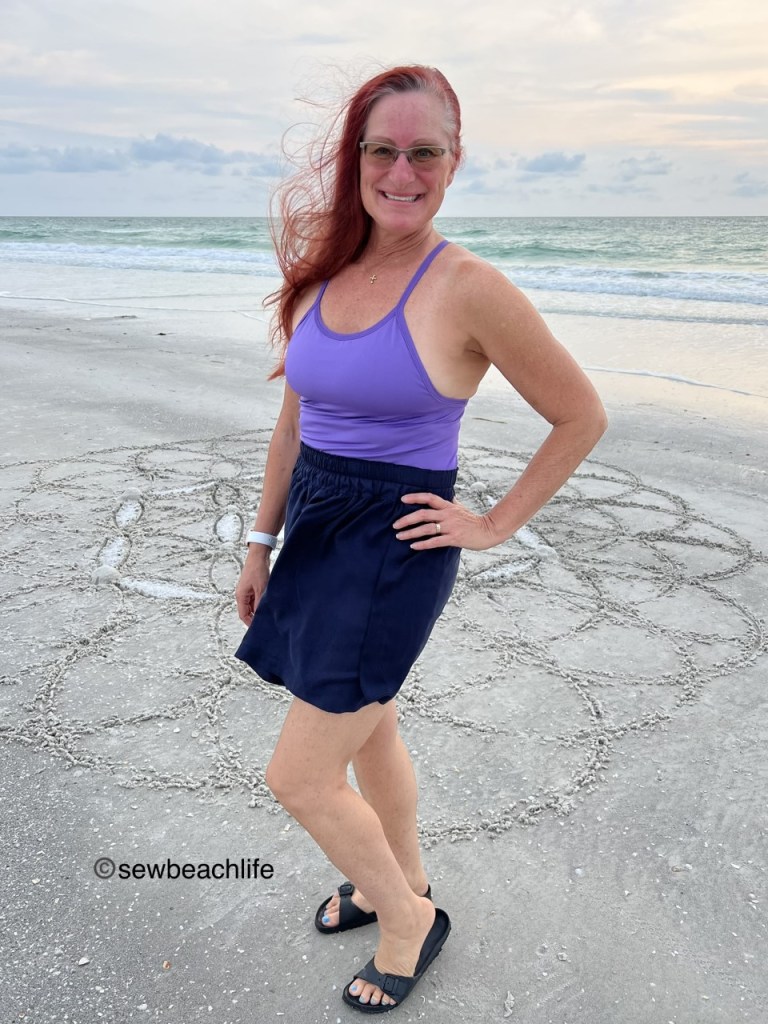
About a month ago, I was sitting at the beach with family and friends and noticed the skirt a woman walking by was wearing. I know people watching is a common “sport”, but garment sewists, we tend to clothing watch. 🙂 Whenever I see a cute dress, top, skirt, or outfit, I start thinking: do I have a pattern for that? Anyways, the maxi length skirt she was wearing was made of a white gauzy fabric, had overlapping sides, and an elasticated waistband. It looked so cute, but I had never seen a pattern like it. About a week later, the testing call for the Cinder Skirt popped up and I was so excited to sign up for it! The Sage Top was also being tested, and I couldn’t resist the opportunity for a cute new summer outfit.

It’s a perfect beach walking outfit!

The design of the Cinder Skirt is perfect, with beautiful, clean finishes. There are no exposed raw edges, all the seams are enclosed. With quality finishes like this, no matter how many times you wash and wear this woven skirt, it won’t fray. The secret to the hem on the curved sides is the facing. My best tip for the facing is to serge along the inner curve with a four thread overlock, then press that inner curve to the wrong side of the fabric. This will make it easier to press, and keep your fabric from fraying inside the hem, even when using fabric that tends to fray a lot, like linen.

The facing is pinned to the skirt panel right sides together. See how smoothly that inner curve lays? And how badly the linen fabric (along the outer cuve) frays before serging?

When serging the facing to the skirt panel, up the differential to 1.3 or even 1.5 when serging the outer curves. This will help the curved seam lay flat when the facing is flipped to the inside and pressed. Just don’t forget to put it back on N for the straight sections!

I love the beautiful details of the elasticated waistband and overlapped panels on the sides of the skirt!

The waistband calls for either two rows of 1″ elastic, or one row of 2″ elastic, stitched in the middle. The directions call for top-stitching the upper edge of the waistband, inserting the elastic, then top-stitching below the elastic, and inserting the second row of elastic. I followed the rules on my first test version, but decided to try using my coverstitch and a different method on my second skirt.

I thought it might be easier to leave an opening for elastic, stitch the waistband, then insert the two pieces of elastic. To prepare the waistband for this, I serged along both short ends to finish them. Then I sewed the short ends together 1/4″ past the halfway fold of the waistband. I stitched the bottom 1/2″ of the short ends together too. This left me an opening for the elastic on the inside of the waistband. I pressed the seam open and stitched along the opening to finish it.

Notice how the bottom of the waistband is serged and pre-pressed? This will make it easier to do the final top/cover-stitching on the waistband.

Since even a narrow coverstitch is wider than a single row of top stitching, I had to make small changes. Rather than top-stitching 1/2″ from the upper edge of the (folded in half) waistband, I coverstitched 1/4″ from the upper edge. Leaving 1″ of room for the 1″ wide elastic, I ran the next row of coverstitching. As per the pattern tutorial, the raw edge of the waistband was serged onto the gathered skirt. The pre-pressed bottom of the waistband was folded over the serged waist seam, carefully pinned in place, then coverstitched.

It’s important to stitch slowly, and pause to remove pins to avoid breaking a needle or damaging your machine.

I love the beautiful clean finish on the waistband, and the professional look of coverstitching. I will admit though, that it took a bit of work to get both pieces of 1″ elastic threaded evenly through the waistband with this lightweight fabric! It’s such a fun skirt though! And I love that there are three length options- mini (which is what I made), knee, and maxi length. I still need to find some white gauzy fabric to duplicate the maxi skirt that I saw at the beach!

Here’s what the inside of the waistband looks like before adding the skirt and elastic. I could have hand-stitched the openings closed after adding my elastic, but because I finished the edges, I don’t feel the need to get out a needle and thread! Also, my cat obviously likes to hang around and requires petting while I am sewing! 🙂

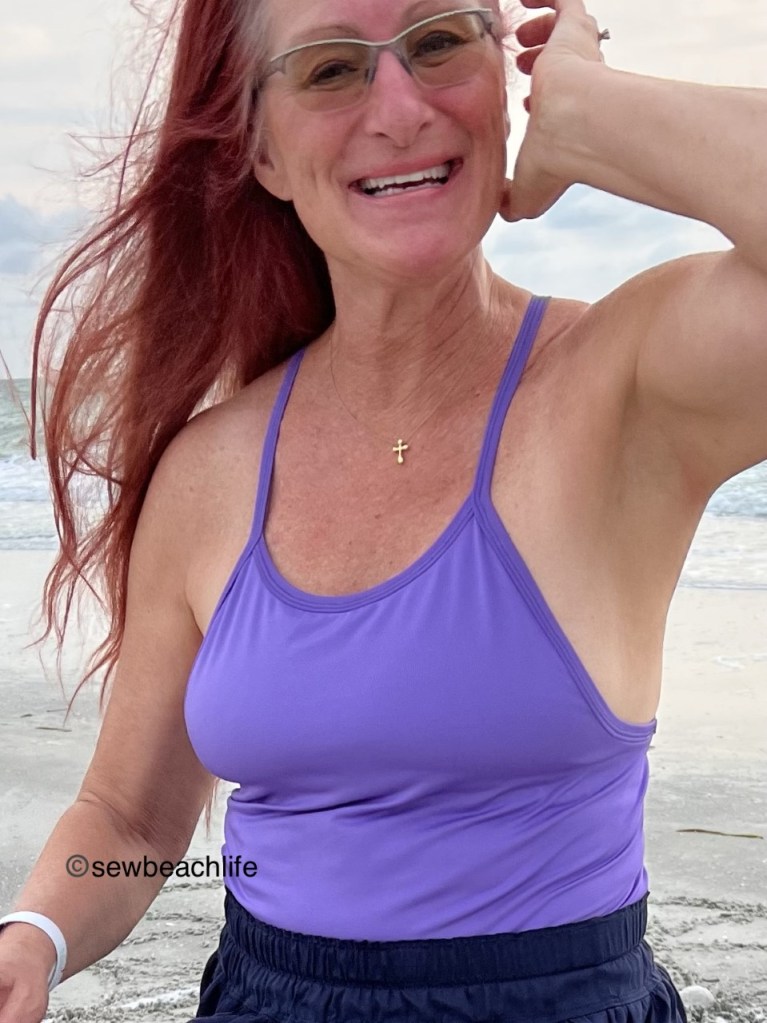
The Sage Top is such a great companion to the Cinder Skirt! Being a fitted tank, it skims the body and works well with the gathered skirt. I love that it has a built-in shelf bra so that I don’t have to wear an uncomfortable strapless bra.

The shelf bra is surprisingly supportive and comfortable.

The Sage Top with shelf bra is not designed to wear as workout top (unless of course your bust doesn’t really need support for exercise). But for casual wear, it provides adequate support to wear comfortably. Because I have a larger cup size, and have a “grandma” bust, I always use powernet in every bra/shelf bra/swimwear/workout top I make.

The main fabric I used is a lighter weight nylon/spandex circular knit. It is super soft and comfortable, but doesn’t have as much recovery as say an athletic or swim knit. So I used a nylon/spandex swim fabric, and a layer of powernet for the shelf bra. And, I snuck some clear elastic in on the strap section of my binding.

I love that it’s so easy to thread 1/4″ clear elastic through the presser foot of my machine, and it feeds evenly as it’s serged into the seam.

This photo makes it obvious that I didn’t follow the pattern tutorial and do a double folded binding. When doing binding on a knit garment, I just find it easier to use 1/4″ seam allowances, and use the faux binding method. Should I be advising people to not follow the tutorial and go rogue? Possibly not, but it’s what works best for me, and gives such beautiful results that I’m unlikely to change my faux binding habit! 🙂 To accommodate the method, I cut the binding strips at 1-1/4″ wide, instead of the called for 2″. (1/4″ seam allowance + 1/2″ wide binding + 1/2″ folded under).

To prep my binding strips, I serge along one long edge of the binding, using a four thread overlock with a stitch width of M, and a stitch length of 2, upping my differential to 1.3 to add stability to the straps. Then I serge the binding to the garment right sides together, and press the binding up. Then I fold the binding around to the back until the raw serged edge aligns to cover the seam. Use plenty of pins to keep the binding in place, and coverstitch.

I love finding random designs, sandcastles, and messages left by beach-goers. I don’t know who drew this cool design in the sand, but I admire the precision and time it must have taken! It added an interesting background for my photos. So, thank you to whoever made it!

The design of the Sage Top and Crop is so elegantly simple- a seam up the center back, and binding. Easy breezy! Center back seams are great for shaping. In for the waist, and curving out to fit smoothly over the bum.

Yoga has given me some rather serious lat muscles 😉 even if this isn’t the most flattering photo. We were losing the light and it was a cloudy evening, so Dan (my sweet accommodating husband) just took a quick snap.

I’ll wear my Sage Tops with shorts to go skating. It’ll be nice to not have to wear a bra on hot, muggy Florida days. Since we’re busy working on a home updating project, I haven’t had time to skate in weeks. It’s killing me to miss out on my normal Wednesday morning skate around the neighborhood, but such is the life of avid DIYers! It’s also taken away pretty much all of my sewing time, which is why I don’t have any more of these outfits made yet.

The wind didn’t blow the overlapped sides on the skirt open. So there is enough modesty for general wear. Along with knee and maxi lengths if mini length isn’t your style.

So, I’ll have to content myself with this cute outfit until I get some more sewing time! I’d also like to hack the Sage Top, by cutting the crop length, and adding either the Max Top and Dress skirt, or the Wylde Dress skirt. Ah, so many possibilities!

The details:

The Sage Top and Cinder Skirt are new patterns from Stitch Upon A Time.

I used nylon/spandex circular knit, nylon/spandex tricot swim knit, and powernet from Phee Fabrics for the Sage Top.

The 1″ wide knit elastic for the shelf bra in the top and the waistband of the skirt was purchased at Wawak, along with the MaxiLock serger thread used for construction.

The navy lyocell twill fabric for the skirt was a surprise clearance section find at JoAnn Fabrics. I would definitely buy it again, as it was the perfect weight and drape for this skirt.

Thank you for reading and sharing my love of creating, sewing, patterns, patterns, fabric, and making beautiful, well-fitting garments! ❤

The links to Stitch Upon A Time may be affiliate links, which means that at no extra cost to you, I may receive a few pennies if you purchase through my link. As always, I only give my honest opinion. After all, it is my blog, which represents me!

Waimea Rashguard & Bottoms And The Stained Glass Effect

Playing with the coverstitch can really elevate and add depth to your garments

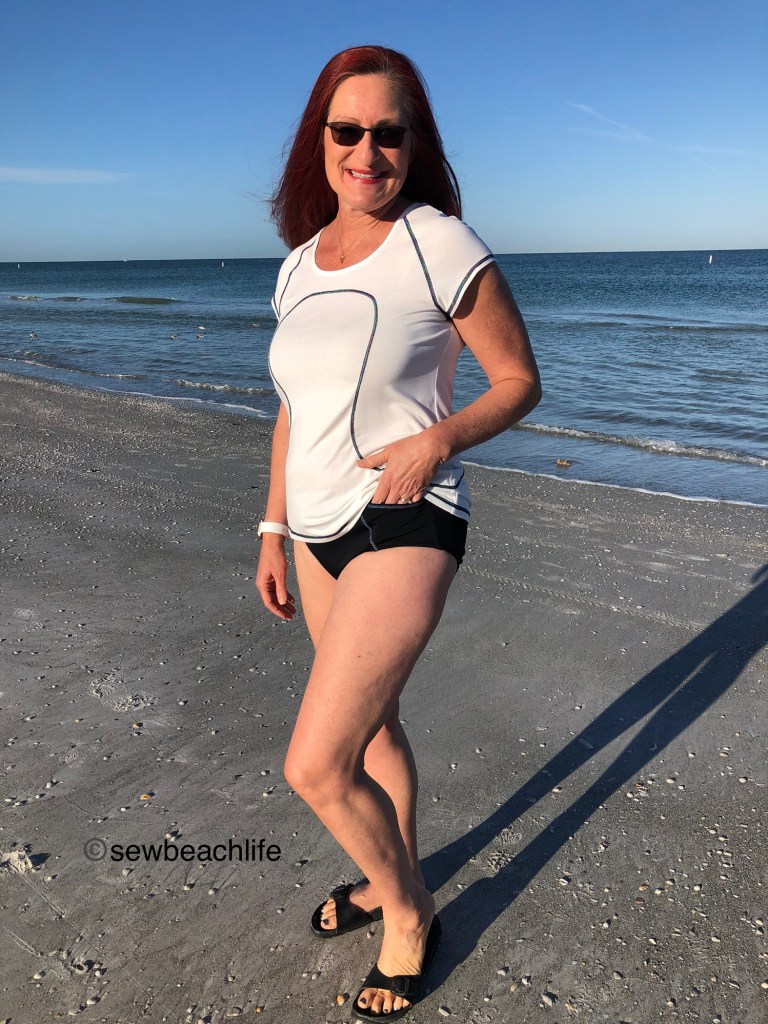
Let’s start with the GreenStyle Waimea Rashguard. I never buy or wear raglan sleeve tops because they never seem to fit right. Every time I try on a RTW raglan style, it rides up and chokes me and the sleeves never fit properly. But GreenStyle patterns are so well drafted that I figured I would give it a shot. Wow! Color me impressed! The sleeves are actually shaped to fit your shoulders. Because it fits your shoulders, it doesn’t ride up and cut into your neck.

Had I been making the top as an actual rashguard, I would have followed the pattern precisely, and used the wider neckband. That would give maximum sun protection as the pattern intended. But I like to play with patterns, and make them for the way I plan to use them. So I tried the top on, and the neckline fell right about at the cross on my necklace before adding the band. Since I just wanted a casual top, I cut the front neckline an inch or so deeper than the pattern, and used binding instead. This leaves the neckline more open, which suits my casual wearing perfectly.

I love the cap sleeve option. It makes the perfect summer top whether I throw it on over my swimsuit or pair it with shorts or a skirt.

The (optional) fun curved hourglass design lines on the front and back offer the perfect opportunity for color-blocking and having fun with your coverstitch. I decided to go all out with coverstitching, and tried a new technique. I knew I wanted a variegated look so my top would match whatever bottoms I wanted to pair with it.

When I first bought my machine and took the “get to know your machine” orientation, I recall the instructor mentioning that if you didn’t have variegated thread, you could use two threads in your chain looper to get a more colorful variegated look. We didn’t try it, but apparently I filed this tidbit of information in my head. I’m sure there are places to buy fancy and fun variegated blends, but I tend to buy my thread from wawak.com when they have cones of MaxiLock serger thread on sale. My favorite and most used variegated thread is called tie dye punch. It’s colorful and multicolored, and yet not the traditional red, yellow, blue, which is just too stark for me.

Although tie dye punch is pretty, it doesn’t lean purple and teal enough for me. And that’s when the filed away thought of using multiple threads in my chain looper came back to me. My plan was to accent the top with a reverse triple coverstitch, which means that I would stitch with the top inside out, so the needle threads would show on the inside of the top, and the looper threads would show on the right side of the fabric. Here’s how I set up my machine:

Can you tell I don’t have a dedicated sewing room and sew at my dining table? 🙂

I put the tie dye punch on the chain looper spool, and set the other two cones (MaxiLock teal, and SureLock purple) on the table just below the looper spool. All three threads went through the thread stand and were fed through the chain looper threading path like normal. I used a thread cradle when autofeeding them through the looper, just like you would when using a thicker thread. To get a “stained glass” look, I used black thread in all three needles. I used Babylock curved foot C to make it easier to sew the curved shapes, and played around on fabric scraps to ensure that I liked the look. Glancing at my practice scrap, I’m kind of impressed at the tight curve near the top of the fabric. Using the curve foot (and having the wide bed space between the needles and the machine) really does make it easier to maneuver tight curves!

I love the fun stained glass effect that using multiple threads achieved!

It’s such a fun look, that I had to play with it some more! The Waimea Swim Bottoms got a similar treatment on the pockets. Since I used black nylon spandex tricot for the bottoms, I changed my thread choices a little bit when coverstitching them. They’re still accented with a triple reverse coverstitch, and again I used tie dye punch variegated thread, along with the purple and teal in the looper. But this time instead of using black thread in all three needles. I used black for C1 and C3, and purple in C2, just for an extra punch of color.

It’s so fun to personalize your swimwear!

How fun is it to have pockets on your swim bottoms? If you’re walking the beach you can easily carry a key or credit card and your phone, and not have to worry about carrying a purse. Of course if you’re a Mom or Grandma, your pockets are likely to get filled with little shells and rocks and some snacks! 🙂

As with every swim bottom pattern I make, I personalize the leg line to suit my body. I don’t like a low leg line, as it’s not flattering on my shape. So I put the bottoms on before adding leg elastic, and carefully pin along the joint at the crease line of my legs. I trace the line of the pins onto my pattern piece to mark my preferred finished leg line. Then I add the 3/8″ seam allowance for the elastic, and trim off the excess fabric. It gives me a beautiful leg line every time!

Can you even take swimwear photos without the obligatory hair flip? 😉

Front to back, I love that I challenged myself to try a new style, that I have some new swim bottoms, and that I played around to create a fun stained glass effect coverstitching look that I know I’ll use again!

I think the hourglass design on the back of the rashguard is quite flattering. And it gave me even more opportunity to coverstitch!

Do you need a rashguard or cute raglan top in your life? And really, who doesn’t need swim bottoms with pockets? 😉 The details:

The Waimea Rashguard has cap, half, or long sleeves. There are two cropped lengths with banded bottoms, as well as a regular full length top. It can be colorblocked or just seamed with fun hourglass shaping, or left solid.

The Waimea Swim Bottoms have pockets and a high or low rise, and an elastic or a foldover waistband.

I used rayon spandex for my casual version of the top, and nylon spandex tricot for my swim bottoms. If I were making the top as an actual rashguard, I would have used the nylon spandex tricot for its UV protecting abilities. All fabric was purchased from Phee Fabrics.

GreenStyle also carries fabric, but I haven’t tried it yet.

Links to GreenStyle and the Waimea patterns are affiliate links. This means that at no extra cost to you, I may receive a small commission if you purchase through my link.  As always, I only give my honest opinion.  After all, it is my blog, which represents me!  Thank you for reading and sharing my love of creating, sewing, patterns, fabric, thread, coverstitching, and making beautiful well-fitting garments! ❤