GreenStyle North Shore Swimsuit

And A Strappy Bikini Hack

I was super excited to see that the North Shore Swimsuit is one of the GreenStyle patterns of the month (which means it’s on sale through July 2019).  I’ve been wanting to try the pattern ever since I decided that this is the summer of swimwear sewing.  It is a classic pattern with options for a monokini, or two piece with a deep V or full coverage front, and a halter or U back, in pullover, tie-back, or S-hook closure.  The bottoms can be scoop, low, mid, or high rise.  Whew!  And you can mix and match the options for an entire wardrobe of swimwear.  If you are completely new to sewing swimwear,  there is a great video tutorial series for the GreenStyle North Shore on YouTube, linked here.

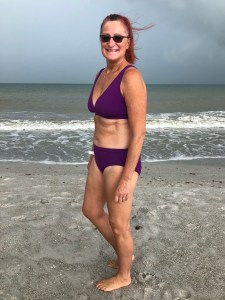
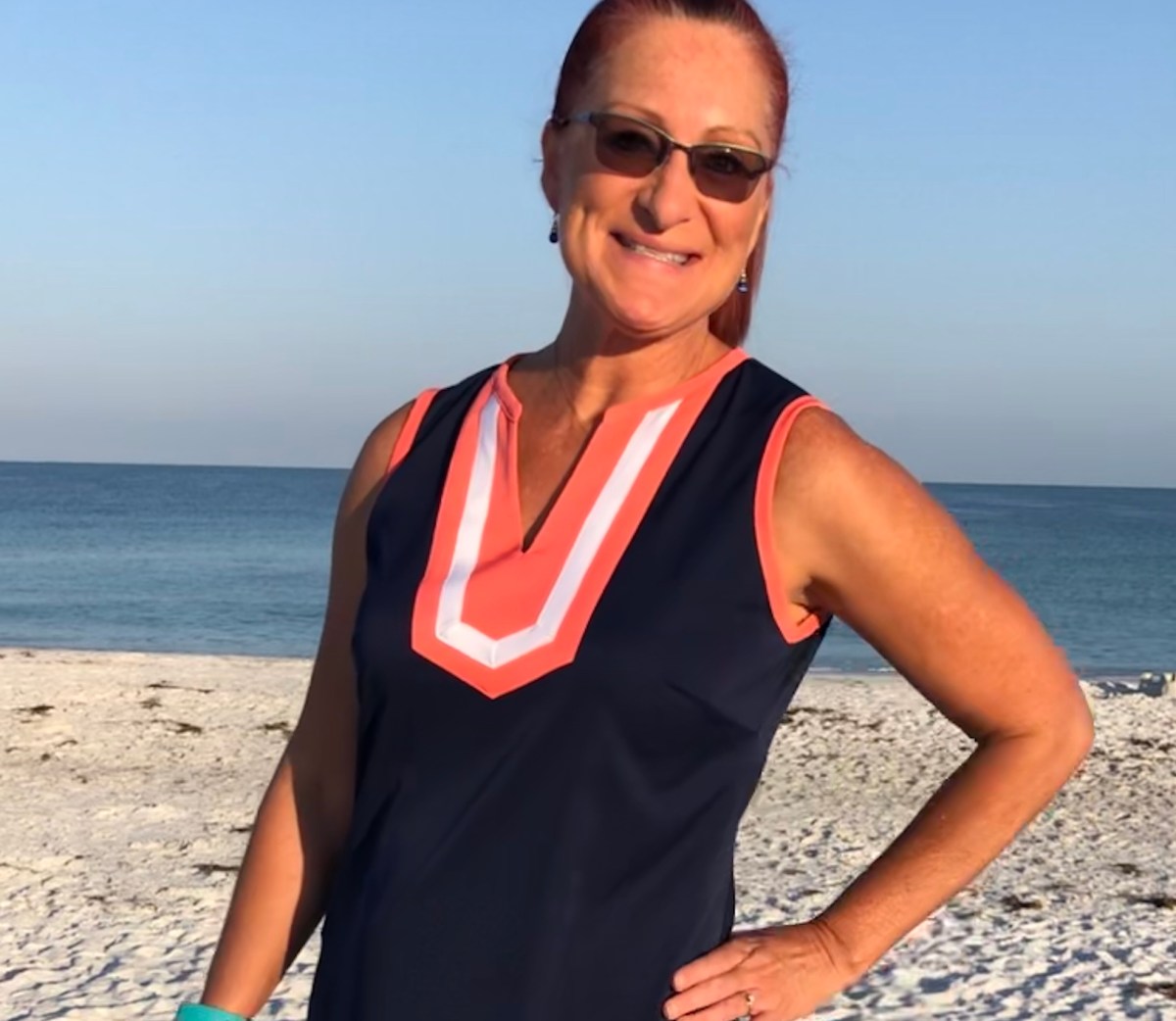
For my first version I went with a mid-rise bottom, and a deep-V full cup front with the S-hook U-back.  It turned out great, and is a classic two piece that looks like RTW.  Using Tricot as the main fabric was a no-brainer, as it is a classic swimwear fabric that can withstand lots of use.  As always when sewing a swim top, all of the top pieces were cut out of the Tricot, high quality powernet for support, and swim lining.  For the bottoms, I used powernet in the front only.  It adds a little bit of tummy control, without giving a “muffin top”.

NS purp frontNS purp side

Basting the powernet to your swim fabric makes sewing so much easier.  I don’t know about you, but there’s no way I can keep multiple layers lined up without basting and a bunch of pins!  The pattern has an elastic chart that makes adding the elastic easy, especially if you are new to swimwear sewing and not yet comfortable with just sewing it on by feel.  Definitely follow the directions about sewing the elastic around the legs.  The extra stretch in the back keeps the bottoms sitting properly on your bum, rather than riding up uncomfortably!

NS purp back

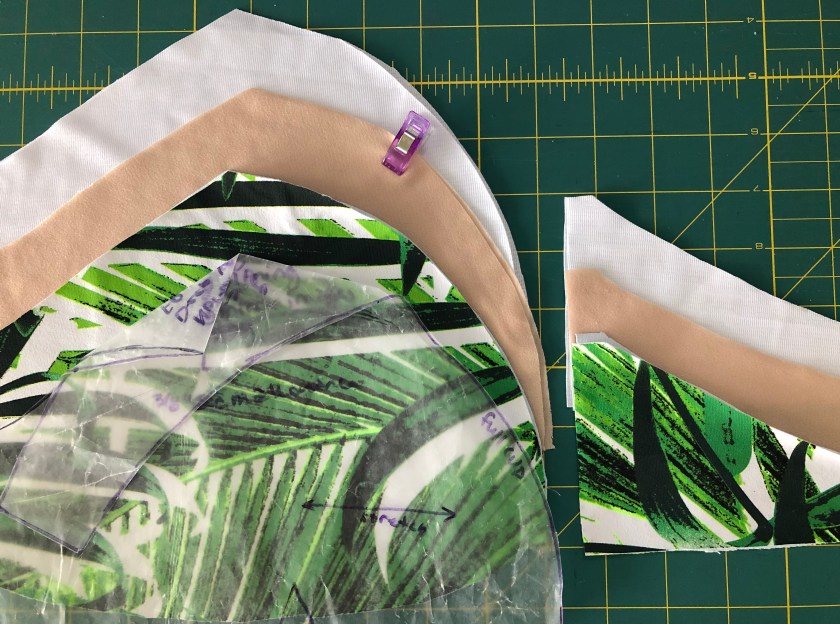
Since the first version turned out so well, I decided to have some fun with the pattern, and turn it into a strappy bikini.  I folded down both sides of the deep-V full cup front, shaping it into a curvy triangle.  I used the halter S-hook back, and cut both pattern pieces out in my nylon spandex fabric, swim lining, and powernet.

NS pieces

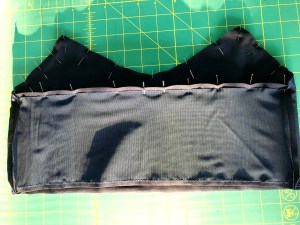
Baste the powernet to the main fabric, and sew the front and back together at the side seam.  Sew the lining front and back together at the side seam.  Lay the lining on the main fabric wrong sides together and baste.  Knowing that “triangle style tops” don’t normally have a whole lot of support, you need to add support by stretching the elastic tighter to help the top hug your body.

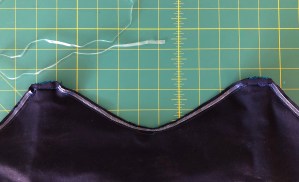
To figure your elastic lengths, measure along the front edge from the top of your triangle down to the center front.  Subtract 3/4″, (because you don’t want elastic in the 3/8″ seam allowances) then multiply by .75.  Exercise your swim elastic before measuring to that length.  Rather than cutting the elastic, just use a pencil to mark your line.  This makes it easier to hold on to the elastic and stretch it while you are sewing.  Use a zig-zag stitch to sew your elastic to the center front, starting 3/8″ from the top, and stretching the elastic so that the marked point ends 3/8″ from the bottom of the center front.  Then repeat the process to measure from the top of your triangle, down under the armscye to the end of the back piece.  Again subtracting the 3/4″ for the seam allowances and multiplying by .75.  Mark the elastic, start sewing 3/8″ from the edge, stretching the elastic to fit and zig-zag, stopping 3/8″ from the other end.

Then fold the edges under enclosing the elastic, clipping it in place.  Topstitch with your zig zag set at 2.5 length and 3.0 width.  The elastic will want to curl up a bit until it is topstitched down.

NS elastic

Then add the underbust band and elastic, and sew on the S-hook as per the pattern tutorial.  Because my bust is apparently more close set than average, I overlap my front pieces 1-1/2″ before attaching to the band.  You may or may not want to overlap depending upon the shape of your bustline.

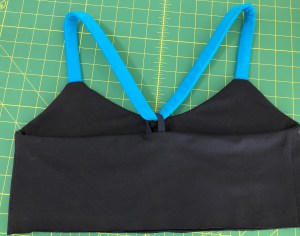
Now it’s time to make some strappy straps!  Cut two strips of fabric 1-1/2″ wide by 16″ long.  Fold them in half, right sides together and clip in place.  Lay your 3/8″ clear elastic (you can use cotton swim elastic, but the clear elastic makes flatter straps and is listed as chlorine safe) along the cut edge, and carefully zig zag so that your zig goes just off the edge of the elastic and into the center of the fabric, and the zag is completely on the elastic.  Once the strap is completely sewn with the elastic, use a safety pin to turn it right side out.
NS straps

Baste or pin the straps in place, and try on for fit.  On the back, my straps are stitched in place 1-1/2″ from the S-hook.  You may need to cut some length off the straps in order to pull the front up to where it is comfortable.  But better to have extra strap length to cut off, than to have too short of straps!

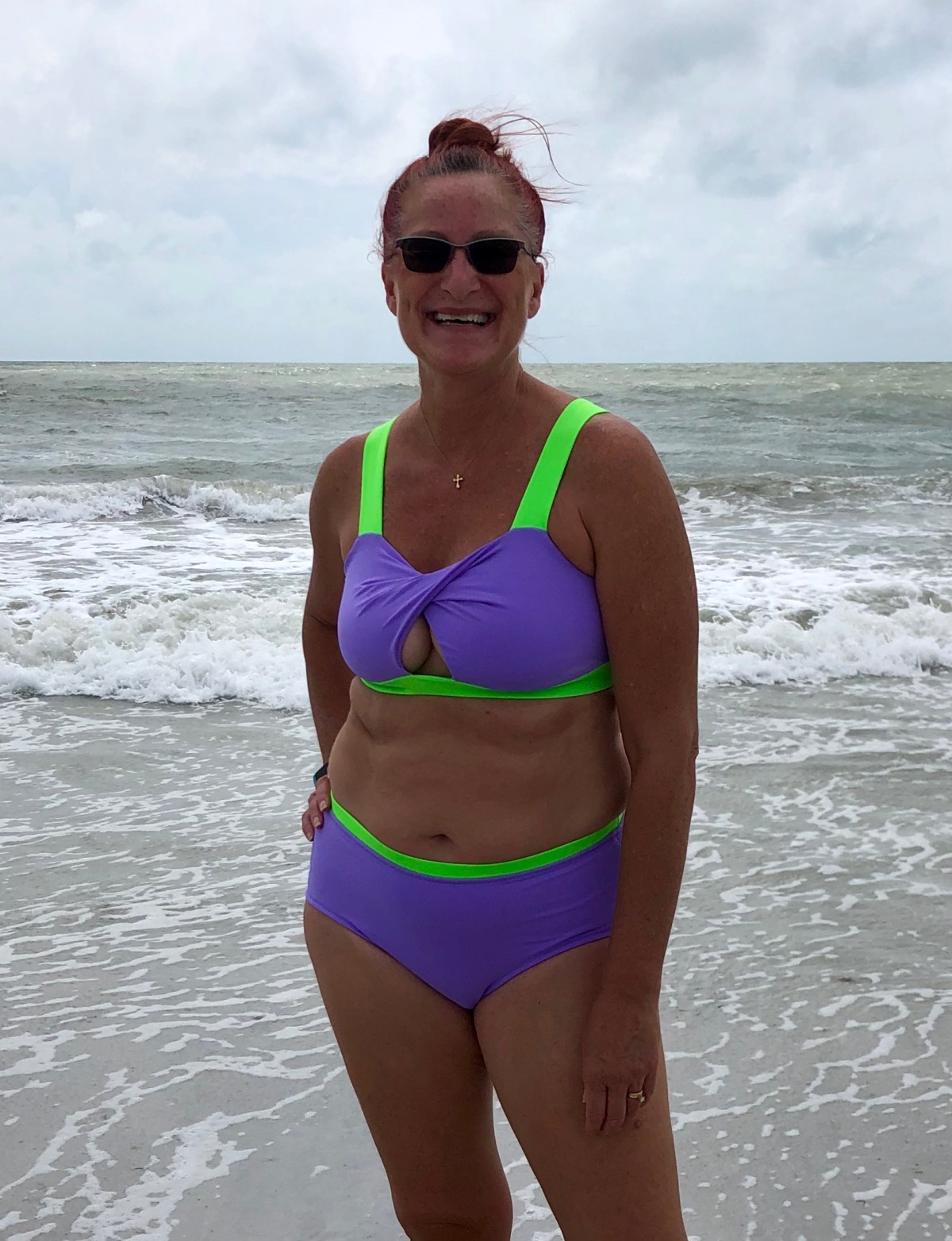
Since I made a sexy top, I decided to make the bottoms a little sexier by cutting them about halfway between mid-rise and scoop bottom.  To finish the top of the bottoms, I zig-zagged elastic along the top edge at a 1:1 ratio to keep the top snug, but not tight.  Top stitch just like you do the elastic around the legs or swim top.  The scoop shaping is flattering and comfortable, even on a 50+ year old Grandma! 🙂  At least my husband certainly thinks so! 😉

NS frontNS back.jpg

While I probably wouldn’t run in this bikini, let’s be honest- I don’t run!  (Hence the jiggly bits that would make me feel uncomfortable while running.)  Hahaha!  But I definitely feel comfortable and supported while walking the beach and playing in the waves.

All of my fabric came from Phee Fabrics, the Tricot, powernet, and swim lining, as did the matte palm nylon spandex print.  Sadly, this particular print is no longer available, which is why I’ve been hoarding it, and was so excited to play with this pattern.  There are however, so many pretty colors of Tricot and a couple of stripe prints to choose from.

Never be afraid to try hacking a pattern!  Even if it doesn’t turn out exactly like you envisioned, you always learn something from the experience.  I’m contemplating double straps next, maybe criss-crossing a set.  It’s another opportunity to add a pop of color and create a new look.  It’s just sew much fun to play with patterns! 😉

*This post may contain affiliate links.  This means that at no extra cost to you, I may receive a small commission if you purchase through my links.  As always, I only give my honest opinion.  After all, it is my blog, which represents me!  Thank you for reading and sharing my love of sewing, patterns, fabric, and pattern hacking. 😉

The Aushui Tank Transformation

Transforming The Stitch Upon A Time Aushui Tank Into A Dress

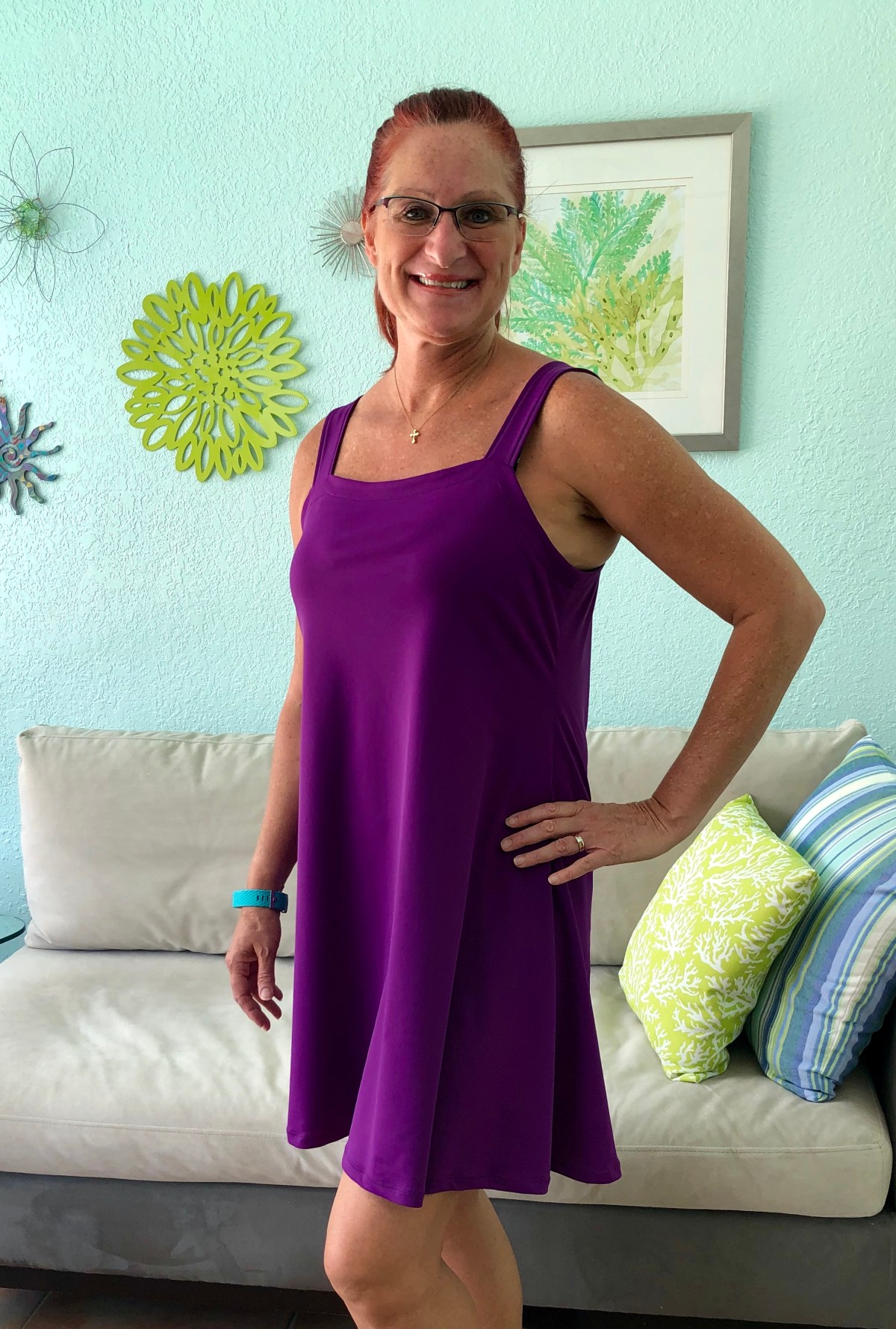
I bought the Stitch Upon A Time Aushui Tank pattern because who doesn’t need a unique tank top in their lives?  The square cut neckline was a new look for me, and I love tanks with straps that completely cover your bra.  The pattern is a pretty quick sew, and the facings really help the tank keep it’s unique shape.  It also has options for a button placket and a tie front, which will totally change the look!

Rayon spandex from Phee Fabrics made for a soft, comfortable tank, with excellent drape.  I added two inches to the length because I am tall and like longer tanks.  But I certainly could have stuck to the pattern length and been just fine.

Aushui tankAushui back

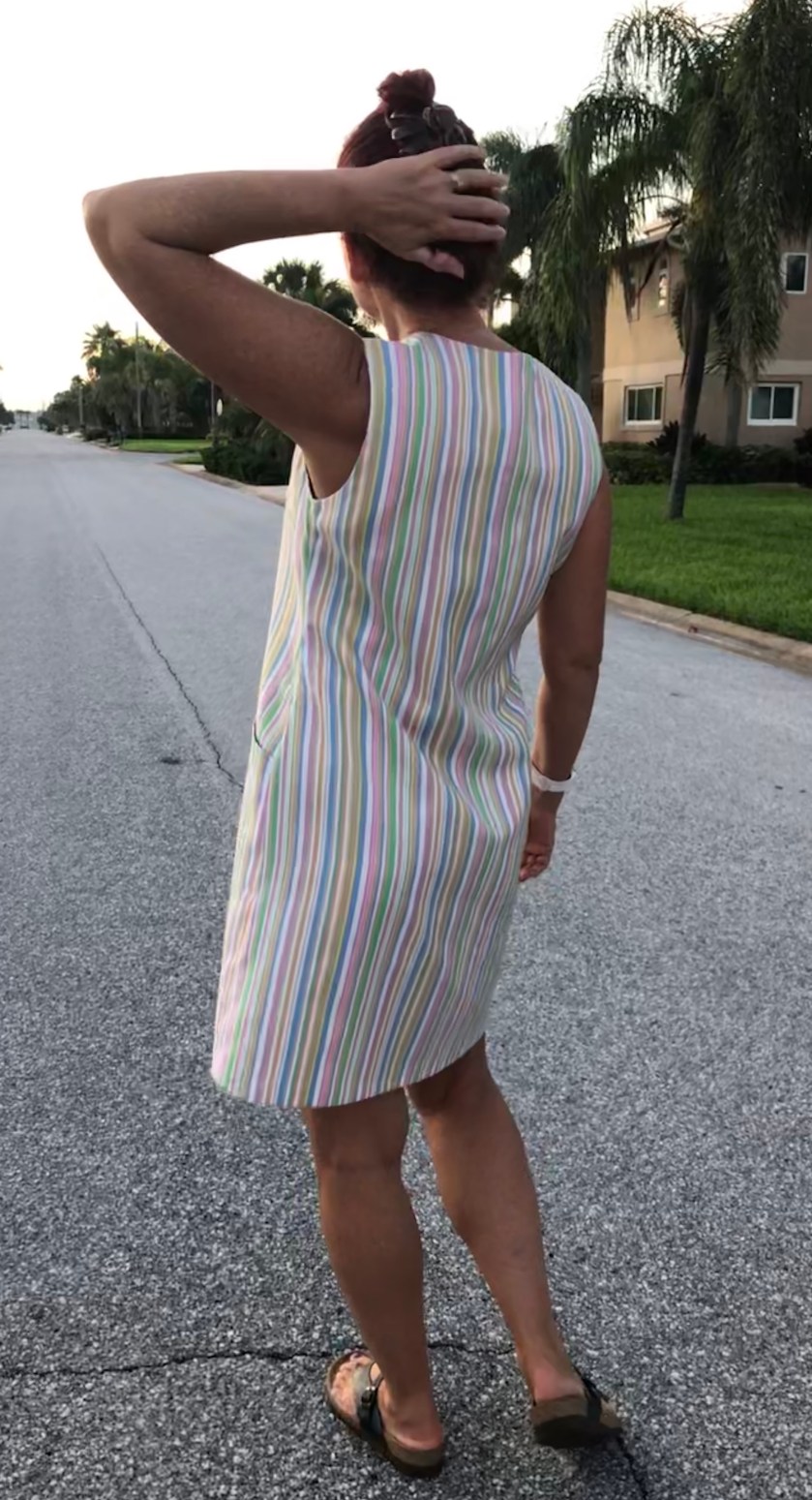
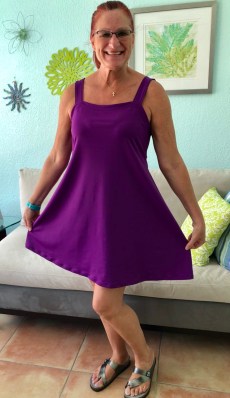
Once I made the tank I started thinking that it would be fun to make the Aushui into a dress.  Not only are dresses a summer time staple, they also make it easy to get ready in the morning.  Wanting to keep the lines of the dress clean, a gathered seam at the waistline was out.  A simple fit and flare design fit the bill, so I pulled out the Stitch Upon A Time Calista pattern.  The skirt portion of the Calista flares out nicely, without being too full.

The hardest part of this pattern mash was determining where the skirt should start!  Fit and flare dresses look best when they are fitted through the bust area and flare out at or just above the natural waist.  A novice sewist may be surprised to learn that your natural waist isn’t necessarily at your belly button.  Tie a string, strip of fabric, or piece of elastic around your waist, and bend side to side several times.  The elastic will settle at your natural waist which may be above your belly button.

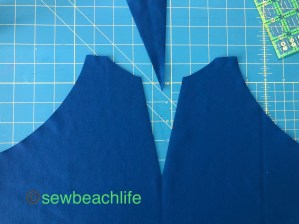
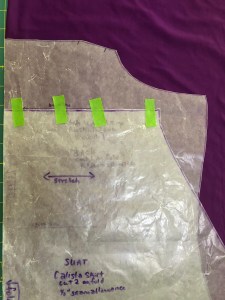
Lay the Calista skirt pattern on top of the Aushui Tank front, with the center folds aligned.   Slide the top of the skirt up to the bustline marking.  With the patterns taped together, cut out the front of your dress.  Align the Calista skirt the same way on the tank back, and cut out the dress back.  There will be a little area where the tank and skirt pieces intersect at a sharp angle.  Gently curve this area (where the purple arrow is pointing in the second photo) when you cut out your dress.

Aushui Cal tapeAushui Cal cut

Then follow the pattern tutorial for construction of view A.  The only difference will be the length of your side seams.  Take your time and use plenty of pins when folding up the hem.  That way you’ll get a nice even hem when you finish your dress.  Pro tip: sewing a line of stitches down the center of the back facing before construction will make it easy to tell the front from the back when you’re hanging up laundry or getting dressed.   If you have a vinyl cutting machine, a cute little HTV design would make a good “tag”

I used Phee Fabrics Tricot for my dress and absolutely love the drape and swing of my Aushui Calista pattern mash!  It’s a fun, flirty length, without being too short.  It only took two yards of fabric, and I have large enough scraps that I can probably make another swimsuit. 😉  You can read about my Water Faery and Scrundlewear bikini here.

Aushui CalistaAushui Cal full

I need more of these dresses in my life!  I’m so glad I played around with the patterns, and that my dress turned out even cuter than I imagined!  There’s no reason to be afraid of trying something new, and hacking and mashing your patterns.  You might just end up with a new favorite dress, or other cute clothing in your wardrobe!


*This post may contain affiliate links.  This means that at no extra cost to you, I may receive a small commission if you purchase through my links.  As always, I only give my honest opinion.  After all, it is my blog, which represents me!  Thank you for reading and sharing my love of sewing, patterns, fabric, and pattern hacking. 😉


Swimwear Shenanigans and Escapades

Hacking The 5oo4 Shenanigans And Escapade Into Fun Swimwear

Since I’ve decided that this is going to be the summer for swimwear sewing, I’m having fun combining and hacking my patterns to make some fun suits!  I like using all the fun colors of Tricot from Phee Fabrics, and always use their Powernet in my swimwear, bras and workout wear for extra support.

The 5 Out Of 4 Shenanigans Skort seemed like the perfect basis for a swim skirt.  Since the Escapade Top and Dress pattern has a drawstring front, I thought it would be fun to add drawstrings on the sides of the Shenanigans.  That way my booty could be covered while walking out to the beach, then I can shorten the skirt as much as I want while playing on the beach.

You can use the shorts included with the pattern, or your favorite briefs pattern for underneath.  If you use a different pattern for the briefs, make them first, without sewing the waistband.  Since my brief pattern has a lower rise, I traced the Sporty Spice length in my measured size for the skirt, and cut on the low rise line.  I didn’t want the sides to flare out too much, so I curved the side seam of the bottom of the skirt front in to the next smaller size.  When I lay the skirt front pattern on top of the brief pattern, you can see that the front waistline curve is the same, and that it’s a couple of inches wider than the brief.

Shen pattern FYou need that extra width to make your drawstring casing, and for your skirt to have a little bit of ease.  The skirt back should also match the curve of your briefs and have the same extra width.  Because I’m tall and have a booty, I added a little extra length to the center back of my skirt, tapering up to the side length.  It’s just enough to cover my bum when the skirt isn’t gathered up on the sides.  Sew the skirt front and back right sides together with a 1″ seam.  Make drawstrings by cutting four 1-1/2″ wide strips of fabric twice as long as the side seam of your skirt.  Fold each strip right sides together and using a stretch stitch sew with a 3/8″ seam allowance.  Use a safety pin or bodkin to turn the strips right side out.

Shen ties

Fold the skirt side seam allowances under 3/8″ and pin in place.  Stitch in place using a 1/2″ seam allowance to form the casings for your drawstrings.

Shen casingFold the bottom hem under 1/2″ and use a zig zig or other stretch stitch to hem.  On the right side of your skirt, make a small horizontal slit in each casing, about 3/8″ above the hem.  Thread a drawstring in each casing and tack the drawstring in place at the top.

Shen insert tiesAlign the center front, center back, and side seams of your brief and skirt and pin or clip in place.   Try it on to ensure everything feels comfortable and lines up nicely.  This is your opportunity to trim the rise a little bit if needed for better alignment.   Easing the skirt to fit the brief, baste them together.  Then sew on your waistband and elastic and you’ve got a new swim skirt!

I’ve hacked the 5oo4 Escapade into a workout top before, so I knew it would make a great bikini top.  I thought it would be cute to have a little cut-out in the back, although due to changes I made after basting the side seams and trying it on, the cut-out is smaller than I’d originally planned.  I used Tricot as the main and lining fabric, with a layer of powernet basted to my main fabric so that it will end up sandwiched between the layers.  (Following the pattern tutorial and basting it to the lining fabric will save you from having to snip through two layers when making your opening for the drawstring!)

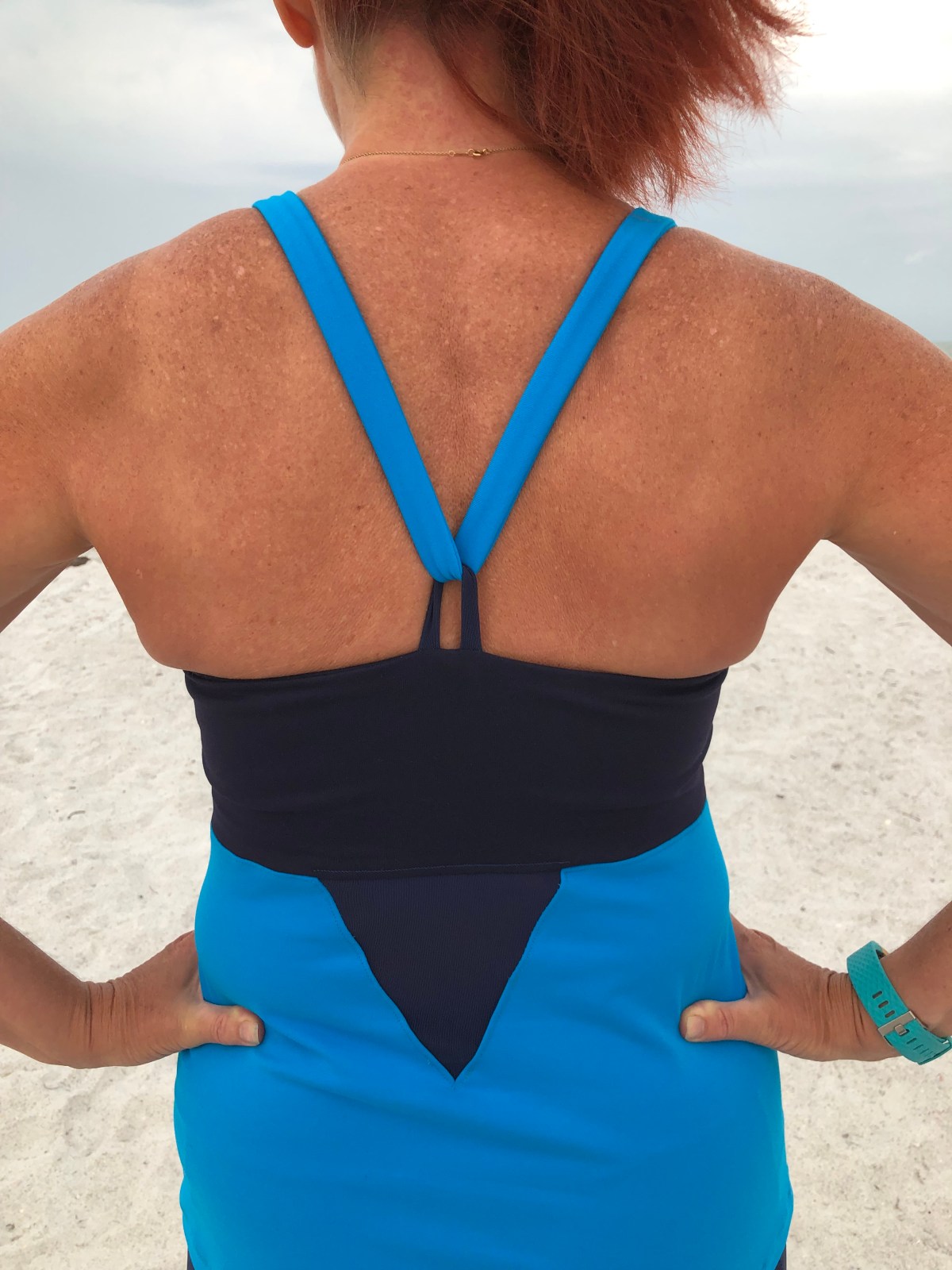
Because adding an underbust band to accomplish the cut-out added length to the top, I ended up shortening and altering my front and back pattern pieces to show a little more skin.  I wanted the back bodice to end up 3″ high, so my pattern piece ended up 3-3/4″ high, with a 3/8″ seam allowance at the top and bottom.  (I did not have my strap drawstring go through the bodice back.  If you want yours to go all the way through, add 3/8″ to the height, since the top will be folded under 3/4″ to form the casing per the pattern tutorial.)  Simply fold up the bottom corner of your pattern piece along the center back fold line to get the triangular cut-out.

Esc cutout back

I cut the front bodice on the C/D cutline, because according to the measurement chart, that’s where I should cut.  I definitely need the extra length in the center front, but not so much at the sides.  So I ended up tapering my bodice height starting 3-1/2″ away from the center front angling up to the necessary side height of 4-1/8″ to match up to my bodice back.

Esc front angle

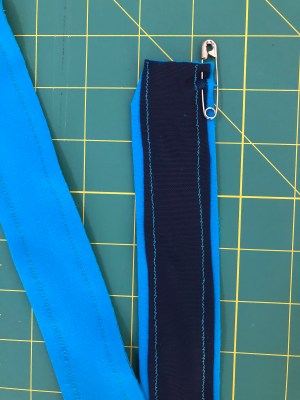
To make my straps, I followed this blogpost from Emerald Erin.  Basically, you cut your fabric four times the width of your elastic, (in this case 1-1/2″ wide).  Fold the straps in half right sides together.  Place the 3/8″ elastic flush with the cut edges, then zig-zag the elastic, right at the inner edge of the elastic.  Then turn your straps right side out.  Take your time when stitching on the elastic, and the straps will end up nice and flat.

Esc strap elasticSew the bodice front per the pattern tutorial until you reach the point where you are supposed to sew the front to the back at the side seams.  This is when I tacked my straps at the side seams, rather than having one long strap run through the entire top of the bodice.  Note: in the photo below, I had not yet made the tapered cut at the bottom sides of my top.

Esc bodice front

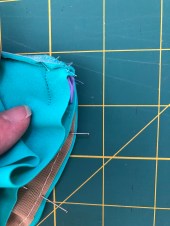
Lay the bodice backs right sides together, and stitch along the top using a 3/8″ seam allowance.  Stitch along the triangle cut-out.  Sew elastic to these seam allowances, keeping the elastic taut, but not pulling on it.  This will give these seams stability, and help keep the top of your suit in place.  It might seem intimidating to sew elastic, but it’s not as scary as you may think.  In fact, 5 Out Of 4 Patterns has several blog post videos showing how to add elastic in their Sewing School series.  In the photo below, you can see where I added the elastic.  Note: The bottom of the back hadn’t been trimmed to it’s shorter height yet.

Esc back elasticYou’ll need to poke one side of the back through the narrow space at center back to turn the back right sides out.  Then it’s time to sew your side seams.  I hate bulky side seams, and with the straps, and elastic, and layers of fabric and powernet the seam could get bulky!  So I do it a little differently than you may have seen.  Since the front strap casing is folded down at the top front, my normal method of sewing the main front to main back, and lining front to lining back, lining up the top seam isn’t going to work.

So I folded the back bodice over the front bodice, aligning the seam with the top edge of the front bodice, making sure that the main fabric front matched up with the main fabric back, and the two lining fabrics were together.  Stitch down 3/4″ until reaching the casing stitch line.  Then pin the main fabric front to the main fabric back and the lining front to the lining back and stitch each of the pinned seams together.

Esc side topEsc side pin

Then clip the seam allowances so that you can press them open.  I also clip the top corner at an angle to help reduce the bulk.  Repeat these steps on the other side seam.

Esc side clip

Cut a band the same width as your bikini top, adding in a seam allowance.  If you use 3/4″ elastic, the band should be 2-1/4″ high (twice the width of the elastic plus the seam allowance).  Sew the short ends of your band together, and aligning the seam with one of the side seams, place the band over the bodice right sides together.  Pin the band to the bodice bottom, then stitch.

Use pins to mark the center front and back, along with the quarter points.  Overlapping the ends of your elastic 1″, zig zag  together, then mark the quarter points with pins.  With the band still folded up on the bodice, pin the elastic to the seam allowance, aligning the quarter point pins.  The edge of the elastic should line up with the seamline, and hang down below the bikini top.  Then wrap the band down around the elastic and overlapping up to the inside and pin in place.  Stitch around the bodice bottom using a zig zag set at 2.5 stitch length and 3.0 stitch width.  At the triangle cut-out opening, stitch across the band at the top and trim away the excess fabric.

You can either tie the straps at the neck halter style, or have someone help you pin them in a comfortable spot and tack the straps in place, cutting off the excess strap length.  Now you have a cute new swimsuit!  I love being able to adjust the drawstrings to make the skirt as short or long, and the top as high or low as I want.

ShenEsc frontShenEsc down front

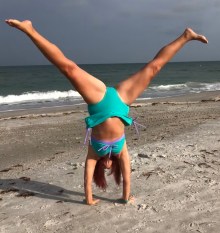
Because it’s boring and awkward to try and look sexy, I decided to have fun doing cartwheels instead.  🙂

ShenEsc cart frontShenEsc cart back

Being able to laugh at yourself and act silly keeps you young, right? 😉  There is no need to be afraid of sewing swimwear.  Have fun with it and mash and hack away!  It’s just another pattern and some colorful fabric, customized to fit YOU!  Does sewing your own swimwear give you super powers?  Maybe not.  But it does give you the confidence to see if you can still do cartwheels!  So sew away and then hit the pool, lake, or beach.


*This post may contain affiliate links.  This means that at no extra cost to you, I may receive a small commission if you purchase through my links.  As always, I only give my honest opinion.  After all, it is my blog, which represents me!  Thank you for reading and sharing my love of sewing, patterns, fabric, and pattern hacking. 😉


Stitch Upon A Time Water Faery Twist & Swim Top

Swimsuit And Workout Tank With Pockets Hack

Summer has arrived, so it’s about time for me to get started on sewing up some swimwear!  When the Stitch Upon A Time Water Faery swim patterns were released, I eyed them closely, but put off buying a pattern because I couldn’t decide which one to buy.  The Retro One Piece has a dress option, which I love the look of!  But I never wear one piece swimsuits.  I finally settled on the Twist & Swim Top because I knew I would wear the sexy yet modest top and could play around with the pattern.

The swim top has the option of a plain or twisted front.  Since I was making the fun twisted front, I decided to follow the pattern exactly for my first version to see how it fit.  I made my measured size, using the green extended cut line for the bodice, since I have the noted 4.5″+ difference between bust and under bust, and followed the tutorial.  As I’ve come to expect from Stitch Upon A Time Patterns, the tutorial is well written, with lots of photos to help you visualize each step.  The elastic measurements are perfect, exactly the right length for support and comfort.

I had some swim fabric from JoAnn’s in my stash that was left over from a project I made last year.  There wasn’t quite enough fabric to make the straps the recommended width, so I made them as wide as possible, but had to omit the gathering on the straps.  As experience has taught me when making bras or tops that need support, I used powernet in the front and back bodice pieces, as well as the straps.  The resulting top is cute, and works great for walks on the beach, but had one small problem.

Knowing that my shoulder to bust apex measurement is longer than average, I should have taken that into account and lengthened the straps.  Since the straps are too short for my body, the top cuts into my armpits a bit.  Because the top is held firmly in place under the bust in front, the back is pulled forward and up, which keeps the back from laying properly.  Fortunately, it’s a simple fix.

TT p frontTT p back

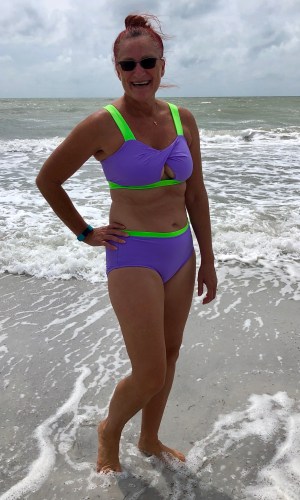
I just added an inch to the strap length before cutting out my next version.  This time I used Tricot from Phee Fabrics.  I think the hardest part was narrowing down which colors to use, since it’s available in so many pretty colors!  Because I liked the way the narrower straps turned out, I decided to cut them at 3.5″ wide again.  I also decided to play around with the bottom band construction, to use one piece of 1.25″ wide elastic in the band, rather than elastic at the top and bottom seams of the band.

I made the top as directed until I got to the band.  I sewed the bands right sides together, along the bottom edge.  I marked the band at the midpoint, then marked the quarter point by folding one end over and 1/2″ past the center pin, to account for the 1/2″ seam allowance.  I also placed pins on either side of my center front pin to mark the V placement.  I stitched between the two outer pins, using a 3/8″ seam allowance.  (Note: I used a 3/8″ seam allowance on the top and bottom seams of my band so that I could use  1.25″ sport elastic.  You can also stick to the 1/2″ seam allowance and use 1″ wide elastic.)

TT band pin

Then I carefully cut down to, but not through the stitching at both ends of this V stitching, and turned the band right sides out.  Because I would need an opening to thread my elastic through the band after I attached it to the bodice, I had to carefully plan out stitching the short ends together.  Placing the short ends right sides together, I stitched from one side for 1/2″.  Then I stitched from the other side to just past the bottom seam.  This left me enough opening to thread my elastic through, but ensured that the side seam was completely sewn on the outer side.

TT band end

I turned the band right side out and basted the long edges together.  When sewing the band and bodice together, make sure that the opening for the elastic ends up on the inside of your top!

TT band

Then I matched up the center front, center back, and the quarter points of the band and bodice, right sides together.  Keep in mind that the quarter points may not exactly line up with the side seams, especially when you use the extended bodice cut lines.  Stitch the band and bodice together and insert the elastic.  Use the recommended underbust elastic length, and overlap and stitch the ends of the elastic together.  You can stitch the opening on the inside of the band closed if you want, but since tricot doesn’t fray, I didn’t bother.

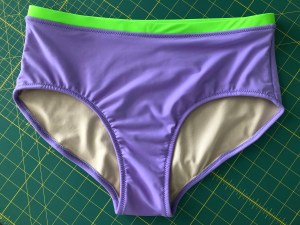
Yay!  I had a perfectly fitting swim top!  Now for some bottoms.  I’ve owned the Scrundlewear 2.0 pattern for months, but had never made a pair.  Since everybody seems to love Scrundies, I figured they would make great swim bottoms.  I cut on the foldover waistband line, tapering in at the top following the side seam cutline to give me a high waisted look.  The front height was great, but the back was too high.  I tapered from 1-5/8″ down at center back over to the height of the front side seam.

The legs felt too low, so while wearing the bottom, I carefully pinned where I wanted the leg line to end.  I added in the 3/8″ seam allowance I was going to use for turning my swim elastic under, marked my pattern, and cut off the excess fabric.  The photo below shows how much fabric I cut off compared to my new higher leg cut line.

Scrundies leg

I also cut a front and back out of swim lining.  And as you can see, the swim lining from Phee Fabrics is nothing like the stuff I’ve bought from JoAnn’s.  It’s soft and lays smoothly.  The edges don’t curl up, and it’s super easy to sew with!  I also cut a front piece out of powernet.  Hello tummy control!  Not only is powernet great for bras and swim tops, it works fabulously to smooth out the tummy and hold everything in place.  Baste the powernet to the fabric front, and sew the front and back together at the side and bottom seams.  Sew the swim lining front and back together as well.  Place the swim lining layer inside the fabric layer wrong sides together, and baste at the leg and waist openings. Using a zig zag stitch, sew the elastic on the inside of the leg openings with the elastic lined up with the edge of the fabric.  Turn the fabric under and top stitch using a zig zag with the stitch length set to 2.5, and the stitch width set to 3.0.  This will give you a professional, even finish.

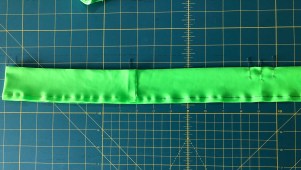
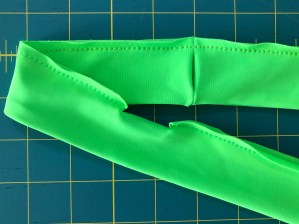
I used a strip of 2″ wide fabric to make my waistband.  I sewed the two short ends right sides together, then layered the swim bottoms and waistband, right sides together, with 3/4″ knit elastic on top.  I stitched through all three layers, using a 1/4″ seam allowance.  This was easier than anticipated, since all three layers were the same length.  I didn’t have to worry about stretching or pulling.  I flipped the waistband open, and carefully folded the waistband fabric around to the inside and pinned it in place.  Using the same zig zag settings, I topstitched the fabric in place just below the waistband.

scrundiesMy Scrundie swim bottoms were a success, and I have a cute new swimsuit!  I love that it’s modest enough, while still being sexy.  My husband definitely approves of my creation!

TT suit frontTT suit back

Since I seem to think that every bra or swim top can be made into a workout top, read the 5oo4 Escapade Experiment, Hack At It, and the GreenStyle Power Sports Bra Workout Top Hack as proof of my workout top obsession! 🙂  I decided to make the Water Faery Twist Top into a workout top too.  I made the Twist & Swim Top out of Tricot, per directions (with the narrower and longer straps out of Supplex) through to basting the completed bodice layers together along the bottom.  Then I got to work on the tank portion.  Supplex is my absolute favorite fabric for workout wear, so that’s what I used for the tank.  The pattern includes a tankini option, but since I was making a workout top rather than a swim top, I didn’t want the negative ease that the swim top has (to keep the tank from floating up while in the water).

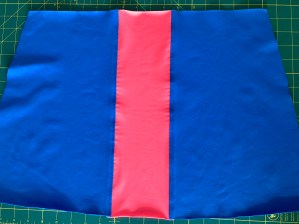
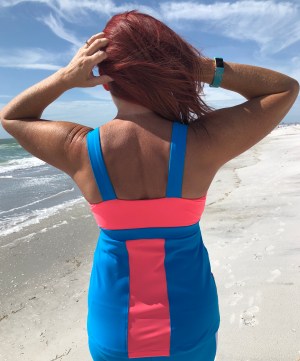
If you have a well fitting tank pattern, you can use that, or you can just trace the tankini piece wider, with a gentle slope down to the bottom, rather than with the inwardly shaped waist curve of the original.  I thought it would be fun to color block a stripe down the center back, and add some pockets to the front for practicality and a pop of color.  I cut a strip of tricot 4.5″ wide by the length of the center back tank piece.  Then I folded my tank pattern piece in 1.5″ at the center back.  That way, when I cut out the two back halves (not on the fold), I would be missing 3″ from the center back.  Sewing the strip to each of the back pieces right sides together, with a 3/8″ seam allowance meant that the color-blocked back ended up the same size as my tank pattern piece.
TT wo back stripeI cut out two 4-3/4″ x 7-1/2″ rectangles for my front pockets.  I wanted them to be hidden seam pockets like the one I did on the GreenStyle Jillian Tank.  I laid the pocket pieces on the tank front and marked the 3/8″ seam line at the top and bottom of the pocket with a pin.  I flipped the pocket toward the center, and with right sides together, pinned the pocket to the tank, then stitched 3/8″ in from the pocket edge.

TT wo pocket pinI flipped the pockets back to the outside edges after stitching and basted them in place.

TT wo pockets.jpgAt this point, I should have been able to sew the tank front and back together, and sewn the bodice to the tank.  But I had made a couple of rookie errors. 😦  The first was that I had made the tank too wide at the top.  This was easily remedied by angling the tank in at the top so that it was the same width as the bodice (and the original tankini pattern piece.)  The second error was not considering the fact that I am tall, and should have added an inch to the length of the tank.  The problem was remedied easily enough by adding a band.  I cut out the band pieces, and sewed them onto the bodice per the pattern tutorial, except using a 3/8″ seam allowance, and spacing my bodice front center V only 1/2″ apart.  I don’t want to show too much skin at yoga class!

Because the 1.25″ wide sport elastic had worked so well on my swim top, I decided to use it for my workout top as well.  With the bands still folded up on the bodice, I used pins to mark the quarter points on the top, and a pencil to mark the quarter points on the elastic, and stretching to fit, stitched the elastic to the seam allowance.  I had the elastic lined up with the stitching line, and hanging down below the bodice.  Then I folded the inner band down, and stitched the elastic to the band.

TT wo elasticI brought the outer band down and basted it in place before attaching the tank portion.  I sewed on the tank, hemmed the bottom, and I’ve got a cute new workout top!

TT wo frontTT wo back

Everything stayed perfectly in place during a sweaty Vinyassa Flow class that included inversions.  Everyone in the lobby when I walked into the yoga studio commented on my top.  None of them could believe that I made it, including the instructor, who knows how to sew.  I went for a walk later in the evening, and the pockets worked great to hold my phone and house key.  It looks like I’ve got a great new swimwear and workout top pattern to add into my rotation!


*This post may contain affiliate links.  This means that at no extra cost to you, I may receive a small commission if you purchase through my links.  As always, I only give my honest opinion.  After all, it is my blog, which represents me!  Thank you for reading and sharing my love of sewing, patterns, fabric, and pattern hacking. 😉


Sewing For Men, Episode 2

GreenStyle Men’s Hampton Shorts

I don’t often sew for my husband, and that’s unfortunate.  Like most sewists, there are so many projects on my never-ending list, and so many patterns I’d like to try, that I don’t seem to get around to sewing for him very often.  When I showed him the GreenStyle Hampton Shorts pattern, he said, “I’ve been thinking about buying a couple pairs of shorts like that!”  So I knew that it was something that he wanted and would wear.  Then came the more challenging part- convincing him to let me photograph him wearing the shorts.  He knows that that is part of the deal.  He’s taken enough photos of me in my makes to know that I like to share what I sew, whether in a Facebook sewing group or on my blog.  Surprisingly, he agreed pretty quickly, so I knew he really wanted the shorts!

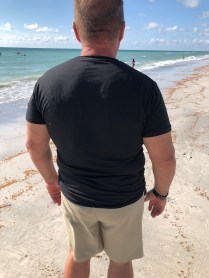
He wanted the shorts to fit like his favorite pair of RTW gym shorts.  So I measured his waist to choose a pattern size, and grabbed the shorts to compare to the pattern.  I noticed something interesting about the gym shorts- the back of the shorts was much larger than the front.  Unlike some men with a flat butt, my husband has a booty.  Hmmm… so perhaps that explains why he likes the fit of that particular pair of shorts.  (That, and the fact that they are a little bit shorter than the rest of his workout shorts.)  He also isn’t a fan of low rise pants or shorts.

Armed with this information, I traced out the pattern, with a few modifications.  His measurements put him in a size Large.  So I traced the back pattern piece in a size XL.  I traced the front pattern piece in a size Medium, but used the rise of the XL to keep them from being too low in the front.  Since this was an experiment, I used some old 2-way stretch cotton jersey that’s been in my stash forever.  Since most knit patterns nowadays call for 4-way stretch, my old 2-way stretch fabric has just been stashed in a drawer.

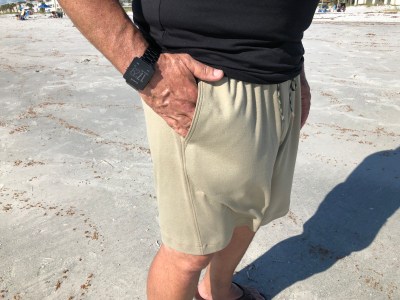
The pattern is easy, a front, a back, a waistband and pockets.  What makes it look nice is the top-stitching.  It always gives a garment a nice finished look.  Since the old jersey fabric had questionable recovery, I wanted to make sure that the pocket openings didn’t get stretched out and floppy.  So I cut a 1″ wide strip of interfacing and ironed it on to the edge of the pocket lining where the lining attaches to the shorts front.  To avoid any stretching, I made sure to stitch with the interfaced pocket linings up when sewing them to the pants fronts.  It worked perfectly, so I did a double row of topstitching to accent the pockets.  As per pattern directions, I also topstitched the side seams, which gives them a stylish, finished look.

Hampton tan pocket

The shorts sewed up pretty quickly.  I made buttonholes for the drawstring, sewed the elastic casing, and attached the waistband to the shorts.  My husband picked out the fun camouflage looking paracord to use as the drawstring.  I enlisted his help to melt the cut ends to keep them from fraying.

Hampton tan sideHampton tan back

Since my husband is not tall, I had taken an inch off the length when cutting out my pattern pieces.  They still ended up too long for his liking, so I cut off another inch and a half and hemmed them up.  The shorts were a success and looked good from every angle, so I knew I was good to go on making another pair.

I had some Twill Polartec Powerstretch left over from the Patterns for Pirates SOS pants I made for our daughter, blogpost here.  I knew it would give the shorts a dressier look, making them even more versatile.  The fabric is thicker, with a nice 4-way stretch.  To keep the pockets trim, I used a scrap piece of woven cotton for the pocket linings.  The blue coordinates well with the gray twill.  It is also my husbands favorite color, because, as he says, “It matches my eyes.” 😉

Hampton pocket lining

Since the cotton woven also stabilized the pocket, I didn’t bother with the interfacing at the pocket lining edge this time.  The shorts sewed up just as quickly, and obviously my husband loves them and had fun modeling for me. 🙂

Hampton gray muscles

Having used two completely different fabric types and weights, with stretch at the opposite ends of the spectrum, and getting great results each time, this pattern is a winner.  Having added to the rise, I would feel comfortable making it in a board short type fabric with only minimal stretch.

I really need to order some more Stretch Twill from Phee Fabrics and make him more Hampton Shorts.   Should I get charcoal, black, or more of the navy like I used for my tunic dress?  Father’s Day is right around the corner, and since he is a great Dad, he deserves some more cute and comfortable shorts!

*This post may contain affiliate links.  This means that at no extra cost to you, I may receive a small commission if you purchase through my links.  As always, I only give my honest opinion.  After all, it is my blog, which represents me!  Thank you for reading and sharing my love of sewing, patterns, and fabric. 🙂

Wandering Back Into Wovens

When I first learned to sew, it was with woven fabric.  I think most people start out using wovens either because that was the type of fabric their Mothers and Grandmothers used and taught them with, or because they gravitated toward garment making after learning to quilt.  I made myself plenty of cotton woven clothes in my teens, and so many pretty dresses for my daughter when I was in my twenties.  I also recall making a bathrobe for my husband (with tons of piping) and a dress shirt for my son (all those buttons and buttonholes!)  But sewing with knits seems so much easier and forgiving, so I had completely switched over to knits and didn’t look back.

Then two things converged that has me wandering back into wovens.  Phee Fabrics started carrying stretch twill, which intrigued me.  A local sewing store held The Tunic Bible workshop, which sounded sort of fun.  And it would have been fun, but it was way out of my budget range, so I put it out of my mind.  But then I started seeing the dresses the women made at the workshop on a Facebook sewing group I belong to.  And I needed the pattern!

It’s totally my style- a simple and straight-forward design, yet with the opportunity to personalize.  So I looked for “The Tunic Bible”, by Sarah Gunn and Julie Starr at a couple of local stores and neither had it in stock.  I probably should have driven to the closest bookstore, but it was easy enough to order the book online.  ISBN 9781617453564.  The pattern is included in the book as two large copy shop sized pages printed front and back.  I traced the basic tunic and all the placket options in my size, dug through my 25 to 30 year old stash of wovens for fabric to use as my muslin, and got started.

The book is kind of a “look book” with lots of photographs of the tunics to give you inspiration, and includes directions for basic tunic construction and for each of the placket options.  It recommends finishing your seams with French seams to give your tunic a more couture finish.  I chose to use flat felling on my shoulder seams, as it seems easier/cleaner to me.

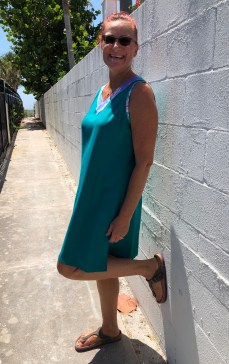
I made a sleeveless tunic length top with a wide split placket as my first muslin, and like the basic look.  However, it was immediately obvious to me that it is too wide across the shoulders in the front.  Frankly, it’s too wide even if I were adding sleeves, even though I had traced on the sleeveless line.  Despite yoga class and trying to have good posture, years of deskwork and hunching over a computer have taken their toll and given me forward rotated shoulders.  While wearing it, I placed a row of pins in my top where I wanted the shoulders to end.  After taking it off, I laid the pattern on my shirt and marked my new cut lines adding in the seam allowance.

TB turq topTB turq side

Thinking that I had solved my fit problem, I moved on to a dress length muslin using the V-neck placket.  Although the pattern includes all the plackets, the tunic is NOT marked with all the neckline cuts.  You are expected to match up the center lines and shoulder seams and trim away the excess fabric on the front and back bodice after sewing on the facing.  If you are an experienced sewist, it’s easy enough to do, although it can feel nerve-wracking to not know for sure that you are cutting it properly.  This could be a bit overwhelming to someone that is just learning to sew.

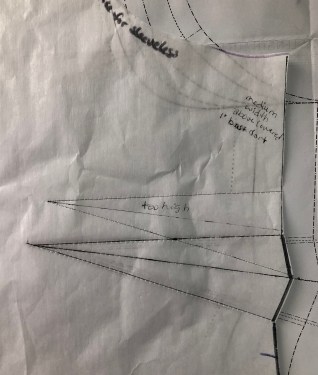
Trying on the dress revealed my second fit issue.  The bust darts are not in the proper place for my body.  I am longer than average from shoulder point to bust apex.  This fit issue should not have been a surprise to me, since I frequently have to adjust patterns because they cut into my armpits.  Since knits are so forgiving and most knit patterns don’t have bust darts, I didn’t really think about the bust dart.  As you can see in my dress, the bust darts are way too high and too far apart.  Since that puts the fullest part of the bodice above my bustline, there is a bit of pooling there.

TB V dressTB V side

So I did a bit of research online to figure the best way to lower a bust dart.  I had determined the amount I needed to lower the bust dart by measuring from where the dart fell on my body, down to the bust apex, and ended up with an inch difference.  I also decided to make my bodice a size smaller, since my measurements put me between sizes and I had traced out the larger size.  A couple of sites recommend just cutting out the bust dart section of your pattern, moving it down to where you want it, and filling in the cut out section with paper.  Since I always keep my master patterns intact and trace out the size I need, I decided to move my pattern piece up an inch on the master pattern and trace the bust dart and smaller size bodice.

TB bust dart

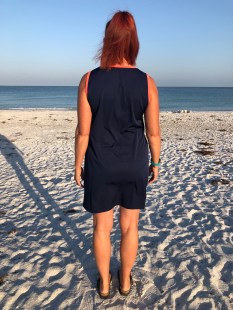
I finally felt confident enough with the pattern to cut into my navy stretch twill and make a dress.  I loved the look of the wide split placket on my top, so decided to use it again.  The Tunic Bible recommends using petersham ribbon or bias tape for trimming your tunic, but since I had a vision of the look I was going for, I had ordered three colors of stretch twill and made my own “bias tape”.  Here’s where the beauty of stretch twill comes into play.  On my muslin top and dress, I had cut strips of fabric on the bias to trim the arm openings, etc.  Since stretch twill has spandex in it, and 10% stretch, I didn’t have to cut my trim on the bias!  I used Wonder Tape (a wash-away double stick tape for fabric) to hold my trim in place on the placket while I top-stitched it, and let me tell you- it is a total game changer.  I used to pin all my trims or pockets in place, then sew and hope that things didn’t shift or get a weird bubble from the pins.  Wonder Tape is awesome and so much easier.  I highly recommend trying it.

I love how my first dress turned out!  It reminds me of a dress my Grandma used to have when I was a little girl.  She was rather stylish, and very beautiful, and an all-around wonderful person.  ❤  I miss her so, and wish I had a photo of her in the dress I remember.  I swear a photo exists, but my Mom didn’t recall it.  Sigh.  Anyway, I have a beautiful new dress that reminds me of her, and I will wear it all summer long!

TB navy fullTB navy back

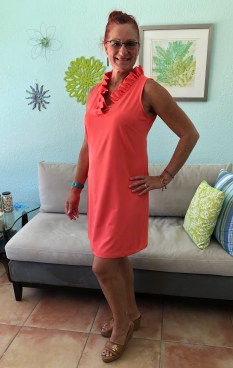
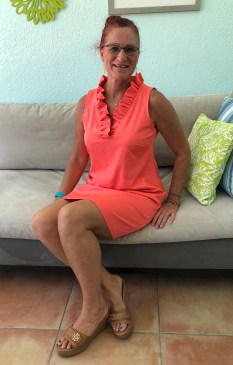
I decided to go with a solid color for my next dress, and used the ruffle neckline.  This is an unusual choice for me because I don’t “do” frilly.  Lady-like, yes.  Girly and frilly, nope!  I’ve put ruffles on the bummies I made for my grand-daughter, but what looks cute on a baby or toddler doesn’t equate to looking cute on me!  I don’t know what possessed me to try it, but I actually like the end result.  The coral stretch twill is so bright and summery, and it looks like something I would wear to a cocktail party.  (If I were one of those people who throws or gets invited to a dressy cocktail party, which I’m not. :-))  But I feel pretty in it and will probably wear it to my nephew’s wedding this summer.

TB coral standTB coral sit.jpg

I’m happy to have wandered back into wovens, and all it took was the intrigue of a new fabric and a few Facebook posts to do it!

Now I’m contemplating what other woven patterns I have to play with.  I bought a yard of the white stretch twill, and hope I have enough left to make a GreenStyle Havana top out of it.  I made a maxi length Havana out of some random gauzy fabric in my stash about a month ago, and liked it.  I think the stretch twill will flow just as prettily.  Are you ready to wander into wovens?

Havana leftHavana back


*This post may contain affiliate links.  This means that at no extra cost to you, I may receive a small commission if you purchase through my links.  As always, I only give my honest opinion.  After all, it is my blog, which represents me!  Thank you for reading and sharing my love of sewing, fabrics, patterns and creativity. 😉


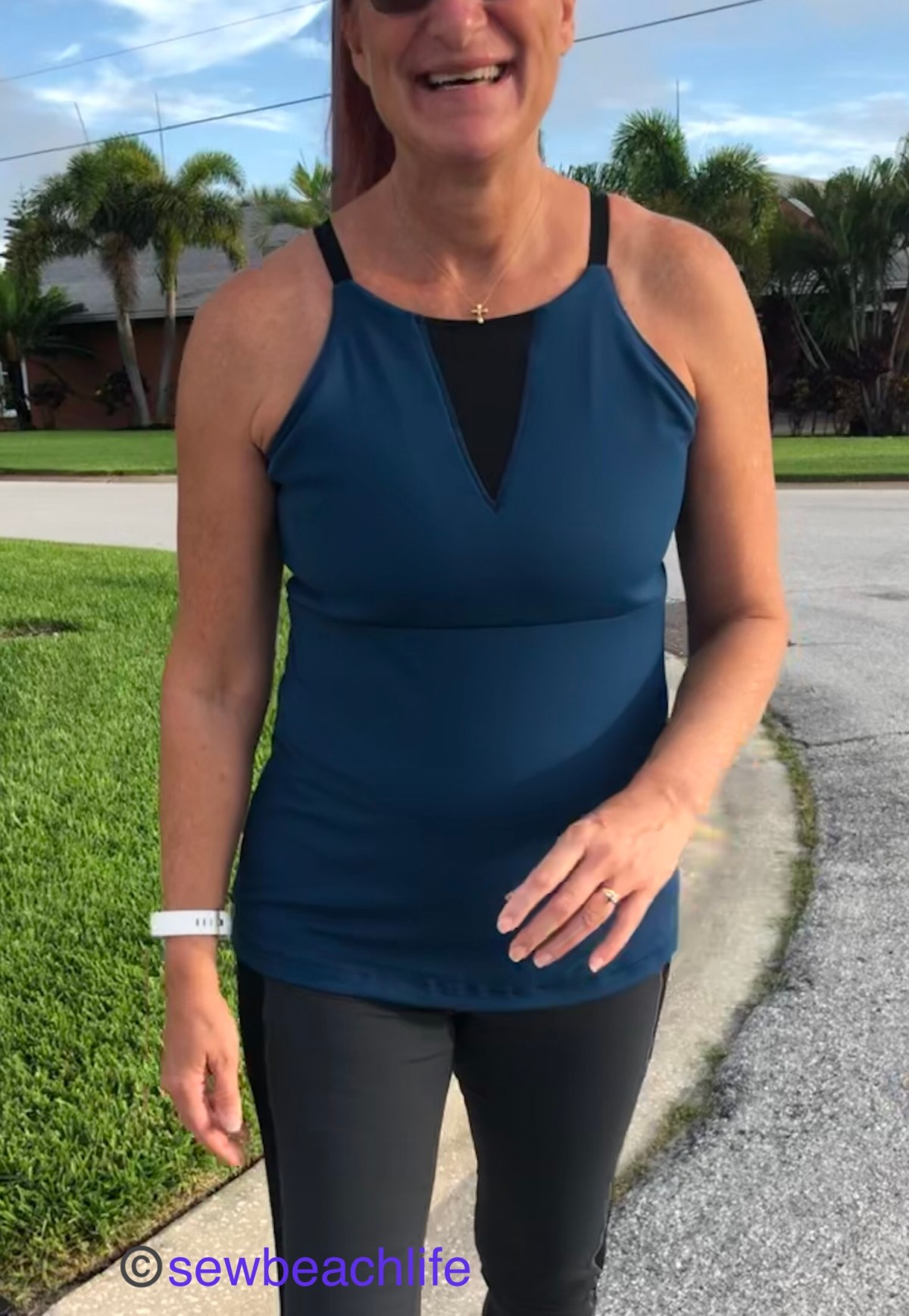
GreenStyle Jillian Tank

Powernet “Colorblocking” And A Hidden Seam Pocket

I love sewing workout wear for several reasons.  First of all, I need something to wear to yoga class.  Secondly, I am far too frugal to spend $50 or more on a cute workout top.  And last but not least, I can customize my makes to suit my style and color preferences.

I have had the vision of a white workout top with powernet inserts floating around in my head for a while.  I just hadn’t gotten around to sewing one up.  Enter the GreenStyle Jillian Tank.  The pattern is loaded with options: a bandeau top; an inner tank, with or without a built in sports bra; and an outer tank that can be made with knit or woven fabric.  I chose to make the inner tank with a built in sports bra.

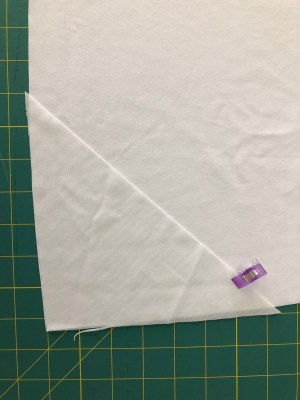
I used white Supplex and white Powernet from Phee Fabrics to make my Jillian Tank.  I like the simple design of the Jillian inner tank, because it gives the powernet inserts the opportunity to stand out.  Adding inserts is really easy, it’s basically a simple color blocking technique.  I cut two right angle triangles out of my powernet, being sure to cut them straight on the grain, with the greatest stretch going side to side.  The sides of the L part of the triangles were 7″ long.  I laid the triangles on the bottom corner of the tank front, and trimmed off the excess powernet to match the shape of the corners.

Jillian triangle

I marked the tank front 6.25″ up and 6.25″ over from the bottom corner and using my quilting ruler and rotary cutter, cut off the (smaller sized) triangles from the bottom corners of my tank front.  Then I laid the powernet triangles on the tank front right sides together and stitched them together.  I pressed the seam allowances toward the Supplex and top-stitched them in place so that you wouldn’t see them through the powernet.

Jillian power

I like to walk the beach whenever I get the chance.  Since I don’t want to have to carry my phone and keys, I need pockets.  I put pockets in all my workout tights and shorts, but occasionally, I’ll find myself wearing something without pockets.  So why not start adding pockets to my workout tops?  A hidden seam pocket gives cleaner lines than a patch pocket, not to mention how much easier it is to keep straight while sewing!

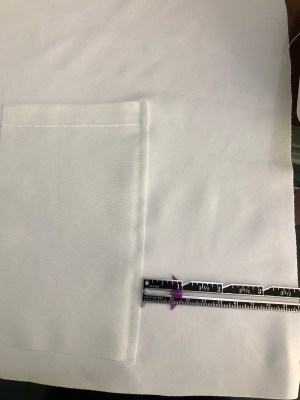
I cut a 4.5″ wide by 8″ tall rectangle out of powernet.  I made it that large to ensure that my phone would stay snugly in place, yet still be able to reach in and grab a key or lip balm from the bottom of the pocket.  I folded the top of the pocket down and stitched it in place.  Then I laid the pocket right sides together 3.75″ from the right edge of the tank back at the bottom corner.  I stitched along the right hand side of the pocket.

Jillian pock 1

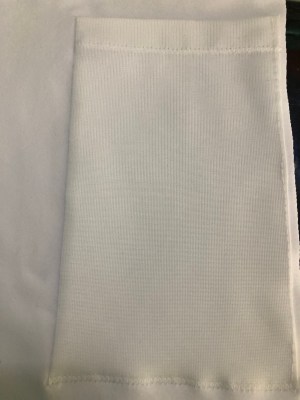
Then I flipped the pocket over and basted it along the side seam, and zig-zagged it in place along the bottom of the pocket.  (Had I cut the pocket a bit longer, I would have lined it up with the bottom of the tank and just basted it in place.)  When the tank is hemmed, the bottom of the pocket is securely sewn in place.

Jillian pock 2

After these simple modifications, I just followed the pattern tutorial to complete my tank.  I made another small adjustment to the pattern out of necessity.  The pattern calls for double straps threaded through the top of the front shoulder strap.   Rather than cutting and sewing the straps, I used plush bra strap elastic to speed up my sewing time. Since my strapping was wider than the sewn straps would have been, I went with a single strap.

Jillian back

I love having a solid white workout top to mix and match with my Super G‘s.  The powernet inserts and pocket give the simple lines a little extra pizazz.

Jillian G frontJillian G side

I can style it with a skirt or shorts for a completely different look.

Jillian hand

I could see myself using this simple color-blocking technique to add in coordinating fabrics if I were trying to match workout tights with color-blocked side panels.  The hidden seam pocket can be customized to fit whatever you want to carry.  It’s so much more useful than the tiny little key pockets you find on ready to wear!

Go ahead and sew all the workout wear!  After all, it is #memademay.

*This post may contain affiliate links.  This means that at no extra cost to you, I may receive a small commission if you purchase through my links.  As always, I only give my honest opinion.  After all, it is my blog, which represents me!  Thank you for reading and sharing my love of sewing and pattern hacking. 😉
5oo4 Escapade Experiment

From Ties To A Strap, And A Little Ventilation

I literally cannot seem to stop myself when it comes to hacking patterns.  I’ll buy a pattern because it’s a cute design, or has lots of options, and I may or may not make it as written.  Then I’ll start thinking, “Maybe it would be fun to add…” or, “What if I changed that into…”  There are some really talented .pdf pattern designers out there, and I am so impressed by them, because I don’t have the talent to design a pattern.  They’ve done the hard work of figuring out fit and design.  And I get to do the fun part of personalizing patterns to suit me, or fill a need in my wardrobe.

I bought the 5 Out Of 4 Patterns Escapade Top and Dress pattern months ago, and hadn’t gotten around to making it yet.  I love all the options: bikini top; tankini style top, and dress.  When I first bought the pattern, I think I planned to make the dress first.  I love dresses.  And since the Escapade has a built in bra, it’s an easy way to get dressed in the morning!  But I usually go to yoga class 4 days a week, so a workout top was a bigger need than a dress.  Which is what led to my experiment.

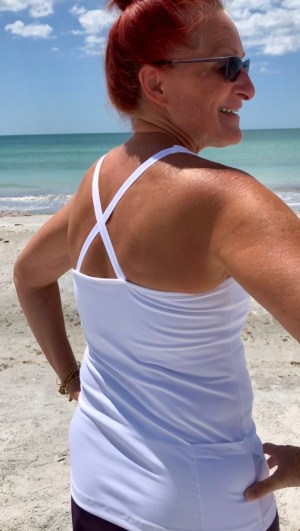
The Escapade is designed to have a drawstring style strap that can be tied halter style (handy if you are nursing or want to easily adjust the strap length), or tacked in place as straight or criss-crossed straps.  Since I enjoy Ashtanga and Power Flow yoga classes, there is a lot of movement involved, and I do NOT want any movement or shifting of my straps!  There is also a center front tie that gives separation, shaping, and lift to the bra front, but I didn’t want to feel the tie when we do upward bow or other floor work.  So that’s what led me to my hacks.

I made my Escapade using Supplex and Powernet from Phee Fabrics.  Supplex is hands down my favorite fabric for workout wear.  It’s moisture wicking and antimicrobial, so you don’t feel all sweaty or get stinky clothes from your workout.  High quality powernet is essential for good support when you’re making bras, so I always use it in the front and back of my workout bras.

I cut out all my pattern pieces except for the drawstring strap, since I made that by cutting two 1.5″ x 30″ strips of Supplex and one strip out of powernet.  I sewed them with the Supplex right sides together and the powernet on top along the two long sides.  I used a safety pin to turn the strap right side out, then pressed it flat.

Esc turn strap

I basted the powernet to the wrong side of the bra front and back lining pieces, then sewed the lining together at the side seams.  I also sewed the bra front and back together at the side seams.  I turned the bra right sides out, and slid the bra lining over it, right sides together.  I pinned them together along the top edge, then sewed along the top edge leaving an inch in the center back, and an inch at the bra front top points open.

Esc pinnedI used a strip of powernet 1.5″ x 4″ to make my center back strap loop.  I folded it in half lengthwise, and sewed it with a 3/8″ seam allowance.  I turned it right side out, made a loop, slid it inside the center back opening I had left in the bra, and stitched it in place.  Then I sewed 1/4″ clear elastic in the seam allowance along the top of the bra using a zig zag stitch.  I stretched it slightly from the side seam up to the bra front points.  I also stretched it slightly along the center front from point to point.

Esc elasticStitch one end of your strap in place at one of the bra front points, turn the bra right sides out, string the strap through the loop and try it on.  Adjust the strap length to fit you comfortably, while still feeling supportive.  Then turn it inside out again to stitch the strap at the appropriate length, and trim off the excess.  I think I ended up cutting a couple of inches off of mine.

Esc strapsBecause I didn’t want the center front tie, I just made a gathering stitch down the center front of the bra top, and stitched my gathers in place with a zig zag, followed by a stretch stitch to ensure that my gathers stayed in place even with the frequent wearing and washing my workout tops get.

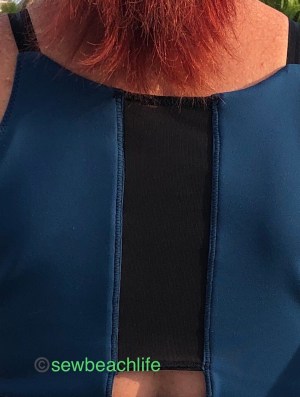
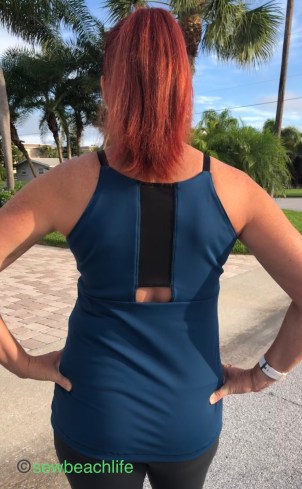
To add interest and a little ventilation to the back of my top,  I marked a spot 5.25″ down from the top of the center back bodice, and 2.5″ from the center back fold and cut this triangle off with my rotary cutter.

Esc cut triThen I cut a 6″ triangle out of my powernet.  You can use the triangle you cut out of the bodice, (adding 3/4″ on the two sides to give yourself a seam allowance) as a pattern.

Esc triangles

Stitch the powernet insert in place on the center back, taking your time when you get to the point, lifting your presser foot, and swiveling to continue the seam up the other side of the triangle.  I’m not going to lie, my triangle shifted a bit while sewing, and I seam ripped and resewed the point more than once.  Oh, the joys of perfectionism while sewing!  Use lots of pins to hold things in place, take your time, and hopefully you won’t have to seam rip and resew like me.  Press the seam allowance toward the Supplex so that it won’t show through the powernet, and topstitch in place.

You can follow the pattern tutorial at this point to finish up your top.  I wore my top to Ashtanga yoga class yesterday, and appreciated the ventilated triangle in the middle of my back.  It was a great, rather sweaty workout and I felt cute and comfortable.

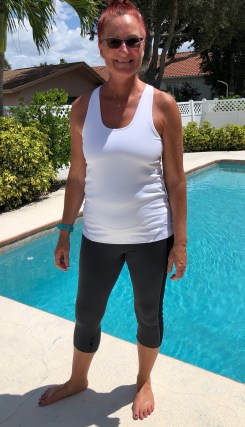
I paired the top with my GreenStyle Super G’s, which have powernet side pocket panels, so my new Escapade top gave me a cute matching workout outfit.

Esc frontEsc back full

Don’t be afraid to try a hack to make a great pattern suit your needs.  I will definitely use this pattern again.  I think I will try the dress version next.  Maybe in circular knit, or tricot… Which do you think?


*This post may contain affiliate links.  This means that at no extra cost to you, I may receive a small commission if you purchase through my links.  As always, I only give my honest opinion.  After all, it is my blog, which represents me!  Thank you for reading and sharing my love of sewing and pattern hacking. 😉


5oo4 Zen Pants Made As Shorts

And An Internal Patch Pocket Hack

Summer time means shorts, and nothing screams summer like bright, white shorts.  They look great with any color tank or tee, or thrown on over a swimsuit.  In my quest to use every pattern in my collection I decided to try the 5 Out Of 4 Patterns Zen Pants, using the shorts cut line.  The Zen Pants are a slim fit with optional front and back patch pockets and a side cargo pocket.  There is also an optional faux fly, and drawstring waistband.

I like my shorts to be a smooth line under my tanks and wanted a dressy casual look, so I wanted to streamline as much as possible.  Pockets are an absolute necessity, so I decided to turn the large patch pockets into smaller internal patch pockets, and to forego any other ornamentation.  It’s fun to customize patterns to suit my needs, and I’m never afraid to try a simple hack.  As I have noted before, I don’t show full pattern pieces to protect designers intellectual property.

The first step of altering the pocket was to decide how wide I wanted it.  I laid my phone on the pattern pocket piece and knew that I could slim it down to the width of the X-small pocket.  I laid my traced out pants front piece onto the master pattern pocket and used a pencil to draw lines from the hip up and from the top out to the outer top corner.  I also curved the pocket side to follow the curve of the hip on the pants front.  I am pointing to this area in the photo below.  (The dashed line is the original pattern shape of the outer top corner of the pocket.)

Z pocket alter

Laying the pants front on the master pattern pocket piece allowed me to trace the curve to make the pocket opening on the pants front.  That small piece in the upper corner of the photo below is the piece I cut off and discarded.  I also hacked the pocket facing, (which is used to reinforce the pocket opening.)  I like my pocket facings to be about an inch wide, so I traced the top curve of the pocket facing piece and just made it an inch wide.

Z pocket fac

Next I laid out all my pattern pieces and cut them out my fabric.  You could use a ponte or one of the other recommended fabrics, but I find that shorts made of ponte make me feel too hot and sweaty.  I love making my shorts out of Supplex.  It’s moisture wicking, so it really helps keep you cool.  And since it washes and wears so well, you don’t have to worry about using white Supplex to make shorts (or anything else for that matter!)  Because I love the consistently high quality, I buy all of my Supplex from Phee Fabrics.  It is a substantial 18oz., so I never have to worry about it being sheer.  And, it took less than a yard of fabric for my shorts.

Place the pocket facing on the pocket opening right sides together, stitch, then flip the facing to the inside of the pocket.  Give it a good press, then topstitch.  The photo below shows what the facing will look like on the inside (or wrong) side.

Z pocket

Place the pocket right side up, to the wrong side of the shorts front, lining up the top and sides.  Baste at the top and side seam, and pin the curved inner edge of the pocket to the front.

Z pocket baste

Use a zig zag, decorative stitch, or cover stitch to sew the pocket to the front.  I used one of the “overlock” stitches on my sewing machine.  Take your time sewing around the curve to make sure you are catching the pocket as you sew.  Press everything smooth.  From this point you’ll be able follow the pattern directions as written to finish your shorts or pants.
Zen back

I like the idea of the back yoke/waistband on the Zen Pants, because it curves down to meet the pockets at the side seams and gives your shorts or pants a flattering shaped look.  It does however take longer to sew than a simple rectangular or a contoured waistband that’s even along the bottom edge.  I also like that the pattern tutorial gives you photos, drawings, and tips for some common pants fitting issues.  I may try to scoop out the back crotch curve of my shorts a little to fit the shape of my bum.  This should correct the wrinkles I seem to get on all pants patterns, (so I know that it’s my body shape, versus an issue with patterns.)

I love being able to make cute, comfortable shorts that will help keep me cool during the heat of summer.  It’s nice to be able to customize them to suit me by choosing from all the pattern options and by a simple hack for the pockets.

 
Zen shorts

Now I need to search through my patterns to see what else I need to make!


*This post may contain affiliate links.  This means that at no extra cost to you, I may receive a small commission if you purchase through my links.  As always, I only give my honest opinion.  After all, it is my blog, which represents me!  Thank you for reading and sharing my love of sewing and pattern hacking. 😉
Pace Skirt

Tips For Pretty Pleats

Like many (most?) sewists, I like looking through patterns, and thinking about new clothing I can add to my wardrobe.  I have eyed the GreenStyle Pace Skirt several times, and even when I’ve made bulk pattern purchases to get the discount, I’ve hesitated on the Pace Skirt because of the pleats.  Pleats may seem intimidating, but you really can sew pretty pleats!  I want to share some tips for making pleats, so you won’t be afraid to try this fun pattern.

The Pace Skirt has a plain front and pleated back, with optional attached briefs, or shorts with pockets! 🙂  Secret hidden pockets to carry your keys and phone?  Not having to worry that a big gust of wind will come along, or that you’ll have to perform some kind of quick un-lady-like move while chasing a little one around?  Sign me up please!

The pattern is drafted for a stretch woven skirt, with a stretch knit waistband and briefs/shorts.  Since it can be challenging to find a stretch woven fabric, GreenStyle has a note in the directions that you can use a stretch knit by sizing the skirt portion down a size.  I have learned to trust the extensive testing and excellent pattern drafting, follow my measurements, and make the recommended sizes.  I like to print and tape a master copy of my patterns and trace out my size on parchment paper.  That way I’ve always got my master pattern to go back to, even if my pattern pieces get torn or a bit crinkled up from use.

So here is my first tip: pay attention when you are tracing your pattern pieces.  Because I was using a stretch knit, I had to remember to trace a smaller size for the skirt front, back, and upper back pieces, while using my measured size for the waistband and shorts pieces.  This is also the time to lengthen or shorten the pattern pieces as needed.  I am tall, so I added 1-3/8″ to the skirt length.  I also used the high rise waistband pieces rather than the standard pieces.  Can I just add here that I love that both rises are included in the pattern?  I didn’t have to worry about adjusting the pattern to add to the rise, and those that prefer a shorter rise also have the appropriate pattern pieces.

Tip #2: Make sure that you are laying out your pattern perfectly on the grain.  Grainlines and direction of greatest stretch lines are included on patterns for a very important reason.  They help you line up the pattern with the fabric so that your garment will hang properly on the body.  This is super important on the skirt back piece, because you will want to reference the grainline when pressing your pleats.  If you cut it out on grain, it will make it so much easier to get perfect pleats.  If you cut it out crooked, you will get crooked pleats if you follow the grainline while pressing.

Tip #3: Mark the pleat lines on the skirt back.  The pattern piece is clearly marked with how to fold your pleats, so they go from the center outwards.  You could use tracing paper or a disappearing pen, but I found it easy enough to use pins and clips.  I placed pins along the top of the skirt at the pleat marks.  And where each pleat folded over, and the next pleat started, I also added a clip.  That was my reminder of where the pleat ended.  In the photo below, I’ve already pressed all the pleats on the right outward toward the right side of the skirt.  (I used the metal hem guides to help hold my pleats in place while I made the folds to pleat the other half of the skirt back.  You could also just use pins or clips to accomplish this.)  Since I had made sure that I cut my pattern piece on the grainline, it was easy to follow the grainline to press the entire length of the pleat down to the hemline.  And obviously, I need to clean my iron, because little white specks of build-up have flaked out of the steam ports! 🙂

pace pinned

Tip #4: When pattern directions suggest that you baste, take the time to baste!  The small amount of time that it takes to baste, will save you so much more time when you are sewing your pieces together.  Once all of your pleats are pressed, pin them in place so that you can baste them down before sewing on the upper back piece.  Check out those pretty, pressed pleats!

pace pleats

By following the pattern directions, you will end up with a fun, flirty, pleated skirt!  It can be casual everyday wear when paired with a simple tank top.  In this case, a rayon spandex GreenStyle Staple Tank.

pace sidepace back

You can use the built-in briefs option if you prefer it when playing tennis or golf.  If you’re like me and want pockets to hold your stuff while power-walking, I recommend the shorts.  I love the “secret” pockets!

pace pocket

I also love that you can change the vibe and wear the Pace Skirt for dressier occasions  by wearing a chiffon top, or adding a jacket or cardigan.  This RTW top had been languishing in my closet because I didn’t really have anything to wear it with.

pace black

I am very happy with my new skirt.  My husband complimented me on it, and said that he loves the pleats.  ❤  Even with the built-in shorts, I don’t feel overheated because I used Phee Fabrics circular knit which is moisture-wicking and super comfortable.  There’s no need to feel intimidated by pleats.  If you have any questions about sewing or pleats, feel free to comment and I will try to help you out.  Take your time, use my tips, follow the pattern directions, and add some cute new skirts to your closet!

*This post may contain affiliate links.  This means that at no extra cost to you, I may receive a small commission if you purchase through my links.  As always, I only give my honest opinion.  After all, it is my blog, which represents me!  Thank you for reading and supporting my love of sewing!