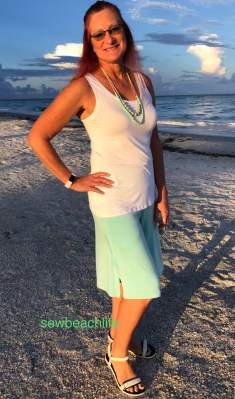
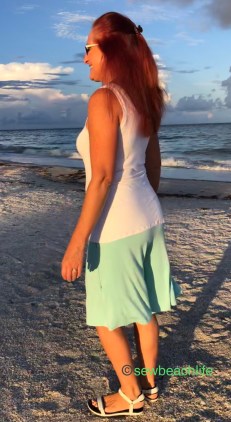
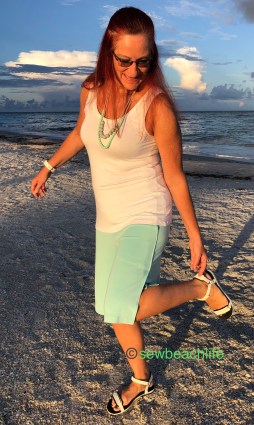
Open Back Pullover

With A Simple Hack

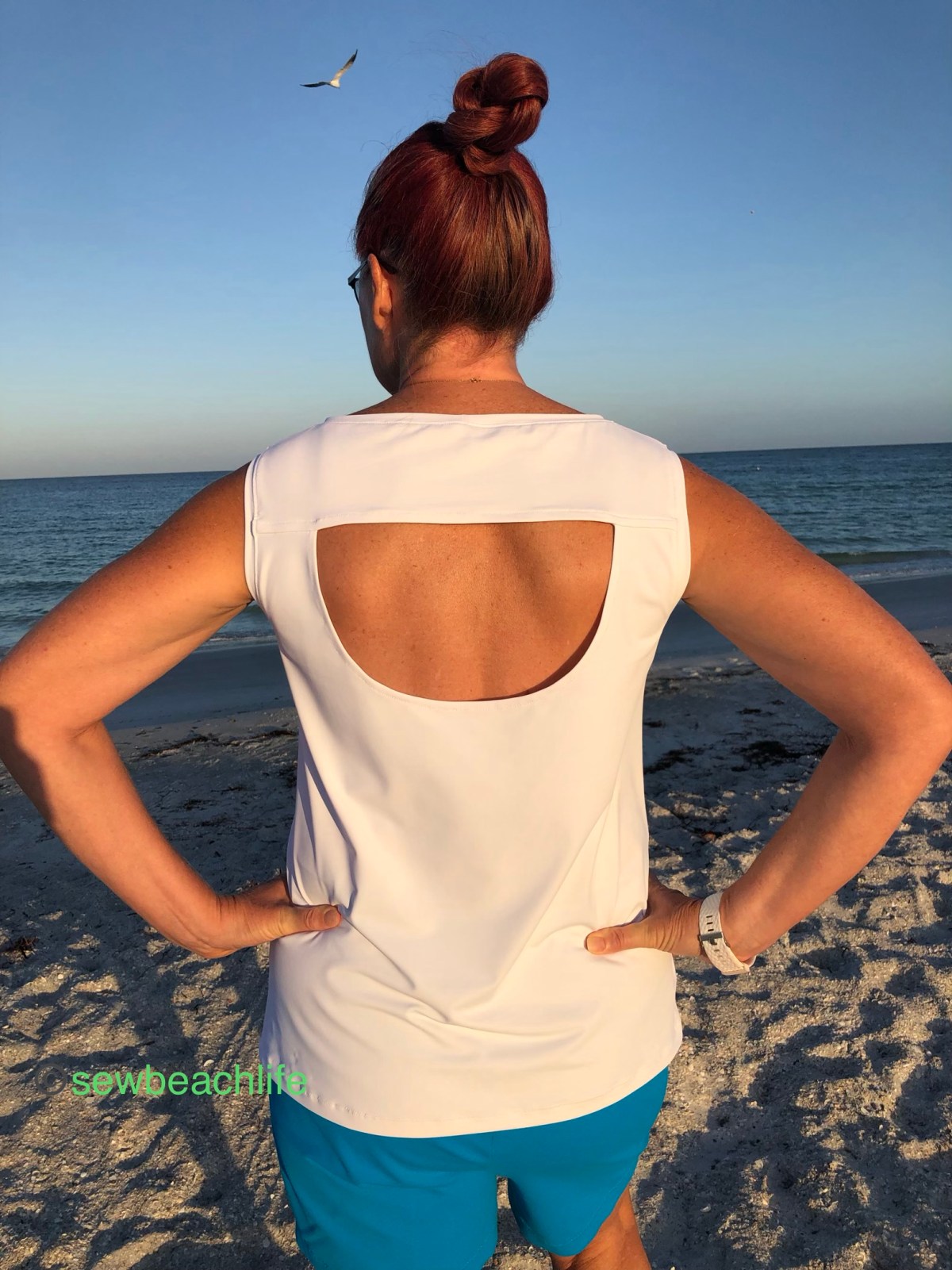
Do you ever look at patterns and think, I really like that, except for…?  That’s how I felt about the GreenStyle Open Back Pullover.  I like the open back, I like that there’s a deeper scooped back, as well as a closed back option.  I like that it can be sleeveless, or have long or short sleeves.  I like that there is a crew neck, as well as a scoop neck, along with a hood option.  Most people love “hoodies” and banded sweatshirts.  I am not one of those people.

Banded bottom shirts are not a good look on me.  I own one banded bottom shirt, and it hangs unworn in my closet.  I’ve tried to wear it, it looked cute on the hanger when I bought it years ago, but on me, it looks like a maternity top.  If I were an expectant Mama I would wear it and look adorable.  But since I am a Grandma and long past the age of having babies, it’s just not the look I am going for!

Luckily, it is super easy to hack the Open Back Pullover to not need a band.  You are going to want to pay attention to your hip measurement.  Make sure you measure the widest/largest part of your hips and booty.  If it falls within the measurements for the size you are making, you’re good to go.  But if it’s at the upper end or bigger than the size for your bust and waist, you will want to grade your pattern out to a larger size, starting at the waist.   Then use a ruler to add 4″ of length at the bottom of the front and back pattern pieces.

Follow the pattern tutorial, (it’s a pretty easy pattern) and instead of sewing on a band at the bottom, simply pin and press the hem up 3/4″ and zigzag or coverstitch to finish the hem.

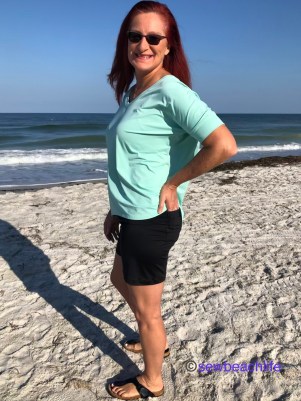
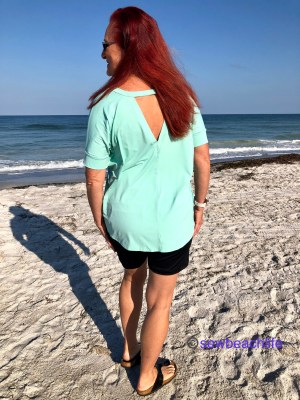
OB frontOB side

I like that I can wear a regular bra with the high scoop back, and wear it like any other top.  The low scoop back would really show off a cute Power Sports Bra and be fun for yoga class or working out.  I thought about using powernet in the scoop opening, (there is a pattern piece for that), but the open back is just the right amount of sexy.  It would also be fun to use powernet as the upper back pattern piece for an even airier feel.

I made my top out of Circular Knit, and would totally consider a long sleeved, closed back version in Rayon Spandex or Ribbing for cooler days.  If you’re looking for a more traditional hoodie feel, Cozy French Terry would be so soft and plush!  Supplex would give a more athletic feel, and would coordinate nicely with Super G’s or Stride Athletic Tights.  I’m glad I gave the Open Back Pullover a shot.  It’s a simple, slightly sexy 😉 , comfortable look.

My shorts are the Brassie Joggers, made out of Supplex.  I purchased all my fabric from Phee Fabrics.

This post may contain affiliate links.  This means that at no extra cost to you, I may receive a small commission/credit if you purchase through my links.  As always, I only give my honest opinion.  After all, it is my blog, which represents me! 🙂  Thank you for reading and sharing my love of sewing, patterns, fabric, and pattern hacking. ❤

Super Fun Super G’s

And A Simple Pocket Hack

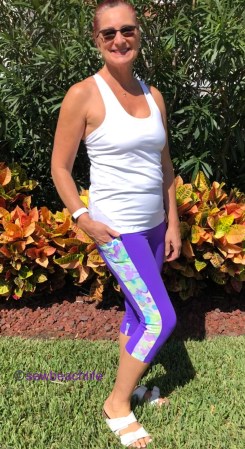
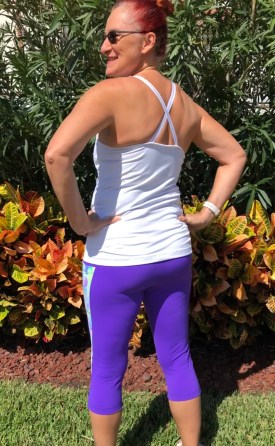
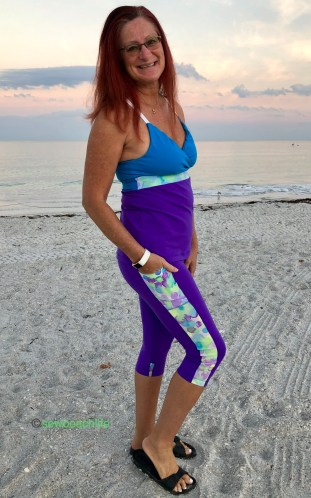
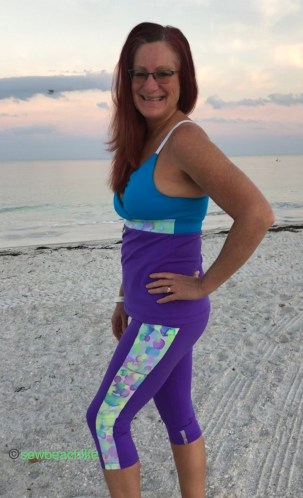
GreenStyle Super G Tights are my “go-to” workout pants pattern.  I’ve sewn more than a half dozen pairs for myself and a pair for my daughter.  I’ve perfected the pattern to suit me, and decided to really have fun with this pair.  Since it’s hot year round in Florida, I prefer capri length (or an inch or two shorter).  It’s easy to fit capri length on one yard of fabric, with enough left over to make a workout top.  The G in Super G stands for the gusset.  It’s one long piece that stretches from calf to calf, and gives your workout tights lots of stretch and movement.

Since the gusset pattern piece is longer than 36″, simply fold up the ends on the gusset pattern, and cut the ends (adding in seam allowances) out of the same or an accent fabric.  It’s a fun way to add another little bit of accent to the inside of your leg.

Supplex is literally the best fabric for workout tights.  I’ve used Tricot as the accent fabric on the side pocket panels of my Super G’s, but my favorite accent fabric is Powernet.  It gives a little more ventilation, and adds a little bit of sexy sheerness. SG flat

On the teal and navy pairs in the photo above, I used Powernet for the upper and lower pocket pieces.  That makes the panels sheer all the way to the waistband.  This doesn’t bother me, but if you’re looking for more coverage, use Supplex or Tricot for your upper pocket piece.

Normally, the lower pocket panel of the Super G’s gets stitched to the upper pocket, and the lower panel fabric gets folded under to form a pocket, effectively hiding the seam.  Since I’ve made so many pairs of Super G’s, I thought it would be fun to give the pocket on this pair a different look.  (It also means that you can use shorter pieces of powernet, 😉  in case you only bought a half yard.)  The pocket can be moved down about an inch or so, and still be wide enough to hold a large iPhone.  You may have noticed this hack on my Super G’s in this post, where the pocket is Supplex and the upper and lower panels are powernet.

SG panels adj

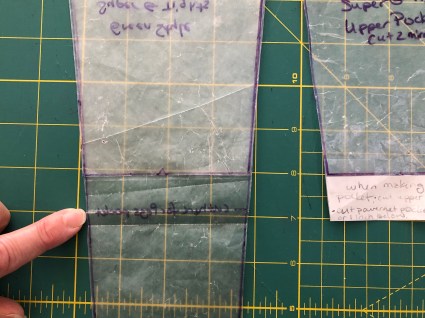
The fold in the lower pocket panel piece on the left shows where the pocket seam will be.  I cut 3/8″ above that (where I am pointing) to give a seam allowance.  I added an inch to the bottom of the upper pocket panel piece, (on the right in the photo above.)  Now I just need a pocket piece which was made by tracing the folded over pocket section (the top portion of that left pattern piece.)  And then the real fun began!

SG panels white

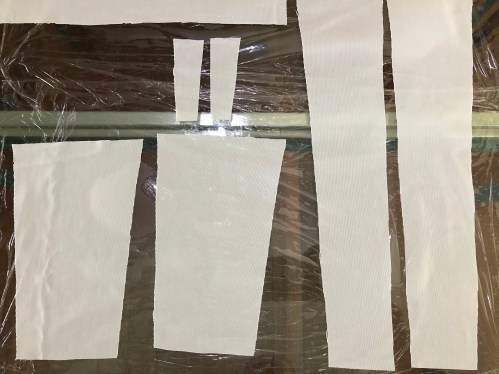
I placed several long strips of plastic wrap on my glass dining table to protect it, and laid  the powernet pattern pieces I had cut out on it.  The little bit showing at the top left corner was used for a workout top.  The small triangular pieces are the gusset end pieces.  The pockets are on the lower left, and the lower pocket side panels are on the right.  (I used Supplex for the upper pocket panels.)

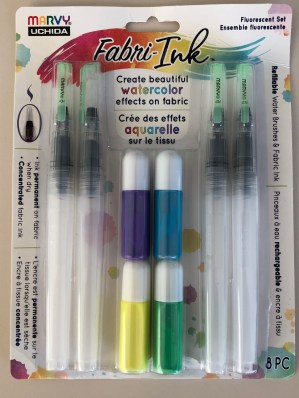
Art is often an experiment, no matter what media you choose.  It is a wonderful way to play and express yourself.  And you get to play with color, yay!  Since the grape Supplex I was using for my Super G’s was such a fun color, I knew I wanted to do something fun on the side panels.  Michaels Arts & Crafts stores often have 50% off coupons in their weekly email ads.  Which I greatly appreciate, since the Marvy Uchida Fabri-Ink kit I wanted to try was $25.

Fabri-Ink

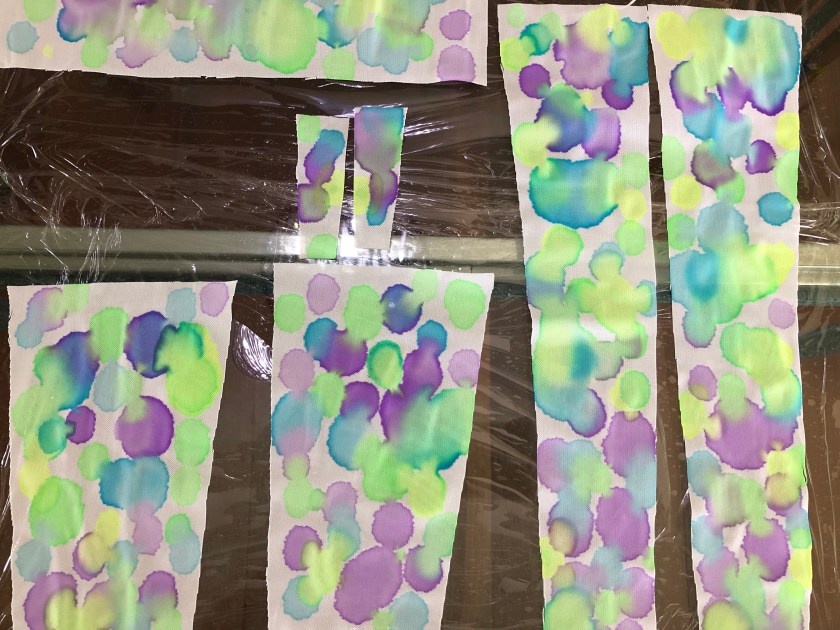
I chose the fluorescent set since the purple, turquoise, and green fit solidly in my little wedge of the color wheel.  The set includes refillable brushes, but that didn’t sound as fun as randomly dropping splotches of diluted fabric ink with an eye dropper!  The darker splotches were diluted 50/50 with water, and the lighter ones are about 25% ink and 75% water.

SG panels dyed

Things to keep in mind: I always pre-wash my fabric before it gets folded and put in my stash for use.  Never, ever, ever skip this step.  This removes any dust, dirt, or chemicals that may have gotten on your fabric from the manufacturing process or during freight.  You do not want that on your skin, cutting mat, or machine.  It also gets any possible shrinkage out of the way.  Ink is permanent, so protect your work surface, hands, and clothes.  I let the ink dry overnight (although it dries in a matter of minutes) then pressed it with an iron to heat set it.

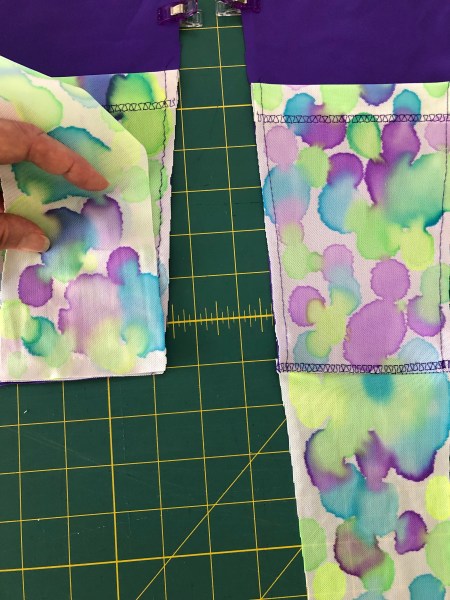
Mark the back edge of each side pocket panel pattern piece with a clip to avoid confusion later.  To assemble the panels, fold the top edge of the pocket under 1″, press, and topstitch with a decorative stitch.  Lay the pockets on the upper pocket panels, right sides up, aligning the bottom edges, and baste along the sides.  Then lay the lower panel on top of the pockets, right sides together, and stitch.  Press the seam up (so it won’t be visible through the lower panel), and topstitch with a decorative stitch.

sew SG panels

With the side pocket panels done, you can simply follow the pattern tutorial to finish up your super fun Super G’s.

SG pocket foilageSG Jillian back

I’ll tell you a funny story about taking these photos.  This pretty foliage is along a rather busy road.  It can be kind of awkward posing for photos with cars driving by.  While posing so my husband could take a photo of the back of my Super G’s, I asked him if my booty looked good.  Right then a truck drove by and the young man in the passenger seat leaned out the window and whistled at me.  Straight-faced, my husband answered, “I think you have your answer!” 🙂 Hahahahahahaha!

Super G pocketSG side

I love these early morning photos because the colorful sky is a pretty backdrop for my super fun and colorful Super G’s.  And who doesn’t love the sound of the ocean as background music?

Sewing is an art, so don’t be afraid to experiment with it, and with other forms of art to make your own fun projects.

All fabric was purchased from Phee Fabrics.  The white Supplex workout top is the GreenStyle Jillian I hacked to have powernet inserts and a pocket, blogged here.  The teal and grape Supplex workout top is another fun hack I’ll be posting soon.

This post may contain affiliate links.  This means that at no extra cost to you, I may receive a small commission/credit if you purchase through my links.  As always, I only give my honest opinion.  After all, it is my blog, which represents me! 🙂  Thank you for reading and sharing my love of sewing, patterns, fabric, art, and pattern hacking. ❤

Sinclair Joanne Faux Wrap Dress & Top

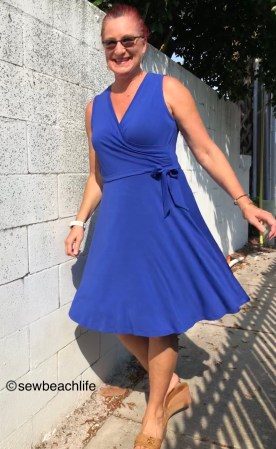
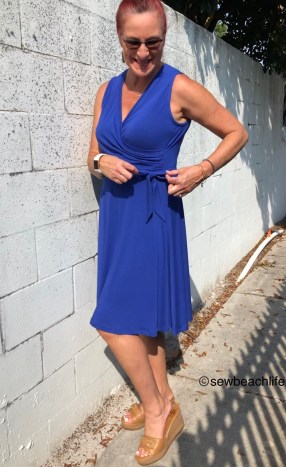
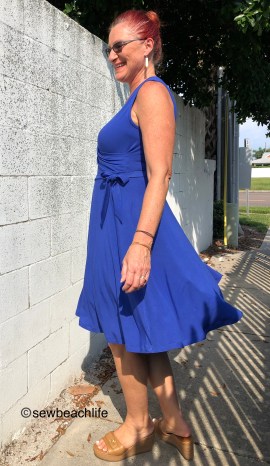
Twirly dresses just make me smile!  As does Sinclair Patterns newest release, the Joanne Faux Wrap Dress & Top.  This is one of those patterns that I will make again and again.  The drafting is just so good.  It was obvious during testing that the design was a winner, because after sewing it up, I had to struggle to think of anything that I would change.  The only thing I could think of was to have the wrap swoop a little lower to get under the bust easier without causing pulling at the side seams, and that I would be comfortable with the skirt being an inch or two shorter.

Joanne1 angle

Other testers struggled to find anything to critique as well.  The dress just looks so good on everyone!  It will be hard for you to see the differences in my periwinkle dress (version 1) and my blue dress (version 2).  Very subtle changes were made to deepen the pleats a little bit so that the crossover was a smidge shorter at the side seams, and the skirt was shortened an inch or so.  There is also a midi skirt cut line, so if you want a longer skirt you’re good to go.   I literally couldn’t stop myself from twirling and swishing this skirt like a little girl! 🙂

Joanne1 blurJoanne full

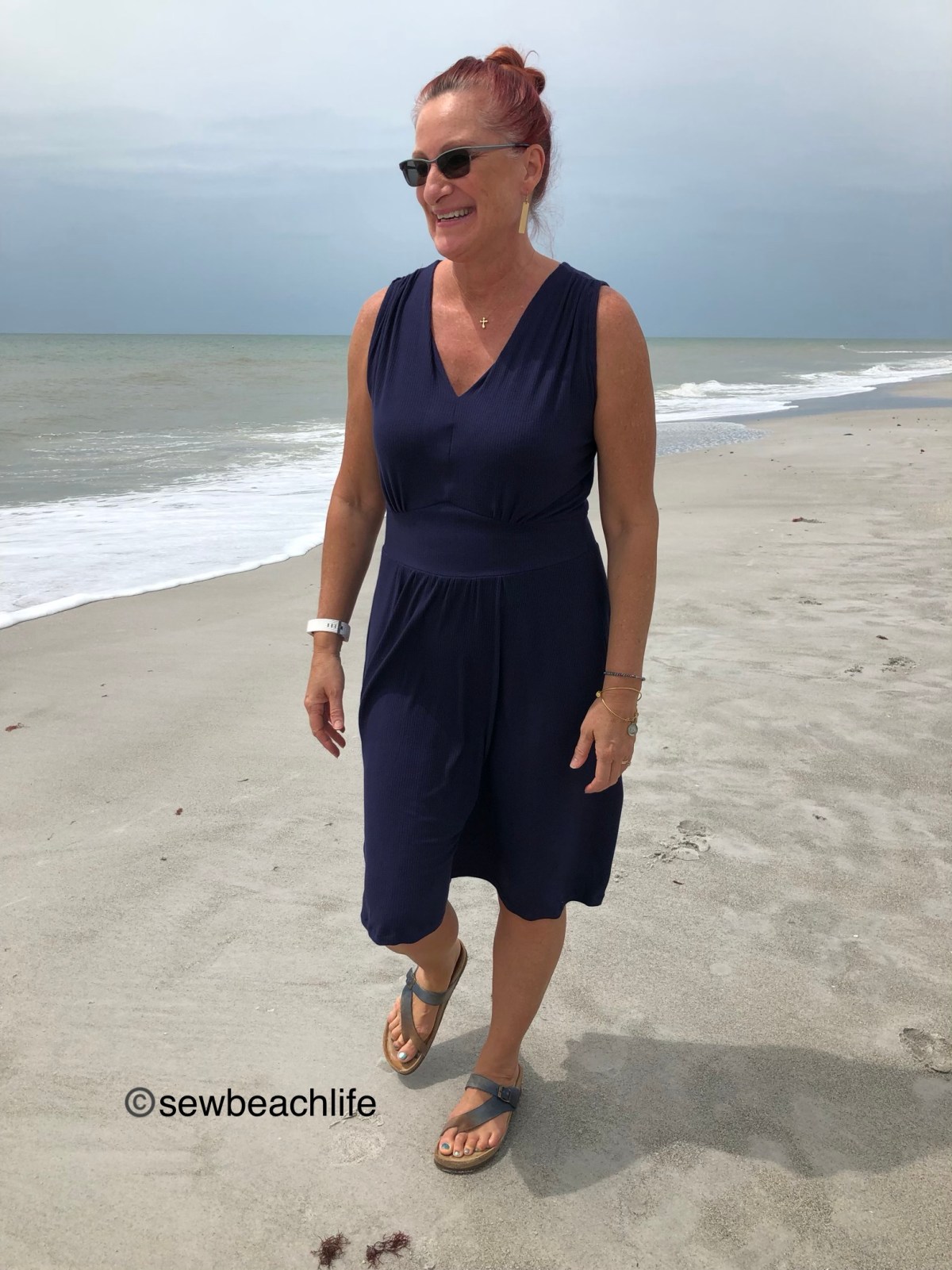
Both of my dresses are sleeveless, because Florida is hot.  As in temperatures are still above 90*F in late September hot.  For that one month of winter that we get, I would really like to make a Joanne with sleeves.  Because there are options galore- short, 3/4, long and my personal favorite, a flounce sleeve!

Since the test went so well, Oxana (the designer at Sinclair Patterns) added a hi low peplum option and it is gorgeous!   She also added the shaped tie belt, which I love.  It really adds to the look of the dress and top.

Joanne tie

The genius secret behind having such a nice crisp bow?  The pattern tutorial suggests using knit interfacing.  If you’ve never used knit interfacing before, it’s a little different than the interfacing you use for woven fabrics.  It’s an open weave knit, so it still has some stretch, and you just iron it on the wrong side of your fabric.  Except you absolutely have to use a pressing cloth, or you will be spending some time cleaning your iron, and could ruin your garment with glue residue.  Due to the open weave of knit interfacing, the glue will spread when heated, and if you don’t use a pressing cloth, the sticky glue will get all over your iron.  Obviously, I am speaking from previous experience here! 🙂  The first time I ever tried it, I spent some quality time cleaning my iron after realizing that yes, you should read the directions included with your interfacing!  Here’s my pro tip: If you don’t have a pressing cloth, use a paper towel.  You will have to kind of peel your paper towel up after pressing, but the residue won’t come through the paper towel and it didn’t leave any paper fibers stuck to my belt.

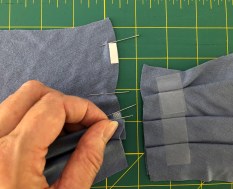
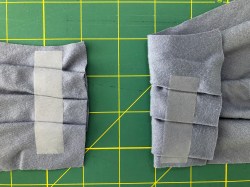
My other tip for sewing is the same as I mentioned for the Sinclair Yasmin Dress blogged here.  Small pieces of Wash Away Wonder Tape are great for holding your pleats in place.  I also used a strip of Scotch Tape to ensure that they stayed in place until the side seams were stitched.

wonder tape pleatsscotch tape pleats

The Joanne is a pretty quick sew, and with all of the options, it’s bound to be a staple in my closet!  I’m envisioning a black or white rayon spandex hi low peplum top because it would go with literally everything!  And of course a couple more dresses!

Joanne sideJoanne back

I know I’m gushing, and probably oversharing photos, but the fit is great whether you look at it from the back or side.

Joanne1 twirl

I am grinning in every photo, and twirling in most of them.  It’s pretty obvious that I love this pattern!  During the release sale is the perfect time to buy the Joanne Faux Wrap Dress & Top pattern, as it is on sale for $7.99 through Wednesday September 25, 2019.  I hope you’ll check it out, and share photos of your makes!

I used Rayon Spandex from Phee Fabrics for both of my dresses.  It’s a substantial 13oz. fabric and works perfectly for this (and every other tank, top, and dress) pattern I’ve ever used it for.  The drape is perfect, and it has enough recovery to make excellent bands.


This post may contain affiliate links.  This means that at no extra cost to you, I may receive a small commission/credit if you purchase through my links.  As always, I only give my honest opinion.  After all, it is my blog, which represents me! 🙂  Thank you for reading and sharing my love of sewing, patterns, and fabulous fabric. ❤


Yoga Class Fun

If you follow my blog for sewing, you’ve likely seen that I sew a lot of workout wear.  It isn’t that I run, or spend hours at the gym because obviously, I don’t!  But I do love going to yoga class.  I’ve been practicing yoga for 16 years and besides walking the beach, it’s my favorite form of exercise.  Like anything else that you practice regularly, the more  you do it, the better you get.  I’m certainly not perfect, but it’s fun when I feel like I’m able to get deeper into a pose than I used to.  I’ve had some excellent yoga instructors over the years, and am happy that I’ve found a yoga studio with classes I enjoy, along with instructors and regular attendees who make me feel like I am part of a happy little tribe.

I’ve never been able to get photos while practicing, but all of the other “regulars” at Friday morning Ashtanga were on vacation, traveling, had work commitments, etc., so I was the only student.  Ashley, my favorite Ashtanga instructor 🙂 asked if she could take some photos as we did class.  I had to laugh when she said after class that she “felt like the paparazzi, trying to get all up in there, taking photos.”  Hahahahaha!  Since I am not some Hollywood movie star or otherwise famous, the paparazzi will never be taking photos of me, so I found this hilarious!

Ashley was discreet while photographing, so you’re not subjected to photos of my sweaty face, just my sweaty back!  Just for fun, here are my yoga photos:

fold side

It was super exciting to me when I was first able to get my head down on the floor during wide legged forward folds.

twisted side angle

My elbows feel like they’re pretty centered and vertical when I’m in twisted side angle, I’m almost to the center of my chest.

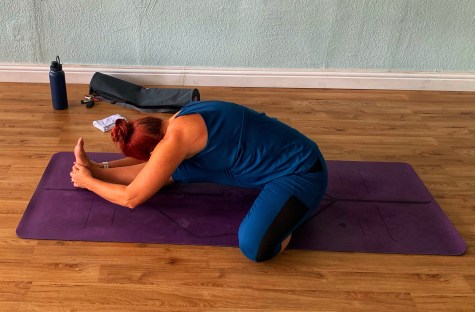
forward fold

There are so many variations of forward folds.

prayer hands

I really like this photo, the lighting was pretty.  Can you see the sweat dripping up my spine?  And can you tell that I never take off my cross necklace? 🙂  I need to work on getting my palms together though.

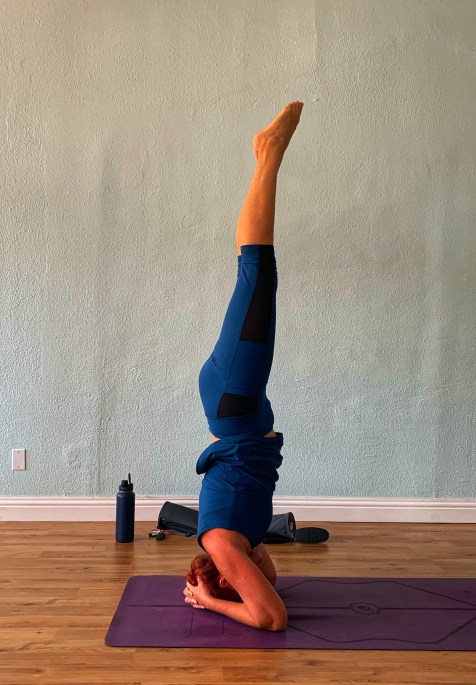
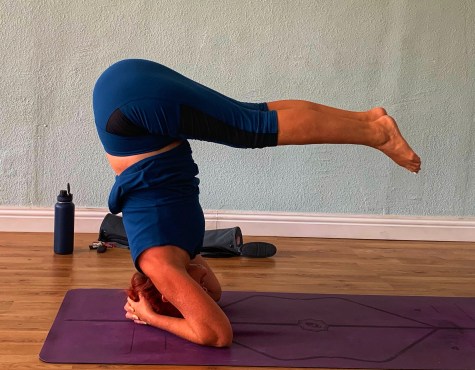
headstand

My Grandpa taught me to stand on my head when I was a little girl, so this isn’t a big deal, since I’ve always been able to do it.

headstand pike

It’s fun to be able to pike out of a headstand too.

If you’ve thought about trying a yoga class, I hope you’ll give it a try.  It isn’t all about being able to stand on your head.  It’s more about breathing, and learning to control your breath and your responses to the stressors in life.  It helps you build focus, along with strengthening and stretching your muscles.  As I’ve heard more than once, it’s a yoga “practice”, not a yoga “perfect”.  It is also a perfect time to pray.  I manage a couple of Hail Mary’s during the opening mantra, and an Our Father during the closing mantra.  Faith is an important part of life, and there’s never a bad time to pray.  I enjoy adding prayer to my yoga practice as much as I enjoy a quiet prayer while walking the beach.

Exercise, eat healthy foods, and take care of your body and soul.

If you’re curious about my workout outfit, the tights are the GreenStyle Super G’s, although I did hack the side pocket panels in this pair a little bit.  My workout top is the hack I did on the Stitch Upon A Time Titania Top, blogged here.  The Supplex, Powernet, and plush bra strap elastic were all purchased from Phee Fabrics.


This post may contain affiliate links.  This means that at no extra cost to you, I may receive a small commission/credit if you purchase through my links.  As always, I only give my honest opinion, because after all, it is my blog, which represents me! 🙂


Chelsea Pants Make Cute Shorts!

I wouldn’t normally start off a blogpost with a photo of my booty, but when you’re talking about a pants pattern, one of the biggest questions people have is, “Will it make my booty look good?”  Um, yeah! 😉  So, let’s talk about the above photo.  My husband has the thrilling task of taking photos of me in my sewing creations.  If you think it’s awkward standing on a public beach (where a good portion of the photos get taken) and trying to model without laughing at the absurdity of it, and trying to not look like a total doofus in every photo, can you imagine having to be the photographer?

“I need close, full body shots of the front, side, and back.”  “I need the light shining on the clothes so that you can see the details.”  “Can you get a close-up of the pockets (or straps, or whatever detail is important about said garment)?”  “Are my fat rolls showing too much?”  “Make sure I don’t have any weird wrinkles.”  “Is my hem nice and straight?”  You get the picture.  He puts up with my requests and awkward silliness while posing, and hurries to snap some photos before people walk, run, or swim into the frame.

He had already taken some photos of my Chelsea shorts earlier in the morning, and I kept my comfy shorts on when we went to hang out in a nearby city.  I wanted a better detail shot of the jeans style pockets I used, and the hedge and brick fence along a shady sidewalk looked like a good spot to take photos.  Being the good sport he is, he was more than happy to crouch down on a public city sidewalk to take a few photos of my booty!  The dog walkers and random passers-by probably thought we were a little weird, but, those are the lengths we go to for good photos!

The GreenStyle Chelsea Pants are a cute, on-trend pattern.  The legs have a nice flare at the bottom, and with bell bottoms rolling back into style again, they are a good way to ease into the look.  I am old enough to recall bell bottoms being “cool” during my childhood.  And for someone who is not quite ready to embrace the full bell trend, a nice flared pant is a great look.  If it were cold here, or rather, stayed cold here for longer than two weeks in January, a few pairs of Chelsea pants in Supplex would be the perfect addition to your work and play wardrobe.  They’ve got a seam down the center front of the legs, which gives them a slimming look.

Chelsea STS front

The pattern includes a fancy two-piece pocket design, but I decided to make a simple jeans style pocket as it works better for my phone.  You’ve heard me comment on the wonders of Wash Away Wonder Tape before, and let me tell you, pockets are another great place to use it.  In the past I’ve measured, pinned, pressed, and basted the edges of my pockets under so that I could place them on my pants.  Now I measure, lightly pin, press, then put a strip of Wonder Tape in the pressed crease.  The pockets stay perfectly straight, with no possibility of getting twisted or pulled out of shape when you sew them on.  As my Dad used to say, “Having the right tools makes the job a whole lot easier.”  Wash Away Wonder Tape is a handy “tool” to have in your sewing box.

It was easy to hack the pants pattern into shorts.  I knew I wanted a 6″ inseam, which is short enough, but not too short on my long legs.  So I marked my front and back pattern pieces 7-3/8″ down from the crotch points, which gave me the 6″ inseam, an inch hem, and the 3/8″ seam allowance.  Keeping my ruler parallel with the lengthen/shorten line assured an even hem.

Chelsea shorts length

Besides using a different pocket design and shortening the length, the only other alteration I made was adding to the crotch depth.  I have a bit of a booty, so extending the crotch point a little bit gives my pants a little more space where I need it, and keeps me from having a “wedgie”, which is never a good look!

The pattern tutorial is easy to follow, and the pants are a pretty quick sew.  I used Phee Fabrics circular knit for this pair, and the moisture wicking fabric kept me cool and comfortable while walking around on a 96*F day.

Chelsea STS sideSTS Chelsea back

The Studio To Street Top blogged here is a great transition piece for cooler mornings or chilly evenings, and I love the Deep-V back option.  This one is made out of circular knit, but you’d get a similar look by using Tricot.

I have three more Studio To Street Tops with long sleeves, all made out of Rayon SpandexRayon Spandex Ribbing and Cozy French Terry would be some other great fabric choices for this cozy top.  They are so soft and comfortable, and are a go-to for throwing on before heading out to yoga class in the fall and winter.  If it’s past tank top weather were you live, the Studio to Street is a great style to wear with your Chelsea’s whether you choose to make them shorts or pants length.

These are so comfortable I’m probably going to have to make a pair in Supplex.  You know, for that two weeks of “winter” we get here in Florida! 🙂

This post may contain affiliate links.  This means that at no extra cost to you, I may receive a small commission/credit if you purchase through my links.  As always, I only give my honest opinion.  After all, it is my blog, which represents me! 🙂  Thank you for reading and sharing my love of sewing, patterns, fabric, and pattern mashing and hacking. ❤

Mashing Patterns To Suit Your Body And Style

People sometimes comment in Facebook sewing groups that they can’t find a pattern that they like, or they want a certain style for the top, but a different look for the bottom.  Do you have patterns with certain elements that you absolutely love, and wish that you could mix and match them with elements from a different pattern?  Have you ever tried mashing those patterns together to give you a new look?  I find myself mashing and hacking patterns all the time.  It’s generally a good idea to make the pattern as designed at least once, to judge how it fits and looks on you.  Once you know how it fits, it’s easier to start playing with your patterns.

A pattern mash can be something as simple as using the contour waistband you love from your favorite workout pants on a different pants or shorts pattern.  I use a modified version of the Patterns for Pirates Peg Legs contoured waistband on P4P SOS Pants and it works great, blogged here.  Mixing and mashing sports bras with workout tanks can really personalize your gym wardrobe.  Like using the GreenStyle Power Sports Bra and mashing it with the body of the GS Lille or Jillian Tank to make a workout top.  It’s always fun to turn a top into a dress, like using the Stitch Upon A Time Aushui Tank and mashing it with the skirt of the Calista Bra, Top, Tunic & Dress.

Sometimes your mash will require a little bit of adjustment in order to work.  Like tracing the armscye from a pattern onto another pattern to ensure that the sleeves you want to use will fit the jacket, top, or dress.  Sometimes it’s a matter of making your best guess as to what will work, then trying it on and adjusting from there.

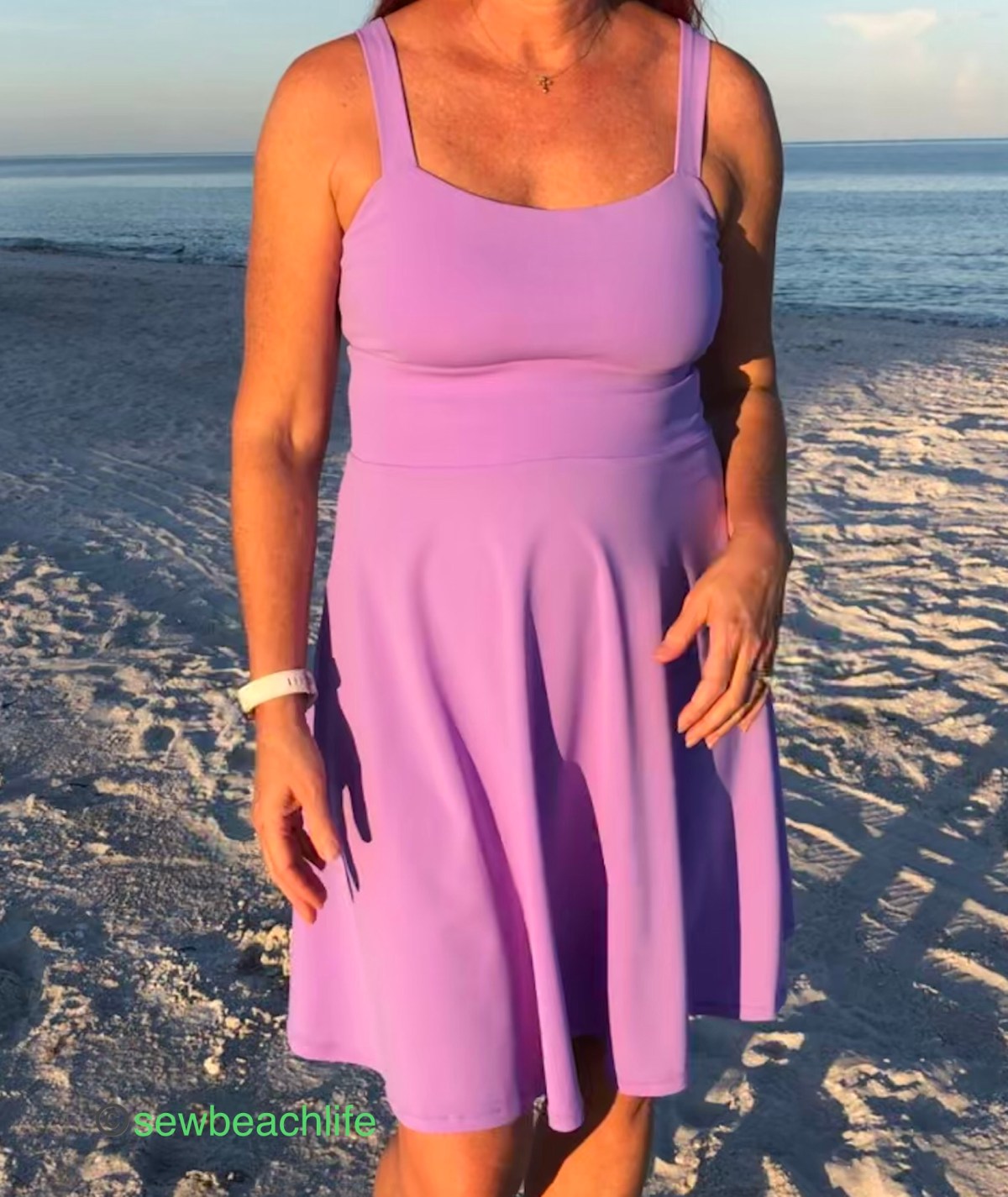
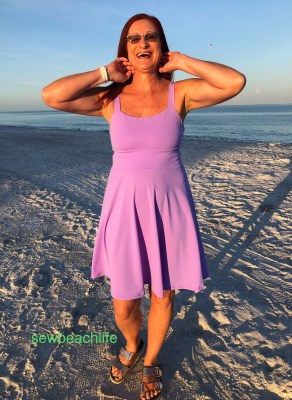
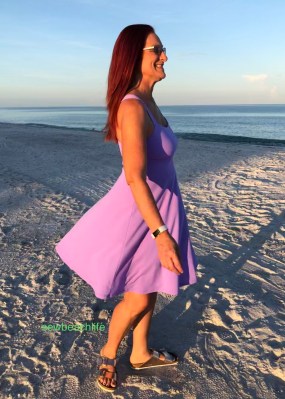
That was my  experience with last week’s pattern mash.  I wanted another new dress, and loved the flared skirt from the Sinclair Yasmin Dress.  Temperatures are still in the 90’s here, so a strappy dress seemed in order.  The Stitch Upon A Time Water Faery Twist & Swim Top (blogged here) fits well, so I figured that mashing the plain front version with the Yasmin skirt would make a super cute dress.  And I think it does.  But it took a little bit of basting and trying on to perfect my fit.  I knew that the V-shaped waistband from the Yasmin wasn’t going to line up with the bodice of the Water Faery, so I cut out the crop length Water Faery body to use as a waistband.  Since it’s technically designed as a swim top, the body is quite fitted, so that it won’t float or ride up when you go in the water.  Since I don’t plan to swim in my dress, I want the waistband fitted, but not too form-fitted.  Since I’ve been known to bake (and thoroughly enjoy indulging in) apple crisp this time of year, I decided to size up one on the “waistband”. 😉

Knowing how a pattern fits, and taking note of any changes you make to the pattern really helps the next time you make it.  When I made the Water Faery into a workout top, I narrowed and lengthened the straps and liked it, so this time I knew that cutting out strips 3″ wide & 14″ long would give me the perfect finished size.  Sewing up the bodice (which is an inner and outer layer of Phee Fabrics Tricot, with a layer of powernet sandwiched between) and straps was pretty quick and easy, and the fit was spot on.  Since I hate seam ripping, I just basted the “waistband” pieces together, and tried it on.  It was too loose under the bust.  So I graded the front waistband piece from my measured size at the top, and somewhat straight down, rather than angling in which gave me more of a rectangular rather than tapered shape.  With the width figured out, I stitched the side seams together and basted the outer waistband to the bodice, right sides together.  Then I pinned the inner waistband to the inside, effectively making an enclosed waistband.  It’s easier for me to keep all of the layers perfectly lined up by basting one layer on before pinning on the other layer and stitching everything together.  Before folding the waistband pieces down into place, I zigzagged 1″ wide elastic to the seam allowance, using the length recommended for my size in the Water Faery pattern.  This ensures that the waistband and skirt will stay down under the bust.

Then it was time to determine how long the waistband needed to be.  I wanted the flared skirt to start right at the natural waist.  Starting the flare at the narrowest part of the body gives the illusion of an hourglass shape.  My natural waist is quite high, pretty much right at the bottom of my ribs, well above my belly button.  It was surprisingly easy to find the perfect spot.  Since the waistband also had powernet sandwiched between the layers, it was definitely going to find the narrowest point for me!  Literally just bending side to side, forward and back, caused the waistband to roll up to the height of my natural waist.  I used my hem gauge to take note of the fact that the waist seam needed to be 1″ up from the bottom of the waistband in the back and on the sides, tapering to 1-3/4″ up in the center front.  Since I prefer using 3/8″ seam allowances, I trimmed 5/8″ off the back waistband pattern piece.  I used a ruler to taper from 5/8″ at the sides to 1-3/8″ at center front on the front waistband pattern piece.  Then I very carefully matched up the side seams of my bodice,  lined up the bottom edges, pinned the bodice together so that the center front and center back were on the two outside edges, and used my rotary cutter to trim off the excess fabric.

Adding the skirt was super simple, sew up the two side seams, match center points and side seams, pin all around, and stitch.  The most time consuming part was pinning up the hem.  I finished the hem with a simple zigzag stitch.  And Ta Dah!  I have a brand new fun and flowy dress!  Because I used powernet in the bodice, waistband, and straps, and elastic under the bust, I didn’t need to add swim cups or wear a bra with this dress.  And I’ve already had two random strangers ask me where I found such a cute dress.


WFY side

See how the seam where the skirt is attached runs perfectly parallel across the back?

WFY back

Laughing while modelling your makes is half the fun!

WFY hair

And of course I had to twirl!  Whenever you make a twirly skirt, you can’t help but twirl!

WFY wind

This pattern mash was a complete success, and something I’m bound to make again.  After sewing it, I realize it’s probably pretty close to the Water Faery Retro One Piece dress option, and that’s ok, because it looks like a great pattern.  Since I already own the Twist & Swim Top, and would never wear a one piece, I don’t feel like I have to buy the pattern just for the dress option.  (Although if you’re not yet comfortable with pattern mashing or hacking, it is a great option).

One of the best things about sewing is being able to personalize patterns, mixing and mashing, and hacking them to suit your body, and your style.  Are you ready to try a pattern mash?

This post may contain affiliate links.  This means that at no extra cost to you, I may receive a small commission if you purchase through my links.  As always, I only give my honest opinion.  After all, it is my blog, which represents me! 😉  Thank you for reading and sharing my love of sewing, patterns, fabric, and pattern mashing and hacking. ❤ 

Sinclair Yasmin Dress

A Few Tips For Simpler Sewing & A Peplum Hack

I was super excited when I was chosen to be one of the testers for the Sinclair Patterns Yasmin V-neck Dress with pleated accents.  I love dresses, and wear them all the time.  And let’s just say that the pleating and detail in this dress spoke to me.  When I saw the line drawing and tester call I immediately filled out the tester application!

Sinclair Patterns are rather unique in that their patterns come in petite, regular, and tall.  No more having to add a couple of inches to a skirt or dress so that it is long enough to wear without worrying about showing more leg than I want when bending, or climbing in and out of a vehicle.  Armscyes that are actually deep enough.  All the things that a tall sewist has to constantly adjust on a pattern are already figured out for you!

When you sign up for a pattern test, you’d better have some fabric on hand.  Testing obviously moves along quickly, so you need to be prepared to print and tape your pattern together, trace your size, cut your fabric, and get sewing.  Luckily, I had ordered some of the new rayon spandex ribbing from Phee Fabrics, and was smart enough to have ordered 3 yards.  I have a bad habit of usually only ordering 2 yards or less of a fabric, and when you are tall, that is not enough for a dress with a full skirt!  The ribbing has a luxurious feel, a pretty ribbed texture, and beautiful drape.  I knew it would look great sewn into a Yasmin Dress!

Call me brave, call me crazy, but I am not one for using cheap fabric for muslins.  Cheap fabric is generally a polyester blend, ewww!  I don’t like the feel of it, it’s unlikely to lay as nicely as quality fabric, it’s generally a pain to sew with, and it’s probably not going to be substantial enough or have adequate recovery for the type of clothing I like to sew, so I just don’t bother with cheap fabric.  That being said, you do run the risk of wasting nice fabric when you test.

This is the first time I’ve tested for Sinclair Patterns, and I have to say that I am very impressed with how thorough Oxana is.  She asked for our thoughts about the pattern before we even started.  I mentioned that I was interested in a sleeveless dress, since Florida is warm most of the year.  Other testers also commented that they would wear a sleeveless dress.  She added a sleeveless cut line to the pattern.  She asked for honest input and made changes as needed as tester photos and feedback came in.  Another thing you’ll notice about Sinclair Patterns is the way the garments are finished.  Just look at how pretty the inside of the bodice and waistband look.  The shoulder seams and waistband are enclosed, and the neck has a neat interior banded finish.
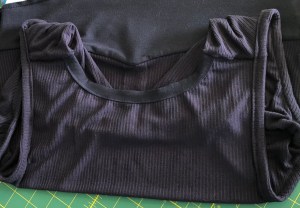
Yasmin inner back

The pattern itself isn’t hard, but the pleats are a bit time consuming.  Don’t worry- the tutorial is thorough, and I’ve got some tips to make the pleats a little easier.  Here’s my first tip: print the bodice front in just the size that you need.  I generally don’t print in layers, preferring to print all sizes of a pattern in case I want to grade sizes, or make the pattern for my daughter who is a much smaller size than me.  You need the pleat markings to be precise in order to get even pleats.  And when you’ve got lots of markings in 12 different sizes all in one general area on a pattern, you need to narrow things down!  So trust me when I say to print the bodice front in just one or two sizes if needed.

Tip number two: Wash Away Wonder Tape is your friend.  You still need pins to mark your pleats, but putting a tiny piece of Wonder Tape for your pleat to fold over and stick to, makes things easier.
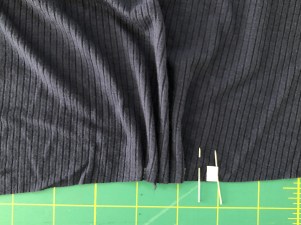
Yasmin pleats

Tip number three: Scotch tape is surprisingly helpful.  Of course I didn’t figure this out until I sewed my second bodice and thought, “Hmmmm….I wonder if a piece of Scotch tape will hold the pleats better than the pins did so that I can keep the pleats even while sewing?”  The answer is YES!  It (and the Wonder Tape) definitely kept the pleats perfectly spaced and even while I sewed the bodice to the waistband.
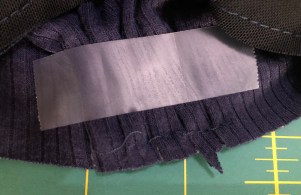
Yasmin tape

Tip number four: Powernet is an awesome fabric.  If you follow my blog, or read my posts or comments on the Facebook sewing groups I belong to, you know that my love for Phee Fabrics powernet is strong.  It is supportive in bras, workout, and swim tops, makes a great accent on workout tops and tights, and has magical tummy smoothing powers in waistbands and swim bottoms.  It is recommended to use an athletic fabric for the inner waistband pieces of the Yasmin to help support the weight of the skirt, and lend stability to the waistband.  Since the Supplex I have on hand is destined for workout wear, I decided to baste some powernet to my waistband to give it the necessary support.

Yasmin powernet

Use plenty of pins to keep everything aligned, and sew with the powernet facing up.  I don’t know if I’ve mentioned that before, but when helping someone who was struggling a bit with powernet, I realized that some people may not even consider fabric stretch when they sew.  Generally speaking, you want anything smaller, or with less stretch on top while sewing, such as powernet, elastic, bands, or when easing pattern pieces together.  If your larger piece or stretchier fabric is on top, your presser foot will tend to stretch it out even more.

Summer in Florida is the rainy season.  But it will usually rain for a short time, and the sun comes right back out.  Not this week!  It rained for two days straight as I sewed, and rained all the next day as I waited to take photos of my dress.  Finally, the rain slowed down to a slight mist, and the sun started to peek out from the clouds.  My dress was all pressed and ready to go, so we quickly drove to the beach for some photos.
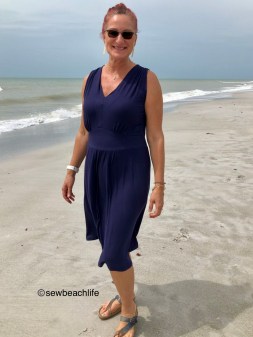
Yasmin frontYasmin back

The rain may have stopped, but there was plenty of wind to whip my skirt around!  I love the pleats at the shoulders and under the bust, and how the V-shaped waistband gives nice definition.  I used the gathered version skirt on my dress, and love the drape and comfortable ease of this dress.

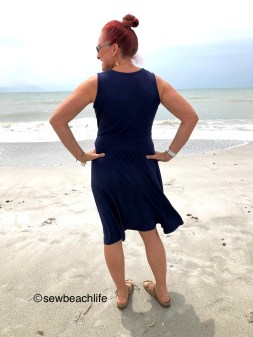
Yasmin hipsYasmin back US12

Since I still had some time before the pattern released, I decided to make the other skirt option.  Apparently I need to order some fabric, (says every sewist and fabric hoarder 🙂 ) because I didn’t have enough fabric for a knee length skirt, let alone a midi length.  So I decided to try a peplum.  I NEVER wear peplums.  But the flare of the skirt really spoke to me, so I had to try it.  I dug through my fabric and found scraps of floral that sort of matched the bit of rayon spandex and ribbing I used for the bodice and waistband.  I marked and cut the skirt at 13-1/2″ from the waist, and used a 1″ hem.  A smaller hem would be easier on a curved skirt, but I was just guessing at the length when I hacked the skirt into a peplum.  If I were short, I’d probably make the peplum 8-9″ long, and would probably cut it at 12″, no more than 13″ for my tall self next time.

Yasmin peplum frontYasmin peplum backYasmin peplum twirl

It’s such a fun look that I couldn’t help but twirl!  And I’m branching out and trying a new style of top.  That’s one of the fun things about sewing, sometimes you end up with a surprising, unexpected new style in your wardrobe.  Although the skirt I’m wearing is RTW, using a pencil skirt along with a peplum overlay would be another cute hack for this dress!

There are options for knee length, midi and maxi length in the gathered skirt version.  The elegant look of this pattern would look so beautiful as a maxi dress.  Since I also love the flared skirt, I guess I need to make another Yasmin Dress (or two)!  Once I order more fabric, of course. 😉


*Note: I recieved the pattern for free as part of the testing process.   I always participate fully when I test by submitting fit photos and commentary, offering constructive feedback on the fit, process, etc., comment on other testers posts, noting any fit issues, and applauding beautiful work, and filling out the survey to try and help ensure that the pattern fits well, and the tutorial is easy to understand and follow.

This post may contain affiliate links.  This means that at no extra cost to you, I may receive a small commission if you purchase through my links.  As always, I only give my honest opinion.  After all, it is my blog, which represents me!  Thank you for reading and sharing my love of sewing, patterns, fabric, and pattern hacking. 😉
GreenStyle Warrior Pants

Made As Shorts, With Other Tips & Tricks

I’ve liked the look of the GreenStyle Warrior Pants ever since the pattern released.  But I don’t often wear pants, so I didn’t buy the pattern right away.  The idea of making them into shorts/culottes opened up some possibilities.  As did the available length of yardage in my stash! 🙂  Originally I considered making them in capri length, but there was no way the pattern would fit onto my available fabric.  So I folded up my pattern 6″ above the capri cut line, and decided to make them into shorts!

The pattern recommends lightweight stretch knit, so I knew that Phee Fabrics Rayon Spandex would give me the beautiful drape that is the hallmark of these pants.  The pattern has an integrated pocket design that is vital to the construction of the pants.  Since I love having pockets on everything, I was curious about the unique pocket technique.  It can seem a little confusing, but if you follow the pattern tutorial, you’ll be fine.

When pinning the pocket overlap, the tutorial suggests draping the pants over your ironing board to help keep everything flat and smooth.  My quilting ruler is a generous 8-1/2″ x 24″, so it was easier for me to slide my ruler inside the pants and not worry about accidentally pinning my pants to my ironing board cover!

I also employed a trick I first used while making the Sunday Cardigan, previously blogged here, and here.  Since I don’t have a serger, rather than “neatening the side edges” by serging or zig zagging, I cut out 3/8″ wide strips of lightweight interfacing using my rotary cutter and clear ruler.  Pressing these strips along the edges made it super easy to turn the edges under and topstitch later in the construction process.

Warrior inter

Since fuller or flowy pants and skirts look best with a fitted top, I wanted to avoid any possibility of a “muffin top” that you sometimes see when using elastic in a waistband.  Using a layer of techsheen (a more powerful version of powernet) worked perfectly!  Simply baste powernet or techsheen to the wrong side of the inner waistband, and treat it as one layer while following pattern instructions.  It will end up sandwiched between your inner and out waistband, and give your tummy a nice smoothing effect.

Warrior tech

I’m happy with my Warrior Pants (turned shorts or culottes, or whatever you want to call them!) and think that they work well with the Staple Tank.

Warrior sideWarrior back

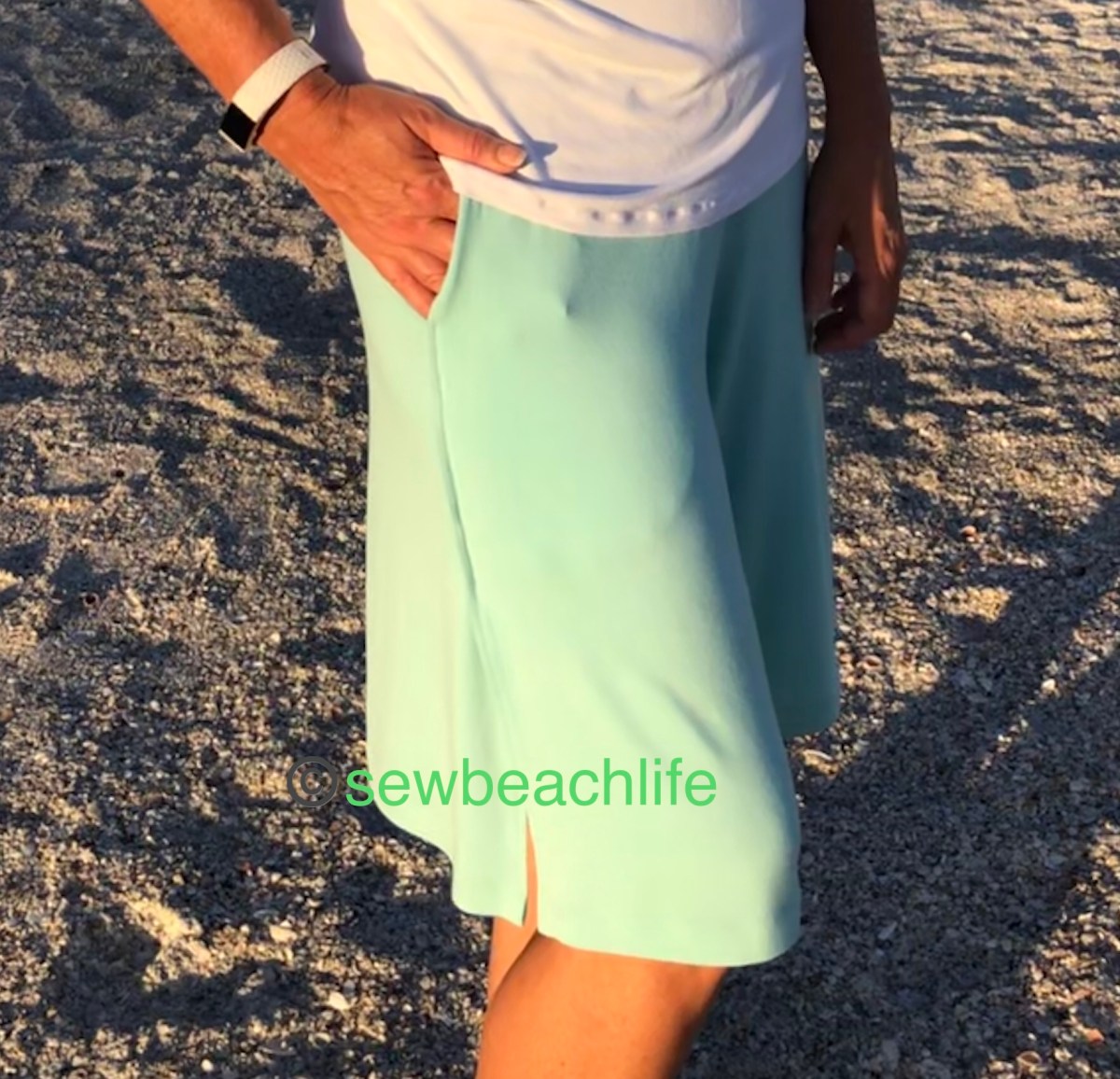
Of course I had to twirl around in them because that’s what you do when wearing comfortable flowy bottoms!  I love that you can make the slit as high or low as you want.  I haven’t tried tying the bottom in a knot, but I think that might be a cute variation.

Warrior slit

These will be easy to throw on over a swimsuit when going to the beach, and are super comfortable for lounging or running errands.  They are a bit dressier than regular shorts, so they’d be appropriate when you want to be comfortable but need something a little bit more “put together” looking.  They are a fun addition to your wardrobe, and can easily transition into autumn and early winter, depending upon the length, and the fabric you choose.  The new Phee Fabrics Ribbed Knit, French Terry, and even Supplex would be fun fabrics to try.

*This post may contain affiliate links.  This means that at no extra cost to you, I may receive a small commission if you purchase through my links.  As always, I only give my honest opinion.  After all, it is my blog, which represents me!  Thank you for reading and sharing my love of sewing, patterns, fabric, and playing with patterns. 😉

Titania Tunic Workout Top Hack

From Dressy Tunic To Workout Ready

Whenever I make a cute top, I can’t help but think about how I could make it into a cute workout top!  The Stitch Upon A Time Titania Top & Tunic was the perfect base for a workout top hack.  Since dresses are a year round staple for me, it’s also going to end up as a dress once I add 8 or 9 inches to the tunic length.  The tunic itself turned out quite cute.  I like the flowy body, especially in this silky soft circular knit.  It has the perfect drape for this pattern.  Can you imagine the twirl in a dress length?

Titania frontTitania side.jpg

Can you see my elastic error in these photos?  Instead of following the elastic length cut chart for the armscye, I thought the elastic should be more taught.  Making it 2 inches shorter than recommended gave me puckering and a bit of rolling at the armpits.  I should know by now to trust Jennifer of Stitch Upon A Time’s design and testing and use the recommended length!  The neckband was easy to sew, and despite being a higher neckline than I normally wear, the rounded shape doesn’t cut into my neck or shoulders.  Using the built in shelf bra means not having to worry about wearing a strapless bra, or trying to find a bra with straps that don’t show.  The stylish tunic would look great with skinny jeans or fitted pants like the Goldilegs Jeans, and of course with a slim skirt or shorts.

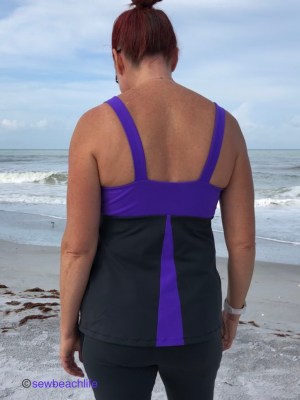
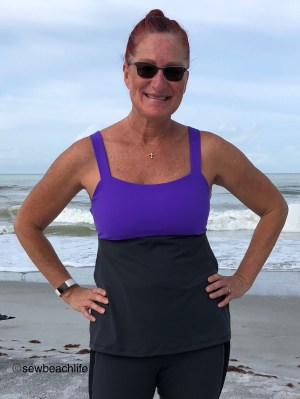
Hacking the shelf bra pieces into a workout top is easier than you think.  Cut two bra fronts out of Supplex.  Rather than cutting the back out on the fold of the fabric, I folded my pattern piece under 5/8″ from the center back, and cut out two left back and two right back pieces.  You’ll also cut a bra front and a right and left back out of powernet or techsheen for support.  For design purposes, I wanted the bra back to have a 2″ strip of powernet down the center, with a little opening between the bra top and the tank body.  I used my favorite tank pattern to make the bodice.  If you don’t have a tank pattern, trace any well fitting tank in your closet.  Don’t forget to add seam allowances!

The trickiest part of this workout top is the V-cutout on the center front.  Lay your clear ruler on an angle, starting 1″ from center front at the top, and down 5-1/2″.  Do the same thing to the second bra front piece, then trim the 3/8″ seam allowance off the second triangle cutout opening.  The trimmed version will become your front lining piece.

Titania cut triTitania triangle cutout

Lay the triangle you cut out of the bra front on your powernet.  Add 3/4″ width to each of the long sides of the triangle as seam allowances.  This gives you the front triangle insert.  Cut a rectangular piece of powernet 2-3/4″ wide, by 2″ shorter than the length of your bra back at center back.  This gives you the back insert.

Baste your powernet/techsheen bra front and backs to the wrong side of your bra lining front and back pieces.  You will treat them as one layer from this point on.  Right sides facing, sew one long side of your triangle insert to the cutout section of your bra front, using a 3/8″ seam allowance.  Snip the center front of the bra down to, but not through the stitching line.  And here’s where I’m going to make it easy to get a perfect V.  With your bra top right side up on a flat surface, fold the seam allowance of the unstitched side of the opening under 3/8″.  Apply Washaway Wonder Tape to the seam allowance.  Making sure that your powernet insert triangle is laying smooth and flat, peel off the backing paper and press the folded under edge of your opening onto the powernet.  You can baste that side into place, or just trust the Wonder Tape to do it’s job.  (Although I am a big believer in basting, I trusted the Wonder Tape and it held fine until I was ready to topstitch all my layers.)

Right sides together, and lined up at the top edge, sew the rectangular powernet insert to one side of the bra back.  Line the insert up with the top of other side of the bra back and stitch, using 3/8″ seam allowances.

Titania back net

Sew the front and back bra pieces together at the side seams.  Sew the lining front and back bra pieces together at the side seams.  Note: the pattern calls for 1/2″ seam allowances, so be sure to use this seam allowance on the side seams, even though I use 3/8″ seam allowances on the rest of this hack.  Fold the center back edges of the bra lining under 3/8″ and baste.

Titania wrap back

With the bra right side out, and the lining wrong side out, place the bra lining over the bra.  Line up the neck and arm openings, and pin in place.  With right sides together,  stitch along the armscyes and add the elastic in the seam allowances as per the pattern tutorial.  Stitch the front and back necklines leaving openings at the shoulders to add straps.  Cut two pieces of bra strapping 6″ long.  Slide a strap down inside each shoulder opening at the back, and with the end of the strap flush with the opening, stitch the straps in place.  You may want to go over the stitch line twice to ensure that the straps are secure.  Turn the bra right side out.  Ensuring that the triangle insert and cutout opening are properly aligned, top stitch around the triangle.

Titania tri topstitch

Lining up the edges of the back and back lining so that they are even with the rectangle insert, top stitch along the edges.

Titania rect top

Now you can try on the bra, and adjust the length of the straps to fit.  You may end up cutting a couple of inches off, but you need long enough peices to work with!  Slide the ends of the straps down into the openings at the front shoulders, turn the top wrong sides out, and stitch the straps in place at the front shoulders.

Sew your tank front and back bodice pieces together.  Then slide the bra down inside the tank with right sides together, and matching center points on the front and back, stitch.  Using the measurement in the cut chart, wrap a piece of elastic around your underbust to check for fit.  I used 1-1/4″ wide sport elastic, rather than the recommended width.  Use whatever width of elastic that works for you, or that you happen to have on hand.  The elastic should fit snugly, but not uncomfortably.  Overlap the ends and stitch together.  Mark quarter points on your elastic, and at the seam allowance, and pin together at those 4 points.  Stretching the elastic to fit, zig zag it in place.  Turn the hem of your workout top under 3/4″ and use a zig zag, twin needle or coverstitch machine to finish.

Smile, and go for a walk or run, or hit the gym or yoga studio in your fun new workout top!

Titania workout back

I bought all of my fabric, the Circular Knit, Supplex, Powernet, and Techsheen from Phee Fabrics, along with the clear elastic and bra strapping.  The consistently high quality makes and keeps me a repeat shopper!


*This post may contain affiliate links.  This means that at no extra cost to you, I may receive a small commission if you purchase through my links.  As always, I only give my honest opinion.  After all, it is my blog, which represents me!  Thank you for reading and sharing my love of sewing, patterns, fabric, and pattern hacking. 😉


The V&A Mary Quant Style Minidress

I’ve never had the opportunity to visit the Victoria & Albert Museum, as I’ve never been to England.  A visit to any museum of art and design sounds fabulous!  I spent hours and hours wandering through the Chicago Art Institute about 10 years ago and would gladly visit again.  Being able to stand mere feet from priceless Monet’s and other treasures is fascinating.

A post on one of the Facebook sewing groups I belong to noted that as part of a Mary Quant exhibit at the V&A, there was a free Mary Quant Style Minidress pattern and tutorial available, designed by Alice & Co Patterns.  A-line dresses are a generally flattering look, so I thought I would give it a try.  The pattern includes plenty of options, so you can personalize it to suit you.  A keyhole neckline or zip front; a rounded or pointed collar, or necktie; curved or angled pockets; and sleeveless, or fluted or gathered sleeves.

It’s warm pretty much year round where I live, so I went with sleeveless, and adapted the front to be a slight V, rather than zip.  The angled pockets are a unique look, and more than large enough to hold my phone.  Taking care to line up the stripes on the pocket pieces with the stripes on the dress paid off.  The pockets are nearly invisible!

VAMQ pocket

My measurements fell between two sizes, so I printed the larger size, knowing that I could take it in as needed.  I definitely should have gone with the smaller size.  Even using extra large seam allowances wasn’t enough to make it fit.  Putting the dress on inside out and pinning and sewing the excess fabric gave me a much better fit.  And tracing the change onto the pattern gave me a reference for next time.  Since I have long arms, lowering the pocket placement 2″ worked out best for ease of use.

VAMQ pattern

I was pleasantly surprised that I didn’t need to lower the bust dart.  I was unsurprised that I had to make the same shoulder adjustments as I did when using The Tunic Bible pattern.  Namely, narrowing the shoulders in the front and changing the angle from the top of the shoulders slightly in the back.  Using a smaller size would have helped, but I still think I would have needed to adjust.

The pattern includes an all-in-one neck and armhole facing when making the sleeveless version.  It gives a clean finish, and you get to practice your burrito roll.  Since the fabric I used frayed terribly, I was glad that I had taken such large seam allowances.  It meant that I could trim off the frayed edges, and wrap them in bias tape.  This gave me a clean finish, and kept the fabric from fraying further.  A wider bias tape probably would have been easier, but I just used what I had on hand.

VAMQ frayedVAMQ biasVAMQ bias wrap

The fabric is an unknown blend, probably some combination of polyester and cotton, that my Mom gave me when she was clearing out her house.  It was quite old, since the tag that had been stapled to the selvage was from a store that hasn’t been around in 30 years! 🙂  The fabric is rather stiff, and had probably been purchased to make curtains, rather than a dress.  Whatever!  It was on hand and it worked.  And I think it suits the style of the dress just fine!

VAMQ back

It’s a fun dress pattern, and will give you a chance to use up some of the woven fabric in your stash.  Happy sewing!