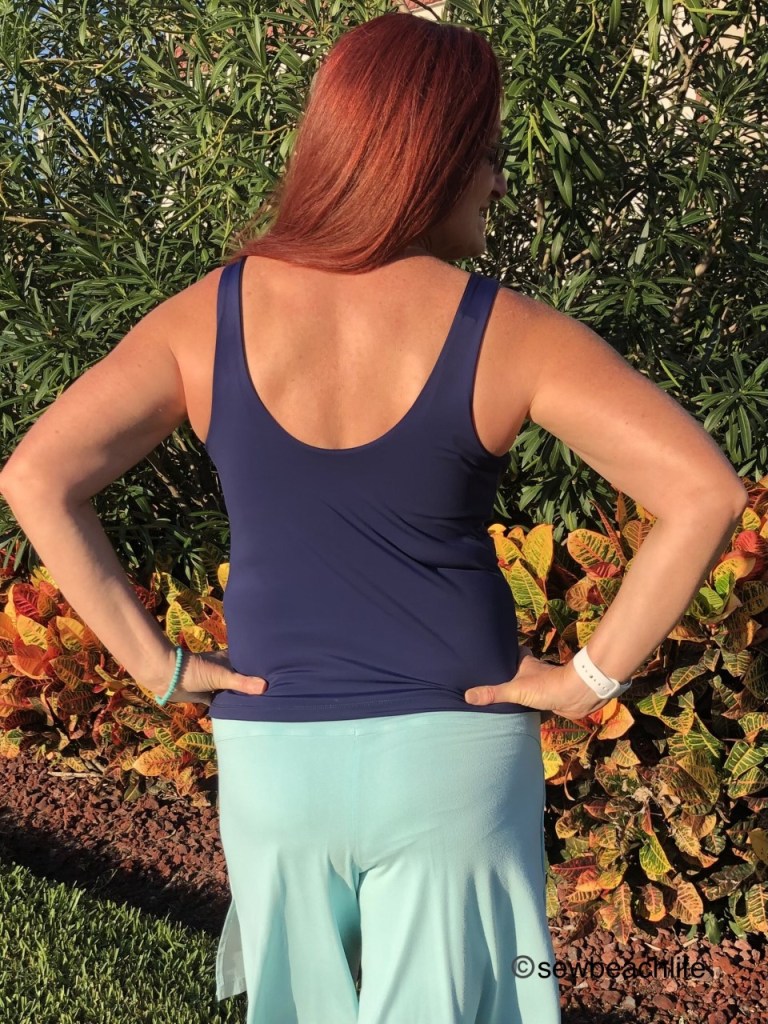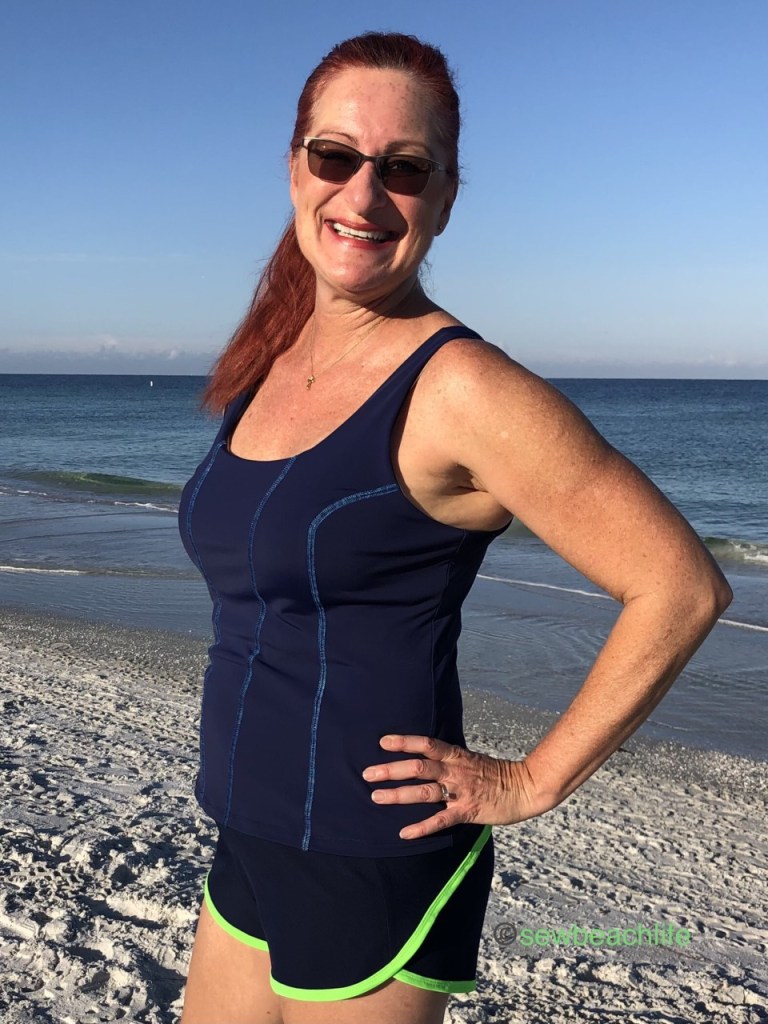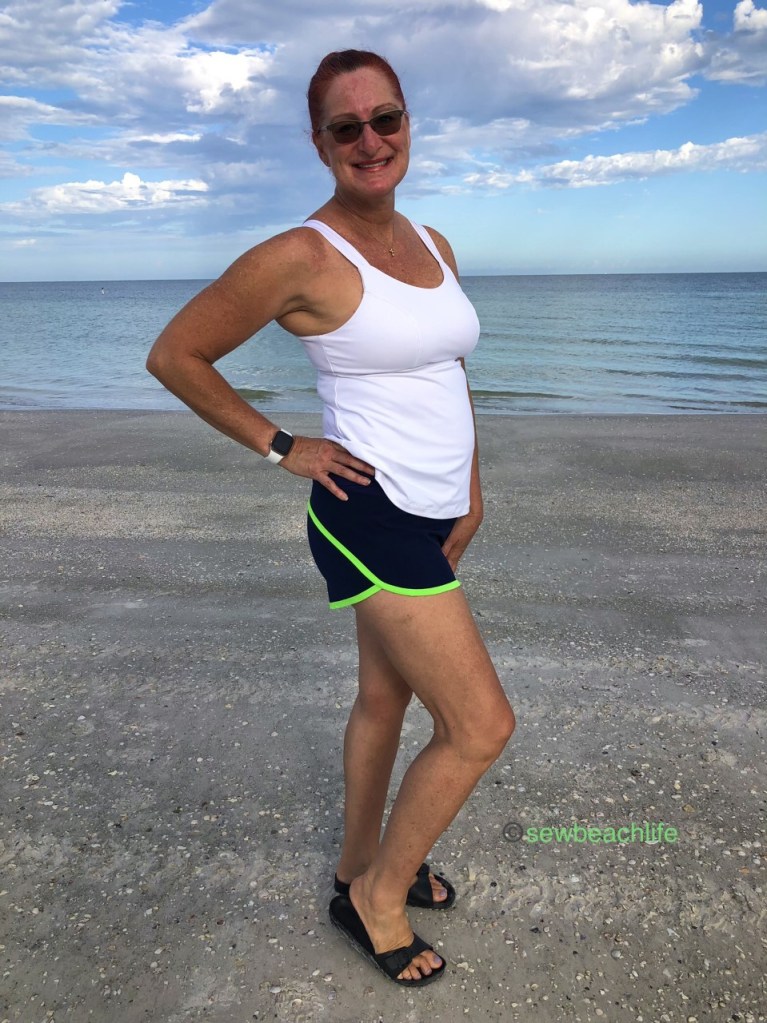
The GreenStyle Leeward Tee (and tank!)

When you live in Florida, tank tops can be worn pretty much year round. If you get chilly, you can always throw on a cardigan. In the southern half of the state, a tee shirt is great for the two or three weeks of chilly “winter” weather we may get. A pattern that includes both a tank top and tee shirt is very useful, and the cute new Leeward Tee is one I was excited to test!

Options range from crew, (medium) tank, or scoop necklines; with a plain or pleated yoke back; crop or full length; racerback or tank; and tees with cap, short, long, or colorblocked sleeves; a 2″ FBA front option; and slimmer or fuller cut lines. I love patterns with plenty of options because I can make so many different looks with just one pattern!

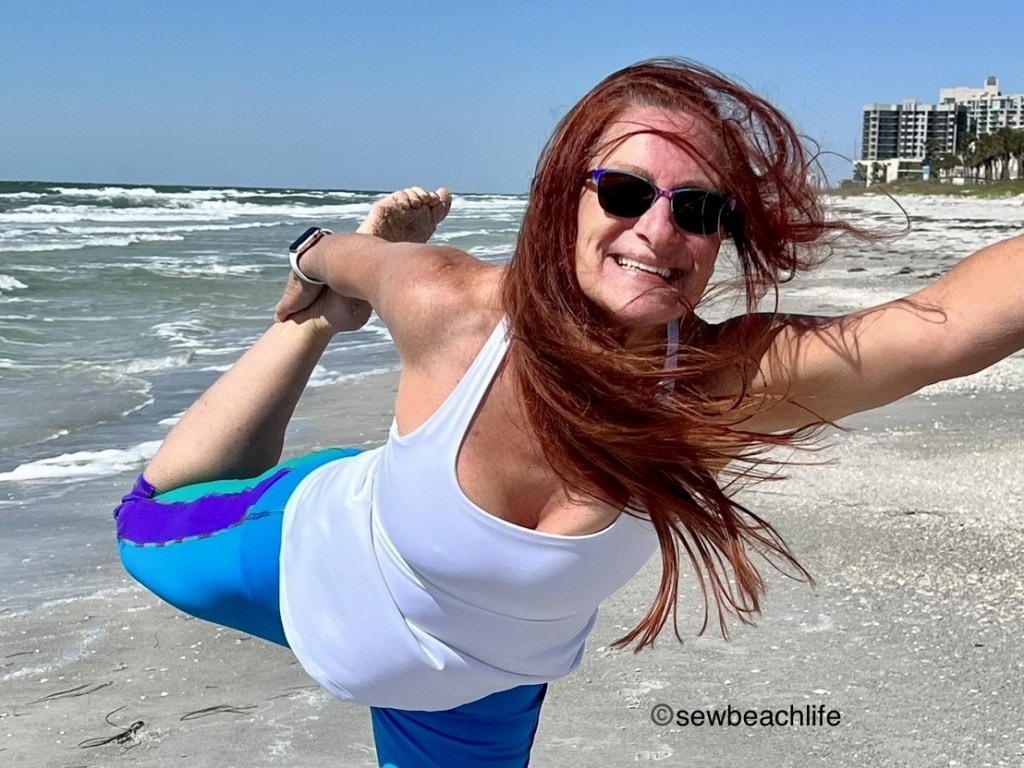
Super windy days on the beach make it challenging to to get photos!

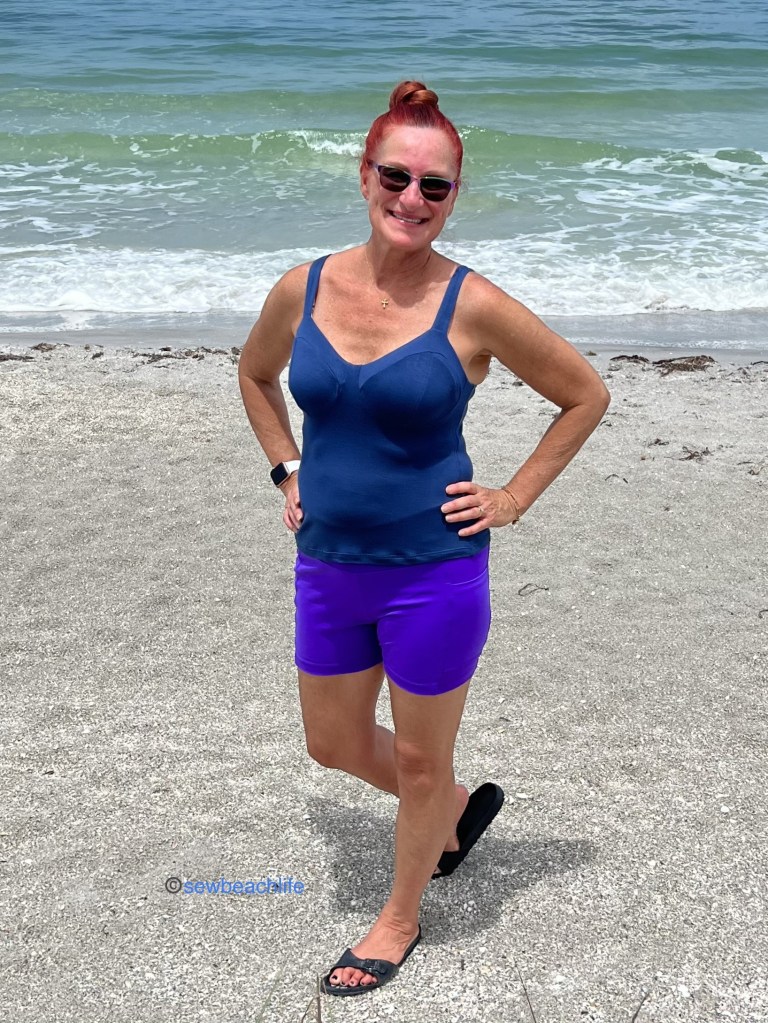
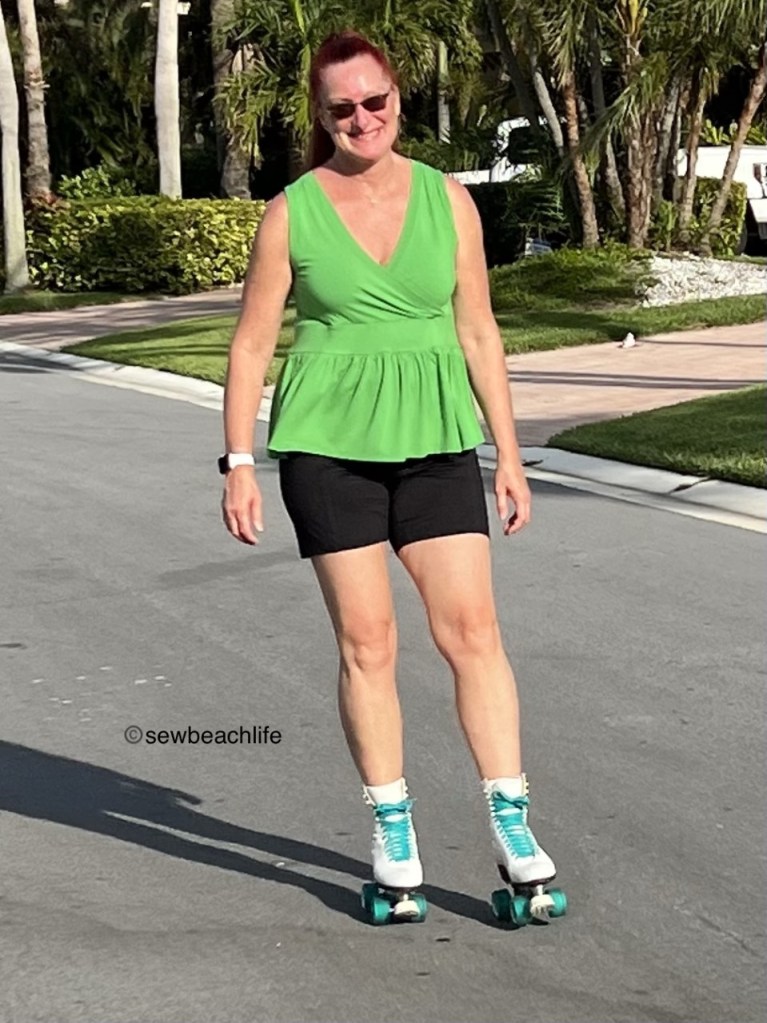
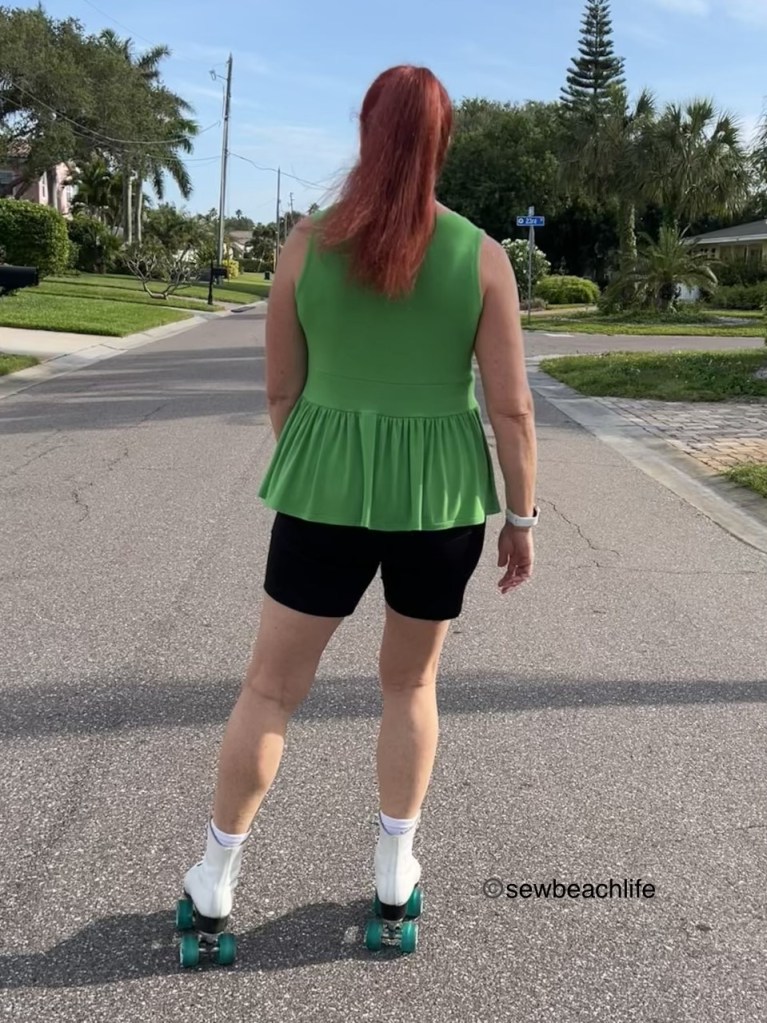
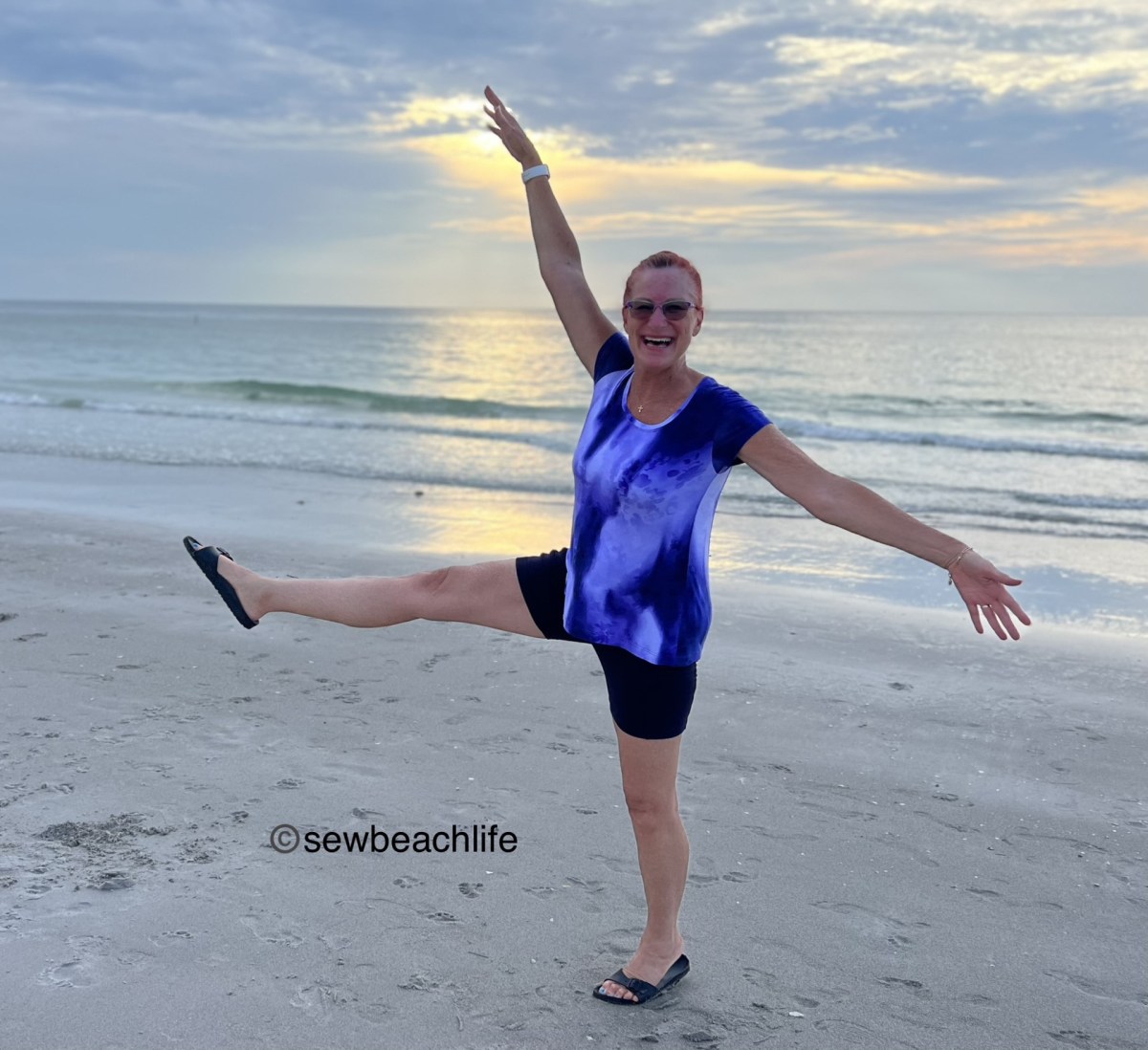
I started with a scoop neck, plain back tank in the fuller cut (which was the only width option when the test started) making a size E graded out to F at the hips. The fabric is a fun ombre striped panel that I bought from Mood Fabrics a while back. I hadn’t used the panel because it wasn’t very long and I hadn’t found a good pattern to fit on the limited length. The pattern pieces barely fit on the panel, and in fact, I had to piece the neckband together to make it work! But I love the ombre effect, and the fact that it matches my purple Moxi bike shorts so well. 😉

Angelyn, the main pattern designer at GreenStyle looked over the pattern testers fit photos and made some slight changes in the shape and especially to the fit of the back. She also listened to feedback and added a slimmer cut line option to go with the fuller, flowier fit. I love testing for designers that listen to feedback from testers, and work hard to perfect the fit on a wide range of body shapes and sizes.

Does this mean that testers have to print a new version of the pattern and make another garment? Of course. But that is the whole point of testing, to get a great look and a great fit that people really like!

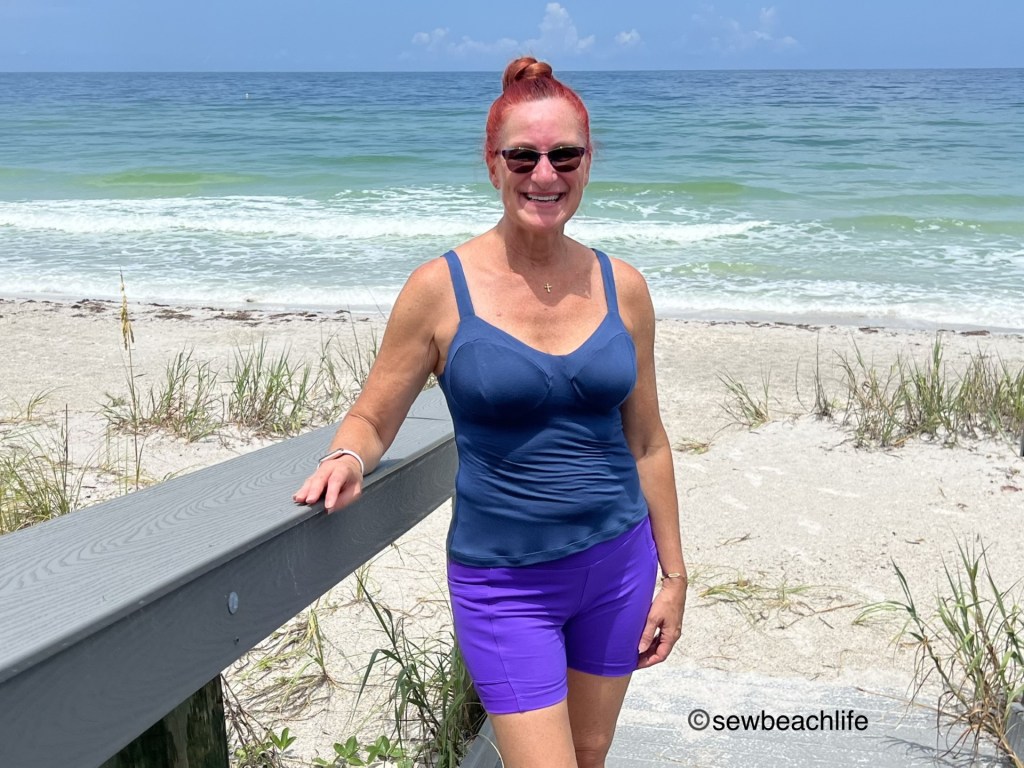
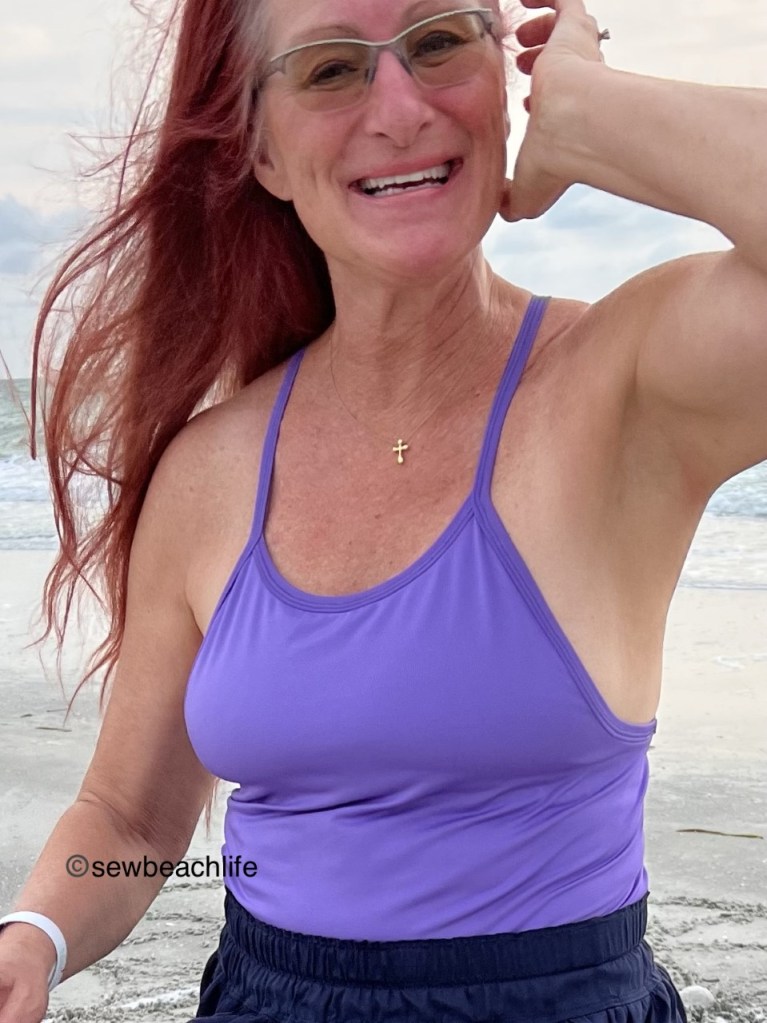
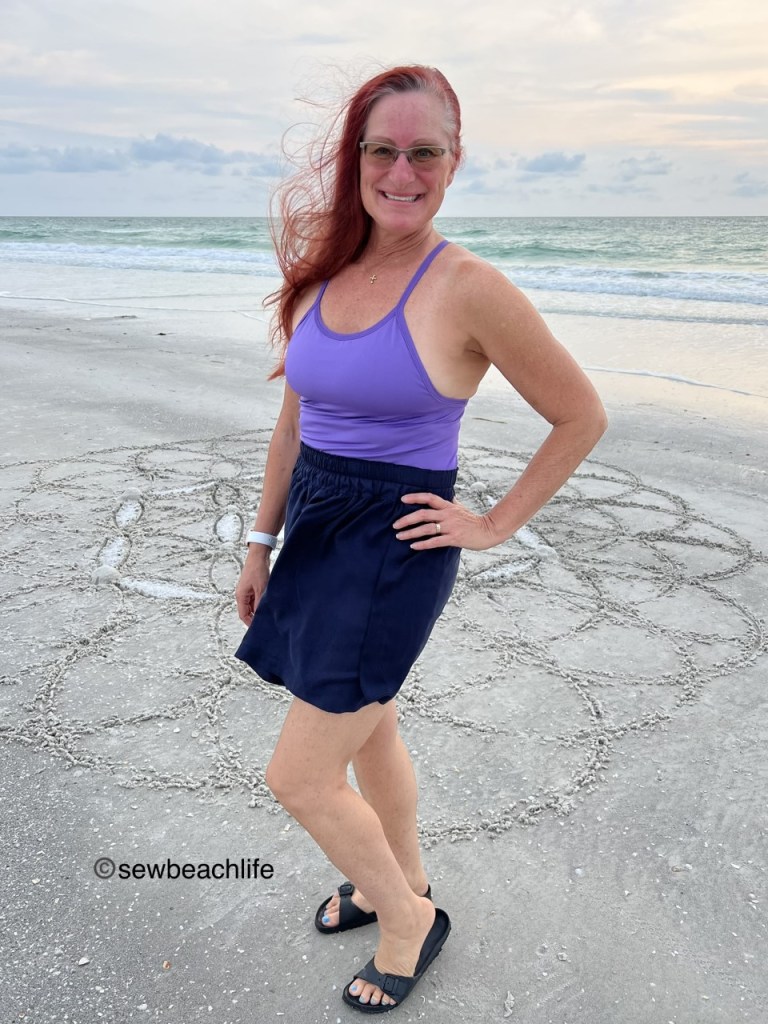
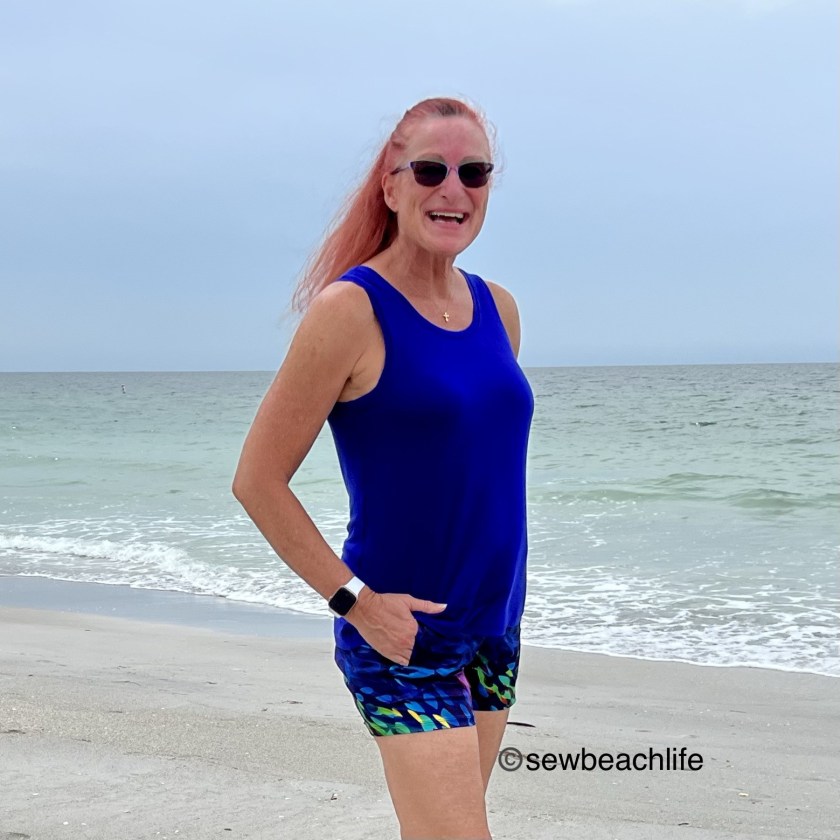
For my second make I stuck with a plain back scoop neck tank, but chose the slimmer cut line. Once again the shoulders are a size E, but with my fuller bust (but not quite full enough for the 2″ FBA option) I started on the fuller cut line under the arm for the needed bust space, merging to meet the slimmer cut line, and finally grading out at the hip to a size G. My hip measurement is on the edge between sizes F and G, so my grading was very subtle, and only ended up on the size G line at the very bottom 2″ or so of the pattern.

The slimmer cut line keeps the tank or top fitted at the bust, and slightly flowy through the waist and hips.

It’s fun/scary to try new sources for fabric, especially if you’re a bit of a fabric snob like me! 🙂 I’m super picky about fabric because I make clothing to last and wear for years. I strongly dislike the feel and lack of breathability of polyester. So I tend to stick to the same 4 or 5 fabric companies that I always shop or order from because of their high quality of fabric and fabric options. After seeing quite a few positive comments about Purple Seamstress Fabric in multiple sewing groups for years, I finally gave them a try and ordered their modal fabric. It’s a blend of rayon, modal, and spandex, and has the feel, drape, and nice rebound of a high quality rayon/spandex. This bright blue color is rich and beautiful, and I will definitely order from them again.

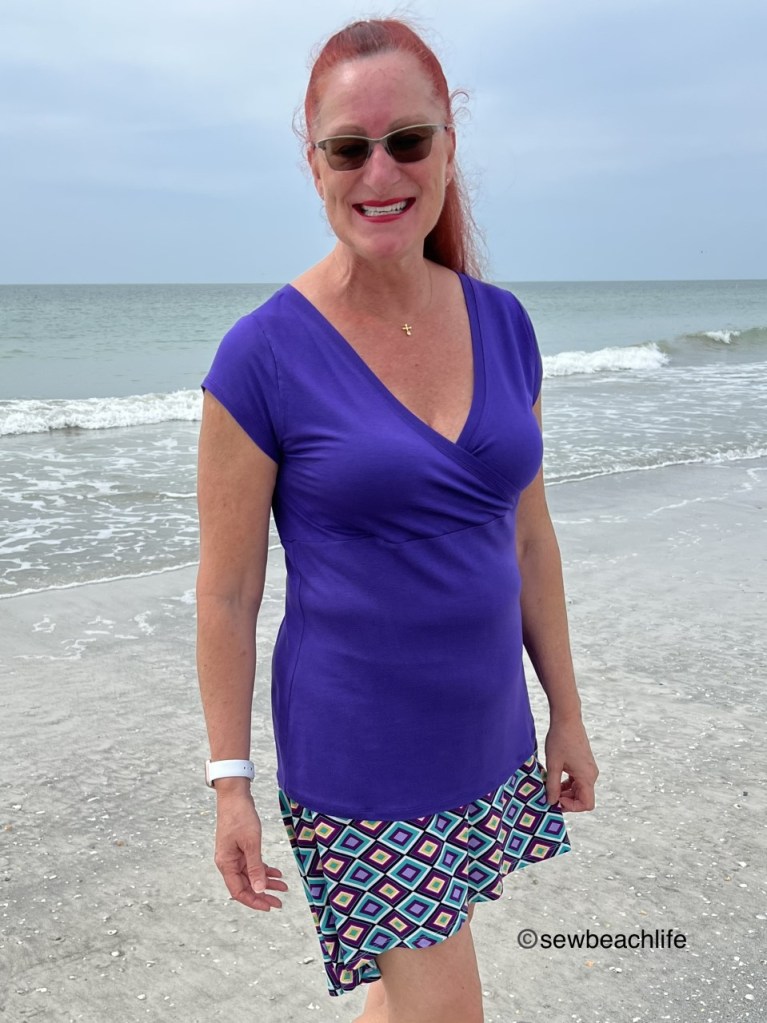
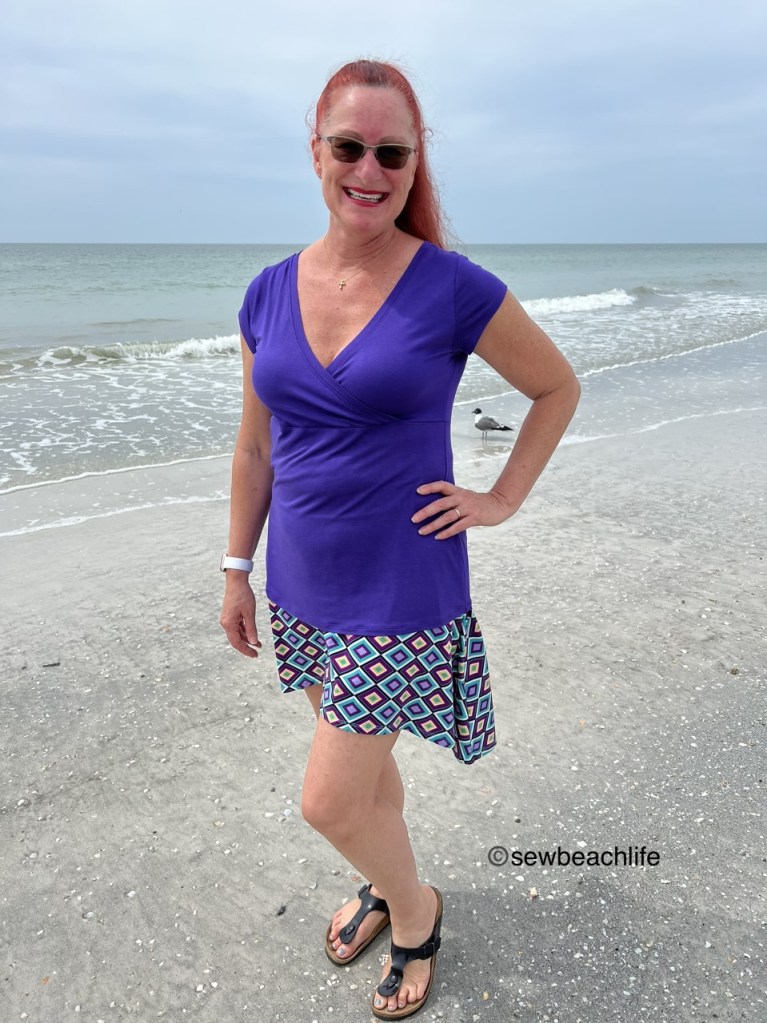
A couple of testers (me being one of them! :-)) asked for a cap sleeve length for the tee. Cap sleeves just look so much more feminine than regular short sleeves to me, and are much more wearable in Florida heat. So my third make is a cap sleeve tee, with a scoop neck and plain back.

It’s super comfortable, and will look just as good when I wear it with leggings as it does with shorts. We’re heading up to Tennessee to visit our daughter, son-in-law, and granddaughters in a couple of weeks. Their autumn weather is going to be a lot cooler than Florida’s, so tees are going to be necessary!

This is a super soft rayon spandex print from Mood Fabrics. It has even more drape than the rayon spandex striped print and the solid blue modal that I used for my tanks. This is the tee I’ll throw on when I’m a little chilly and just want to feel nice and cozy. It also shows just how different the same basic style can look and fit depending upon the fabric you choose.
You can’t go wrong whether you choose to make a tank or a tee! The GreenStyle Leeward Tee pattern has so many options to choose from, you can make yourself a dozen and easily have a dozen different looks, especially when you play with both the slimmer and fuller cut lines.

So, what are you waiting for? Don’t you need some pretty new tees and tanks in your wardrobe? In my world it’s always time to sew something new for yourself or someone you love.

Here are the details on my GreenStyle Leeward Tee and tanks:

The fuller cut tank was made using an ombre striped rayon spandex panel from Mood Fabrics. I’m wearing it with the bike shorts from the Moxi Shorts pattern made in supplex from Phee Fabrics.

The slimmer cut blue tank is made of modal from Purple Seamstress Fabric. I’m wearing it with an as yet unreleased shorts pattern. Don’t you love getting a sneak peek at future patterns? 😉

The cap sleeve tee is made of rayon spandex from Mood Fabrics, and is worn with Moxi bike shorts made of supplex from Phee Fabrics.

Thank you for reading and sharing my love of patterns, sewing, fabric, and creating practical, useful garments! ❤

The links to GreenStyle may be affiliate links (if I did them properly!) which means that I may earn a few pennies if you use my links without it costing you anything extra. Since this is my blog and represents me, I always give my honest opinion about any patterns, fabric, thread or supplies that I talk about. I don’t even bother to use aff links when I share on social media, so obviously it’s not a big deal to me whether you choose to use them. I do like knowing whether the time I spend writing posts actually interests people enough that they take a look at the patterns I review, but I write for me. It’s one more creative pursuit that I hope is helpful or interesting to others. I’m writing to share my love of sewing, not to make money! 🙂
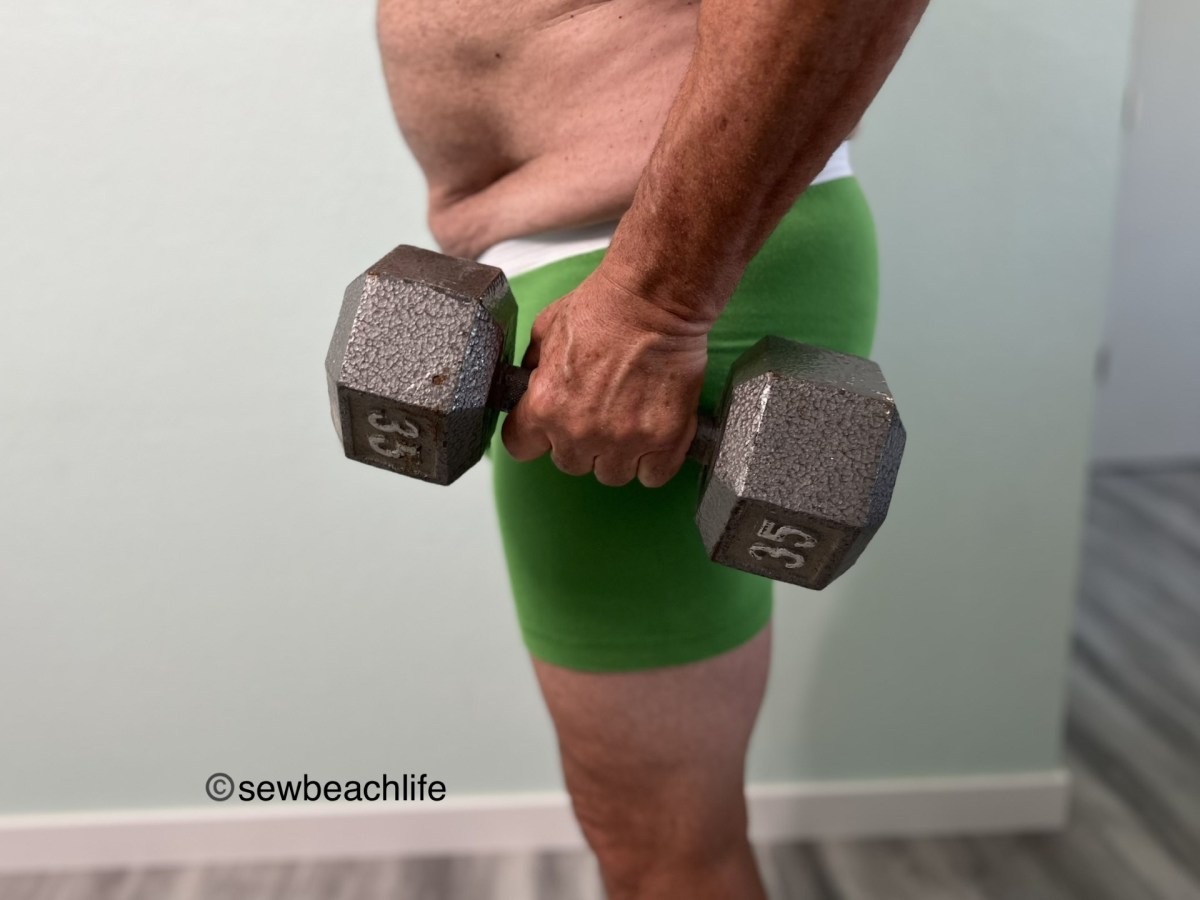
Sewing For Men: Boxer Briefs Edition

My husband is very supportive of my sewing, whether it be tolerating patterns and fabric spread across the dining table 🙂 or the time I spend in front of my machines. So the man definitely deserves some of my sewing love!

I was able to test the Ragamuffin Patterns Men’s Boxer Briefs and added quite a few pair to my husbands underwear wardrobe. My husband is easy going and relatively easy to please when it comes to gym shorts and workout shirts, (which is his normal daily outfit other than dress clothes for Mass on Sunday). But he is quite particular about comfortable and supportive underwear. I don’t blame him, because who would want to wear underwear that doesn’t fit properly? This made him a perfect candidate for pattern testing the Boxer Briefs!

That may sound weird, but truly, the whole point of testing a pattern is to perfect the fit, ensure that it’s comfortable across a range of sizes, offers enough style options to be appealing, and that the tutorial makes sense to sewists from beginner to advanced. So pattern testers need to be able to articulate what they like (or dislike), how it fits, and what could make it better.

I’ve tested enough patterns to understand the importance of clearly communicating with a designer. But it’s a little different when you aren’t testing the pattern on yourself. Luckily my husband was patient enough to try on multiple versions and explain what he liked and what changes or tweaks to the pattern he would prefer.

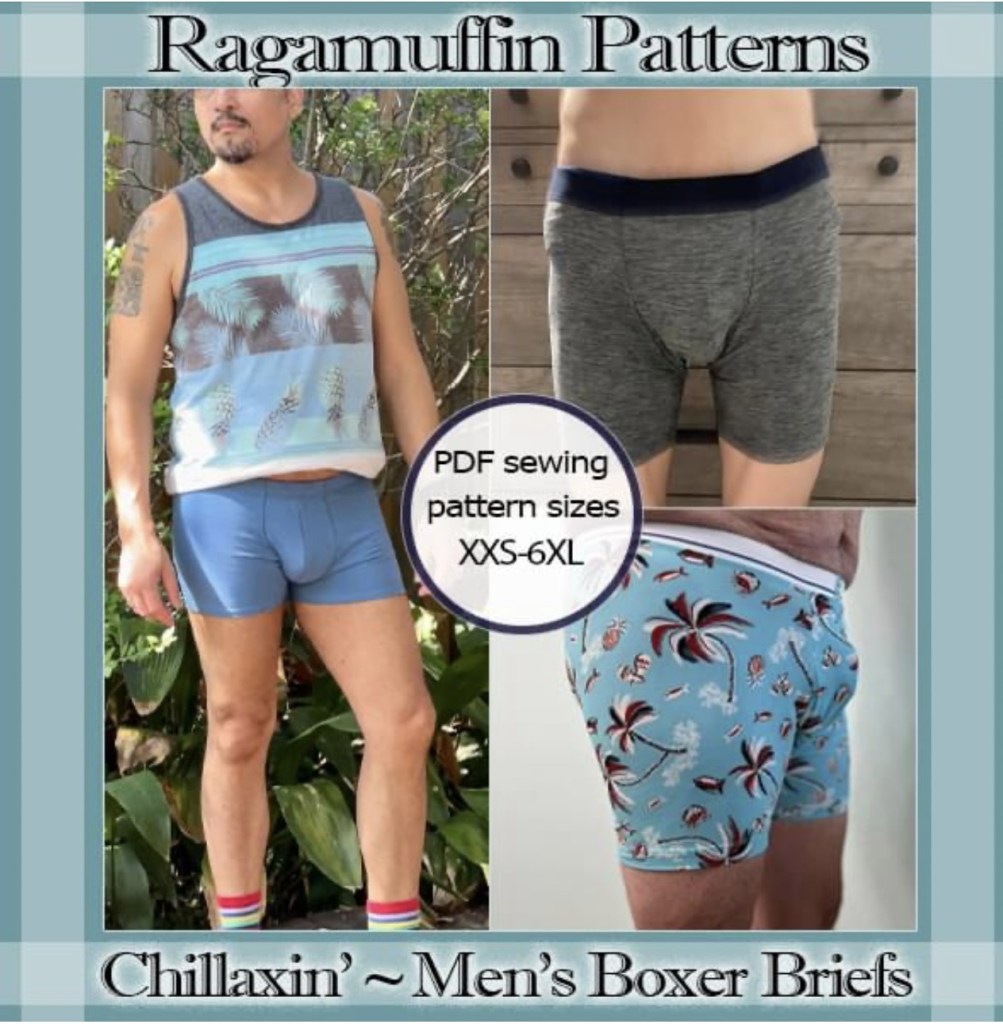
The Men’s Boxer Briefs pattern is loaded with options (in sizes XXS to 6XL) with four lengths from undies to thigh length; no fly; classic fly; and contoured fly with no, side, or horizontal opening; band, exposed, or hidden elastic waistband; leg finish options; and an optional internal hammock.

Long a fan of expensive Saxx and Tommy John underwear, my husbands preferred style was easy to pin down: briefs length (though he’ll wear trunks length), and horizontal contoured fly with an internal hammock.

He says the no back seam is very comfortable, although there is a back gusset option if you like color-blocking or want to use smaller scraps of fabric.

I’ve made side fly underwear for him before, but this was the first time I’ve sewn horizontal flys. Frankly, I think a horizontal fly is an easier sew. You still have that contoured pouch seam to stitch, but really, they are a pretty quick sewing project.

These aren’t the final version of the pattern so the fit has been refined a bit, but they are still always in rotation, and my label addition just cracks me up!

He loves his made with love underwear, and wears them as much as (if not more than!) his name brand ready-to-wear ones. As he’s a bit of a gym rat, he says that the internal hammock is important to “keep everything high and tight” for comfort during workouts.

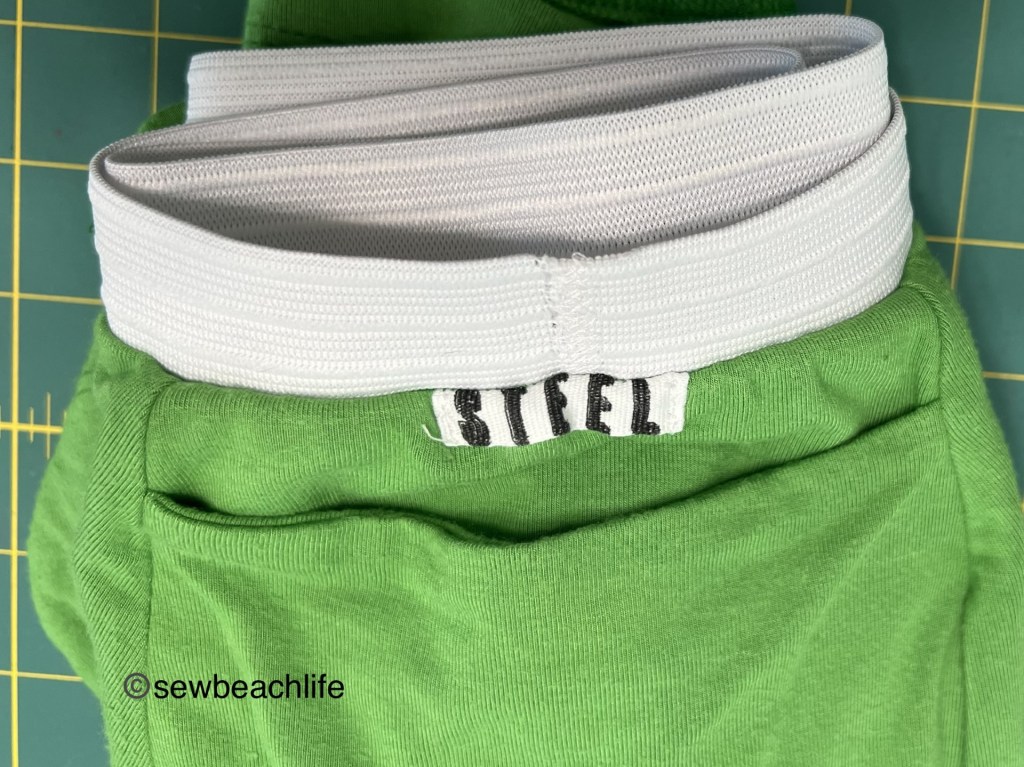
I like adding a personal touch to my makes, and used two different methods to do so. On the green pair, I added a little label centered at the top of the pouch and serged into the waistband. I like saving interesting selvedge pieces if I think they are cute or funny or may be useful for something. Knowing that I had a piece of selvedge that had the word steel on it, I thought it would be fun to use on my husbands underwear. Because hey, what guy doesn’t want to be a man of steel, right? 😉 It’s literally just folded under twice on the sides to hem the edges. The bottom is the finished edge of the fabric, and the top was serged in place when attaching the elastic for the waistband.

A fun tag adds personality!

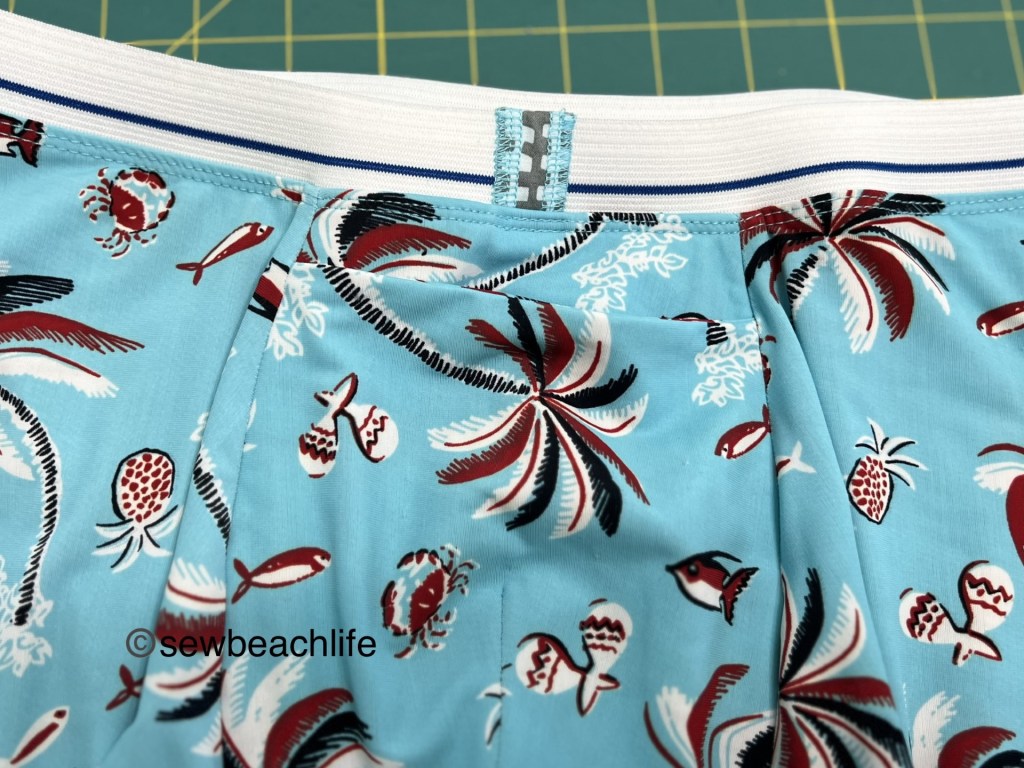
I also like giving a finished look to elastic waistbands by making a decorative seam cover. Simply cut a rectangle of fabric 1″ wide by two times the width of the elastic you are using (plus 1/4″ to give you some wiggle room). My underwear elastic was 1-1/4″ wide so I cut a piece of pretty fabric 1″w x 2-3/4″h using my rotary cutter and a ruler, to ensure that I stayed straight on the grain. Use a 4 thread overlock to serge the two long edges of the rectangle to keep it from fraying. I like overlapping elastic by 1/2″ and zigzagging all around the overlap when using elastic for waistbands. Then center the seam cover over the elastic join, pulling the raw ends to the bottom edge and pinning in place. Finish the seam cover by zigzagging the two long sides. The raw edges of the fabric will be enclosed in the seam when you attach the elastic waistband.

A pretty and practical seam cover.

When I was ordering fabric to make his underwear, I showed him the Patriotic Island Swim print from Ragamuffin Fabric and he thought it looked cool. When I pulled the freshly washed fabric out of the dryer to show him, he felt it and said, “Oh that’s too nice to use for underwear!” 🙂 Baby, you deserve nice fabric. And nice custom made underwear!

After all, he is a pattern cover model!

The details: using the coupon code SewBeachLife will give you 5% off your entire purchase of Ragamuffin patterns and/or fabric and supplies! The coupon code is sort of an affiliate link, and I’ll earn a few pennies if you use it.

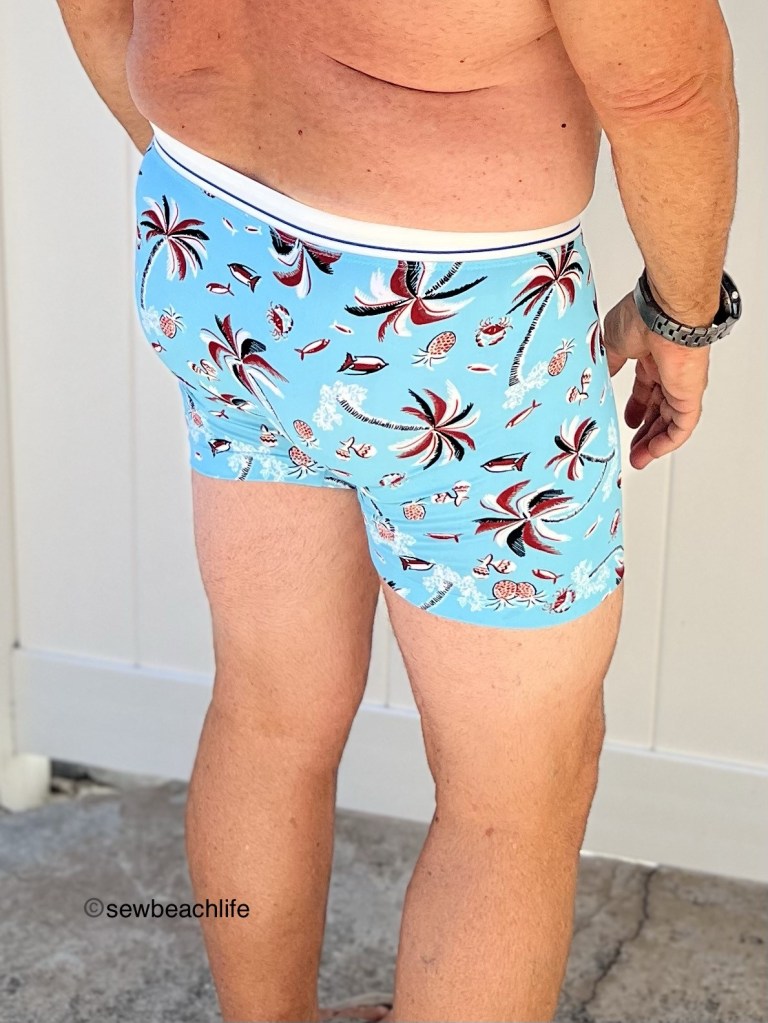
I only took photos of two pairs of the Ragamuffin Patterns Chillaxin’ Men’s Boxer Briefs made.

The green pair are rayon spandex from Phee Fabrics with 1″ wide knit elastic from Wawak for the waistband.

The printed nylon spandex swim fabric and 1-1/4″ wide knit underwear elastic are from Ragamuffin Fabrics.

He loves them so much that I took apart an earlier test version made in this fabric and cut the updated pattern pieces out of my fabric scraps and sewed him up a second pair in the exact same fabric! Which I guess tells you that they are an economical sew, since I was able to make two pairs in size 2XL out of one yard of fabric.

I received the pattern for free in exchange for testing, but feel that it is well worth buying as it has so many options and an extensive size range. The test was a long one, but totally worth it for the final product!

Thank you for reading and sharing my love of patterns, sewing, creating, serging, fabric, and making practical, useful garments! ❤

The Briny Swim Top

And a photo session with my daughter!

The timing of the new GreenStyle Briny Swim Top pattern test worked out perfectly with a scheduled trip to our daughter and son-in-law’s home. I make matching clothes for my granddaughters all the time, and they love it. They frequently ask to wear their matching dresses, tops, shorts, etc. But I very rarely get to match with my daughter because she lives so far away.

As soon as I saw the tester call, I sent a photo of the line drawing to my daughter and asked her if she wanted a cute new swim top. I knew that it was a style that she would look great in, and she loved the look. So matching swim tops it was!

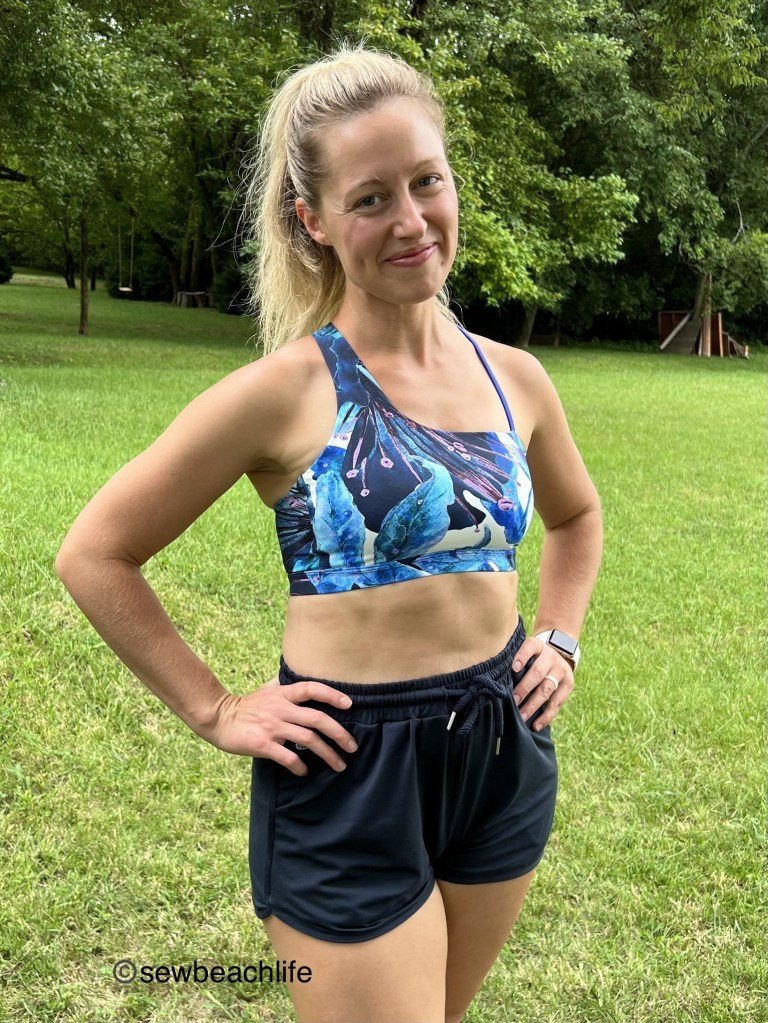
My daughter is a smaller size than me, and has a smaller cup size, and the size D fits her perfectly! She chose to have the optional skinny strap, and thought that the bright blue nylon/spandex swim that I used as the lining fabric would be a cute contrast against the GreenStyle Align 2 Paradise print main fabric.

Isn’t she a beauty? Let me tell you, her inner beauty far outshines the outer. I am so blessed to have her as a daughter!

The crossed straps in the back highlights the fun contrast of the solid against the print, and the narrow versus wide fixed strap even better.

It’s such a cute pattern! Very on trend, and looks cute whether worn with swim bottoms or shorts. It’s so comfortable that she didn’t take it off after photos, and wore it for the rest of the day. She threw a white sheer mesh top over it, slid on a pair of pants, and wore it out for date night that evening. I should have grabbed a photo of her, but I was trying to give the girls their baths and ready for bed so that she and her husband could get out the door.

As I have a fuller bust, I made the size E with the darted bust option. Since I knew that I would be sewing while visiting, I had to pack up my serger and fabrics and attempt to sew during quiet times. Let me tell you, when you have very active three and five year old granddaughters who want to play all the time, (well, other than when they are asking for food :-)) there is no quiet time! Hahahahahaha! I don’t know how all you Mama’s with little ones do it.

I took the girls on lots of stroller strolls, visits to the playground and pool, played dress-up, built with magna-tiles, played with stuffies, played pet shop (where the girls pretended to be snow leopards, clouded leopards, cheetahs, pink kitties, puppies, etc. and I would “buy” them as my pets. They were super cheap, sometimes $3, and sometimes $5. It was hilarious! I had to pretend to pay for them (with a beep on the imaginary POS system), and could then open the imaginary cage doors (squeak) and go in and play with whatever animals they were being at the time.)

The darted front (FBA) bodice is the right choice for me size wise. Rather than just relying on compression and a bit of shaping, the dart gives more room, support and shaping for a fuller bust. I’d get even more support from the compression of powernet, which is something that I always use in sports bras, workout and swim tops. However, when packing for our road trip, I neglected to put it in my bag of fabric, notions, thread, and sewing supplies. 😦 whomp, whomp.

It’s such a cute top however, that I’ll likely go through the trouble of seam ripping it, and add a layer of powernet to the wrong side of the main fabric so that I can feel more supported when wearing my Briny as a sports bra for roller skating.

I added the optional strap to mine, and with a heavier bust, I chose to make my strap have a finished width of 5/8″, a little wider than than the pattern calls for. Surprisingly though, I think that if using powernet in the top, I would feel comfortable even without the extra strap. I guess I’ll just have to make another one, and check it out. 😉

I think the top looks great worn with my favorite GreenStyle Moxi Shorts bike shorts (the compression under layer to the loose shorts.)

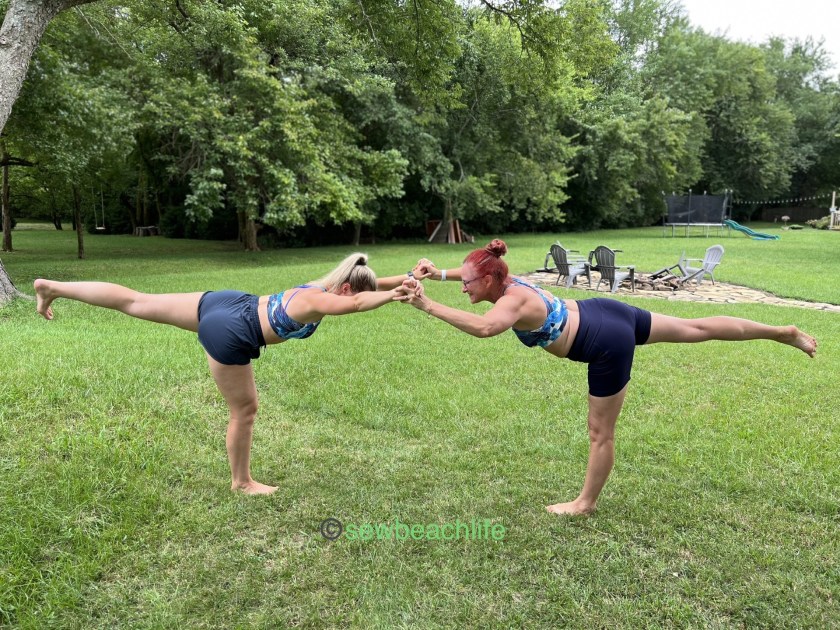
If you ever have the opportunity to make matching clothes with your adult child(ren) and have a photo shoot, I highly recommend that you do it! It’s fun, you get the chance to be awkward and silly posing together, and you’re wrapping your child in a handmade hug. ❤

I swear my leg was higher than this! We only did warrior III because she said she couldn’t do a yoga toe hold. I think she can, especially if we held on to each other. 🙂
Hugging my girl in the cute handmade hug I made for her.

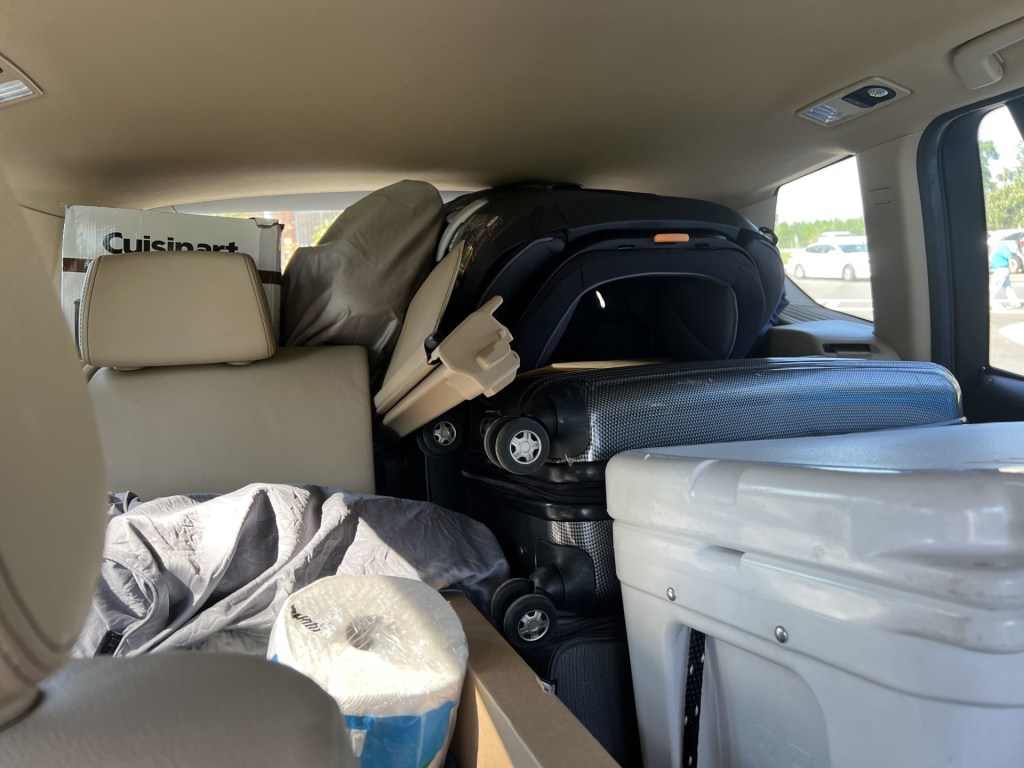
Since I’d never traveled with my sewing before, here are my best tips: pack your serger or sewing machine in it’s original box, so that it can be safely cushioned by the styrofoam and original packing materials. I brought my Babylock Triumph (combination serger and coverstitch machine) with me, and there is no way I would have done it without it being in the original box. Our car was completely full with not only suitcases, our cooler and bin of snacks, our pillows, and a small blanket, but a coffee maker, car seat, and our daughters order from Ikea as she doesn’t have one near her.

It’s a 13 hour drive, so a cooler with water, sliced veggies, and fruit is essential. Especially since I have food allergies, and can’t just stop anywhere and safely eat. My serger was safely tucked in the back, all snug and secure in its box.

Bring all the fabric (double checking that you have powernet if you’re going to need it!), thread in matching colors, elastic, and any sewing notions you may need. You can’t count on whatever local sewing or big box stores to have what you want in stock. Try to have your patterns printed out, and traced in the needed sizes. When you’re doing a pattern test, that’s a little challenging because there is likely going to be an updated version of the pattern before finals. If where you’re staying doesn’t have a printer, check out the local options for printing your patterns. Other than that, just enjoy and go with the flow. Traveling and visiting people you love is fun. And while things may not always work out as planned, enjoy those little moments and memories, and listen for every “Grandma, I love you” and take every snuggle and hug that comes your way.

Thank you for reading and sharing my love of creating, sewing, serging, great patterns, fabric, and making beautiful, well-fitting garments! ❤

The links to Greenstyle may be affiliate links, which means that at no extra cost to you, I may receive a few pennies if you purchase through my link. As always, I only give my honest opinion. After all, it is my blog, which represents me!

The Princess Party Dress

It’s a dress, crop, top, cami, and corset style top all in one

Sometimes a pattern testing call just speaks to you, so you apply and hope to get chosen for testing. I’ve never tested for Ragamuffin Patterns before, and was excited about testing for them. I’ve got to say, Jennifer was super easy to test for. She was very open to all comments on or questions about the pattern pieces, construction, and how everything fit all the testers.

One of the main reasons I was drawn to the Princess Party Dress was the cup size options and the flattering shaping they provide. Whether you have an A or an E (or larger) sewing cup size, having cup shaping that fits your body means you’ll get the most customized and flattering fit.

To ensure proper sizing, testing started with a cami top. My measurements put me in a size Large E cup. I graded out to an XL from waist to hips because I was making the classic length and using rayon/spandex, and didn’t want the back to ride up. Fabric will always choose the path of least resistance, and if it’s too snug across the hips, it will ride up towards a narrower part of the body.

My cup sizing was spot on, and the E cup size fit well.

The cup shaping is so flattering, and the straps are perfectly placed to hide my bra straps. Since I was using a somewhat lighter weight rayon/spandex which doesn’t have as much rebound/recovery as say a nylon spandex swim fabric, I reinforced my straps with elastic.

Obviously I could have done a better job of pressing the hem before taking photos. Yikes! 🙂

Since I knew that the size Large in an E cup fit, I was ready to sew my dress. I contemplated whether to do the princess seaming on the bodice, along with the seamed cups. After a bit of dithering, I decided that with a printed fabric the simple bodice would look best, especially since I planned to accent the cups, straps, and hem with coverstitching in a contrasting color.

I thought that my turquoise coverstitching was quite bold, but it doesn’t look like it in this photo!

One of the best things about sewing your own clothes is that you can adjust things to fit your unique body. For instance, I am longer than average from shoulder to bust point, so I made my straps 14″ long. For being taller than average, I am a bit short-waisted. I tried on my bodice before adding the skirt, and ended up taking 1″ off the bodice in the front, tapering up to 1-1/4″ at the side seams, and up to 1-5/8″ off at center back. I love customizing clothes for a perfect fit, it’s just so satisfying!

Who can resist twirling in a circle skirt? ❤

Since I’m tall, and wanted to ensure that the knee length dress actually ended up at the top of my knees, I cut the waist at my size large, but cut the hem at P2 length, which ended up perfect! It’s long enough for modesty, but short enough to be fun and flirty. Here’s my favorite tip for hemming a circle skirt: serge the raw hem with the differential turned up to 1.5. This will slightly gather the bottom so that when you turn it under to hem, it will lay nice and flat for you.

It’s a perfect summer dress, and I wore it to a party that weekend. The nylon/spandex swim fabric from Ragamuffin Fabrics is breathable, comfortable, and perfect for a fun, swishy dress.

I’m very happy with my new Princess Party Dress. It fits well, it’s a flattering silhouette, and with cup sizing, it lays smoothly over the bust, with no wrinkles or pulling. Yay!

Patterns with plenty of options really make me feel like I’m getting my money’s worth. The Princess Party Dress pattern includes a simple cami, cami with three piece cups (with or without princess seam panels), a lace-up corset style option (with front or back lacing), narrow, wide, or tied straps, cami lengths from crop to classic, and peplum, mini, or knee length skirts for the dress option. Whew! I hope I’m remembering everything.

Sorry for the crooked photo of the graphic of the options. I’m traveling this week, so I’ve got to work with what I’ve got!

I’ve worn the dress and the cami a couple of times now, and am very happy I made them. They are comfortable and cute additions to my wardrobe whether I’m taking my granddaughters for a stroller stroll, attending a party, or walking the beach.

Spellbound By A Summer Dress

A Bra, A Dress, And A Hack To Make A Workout Top

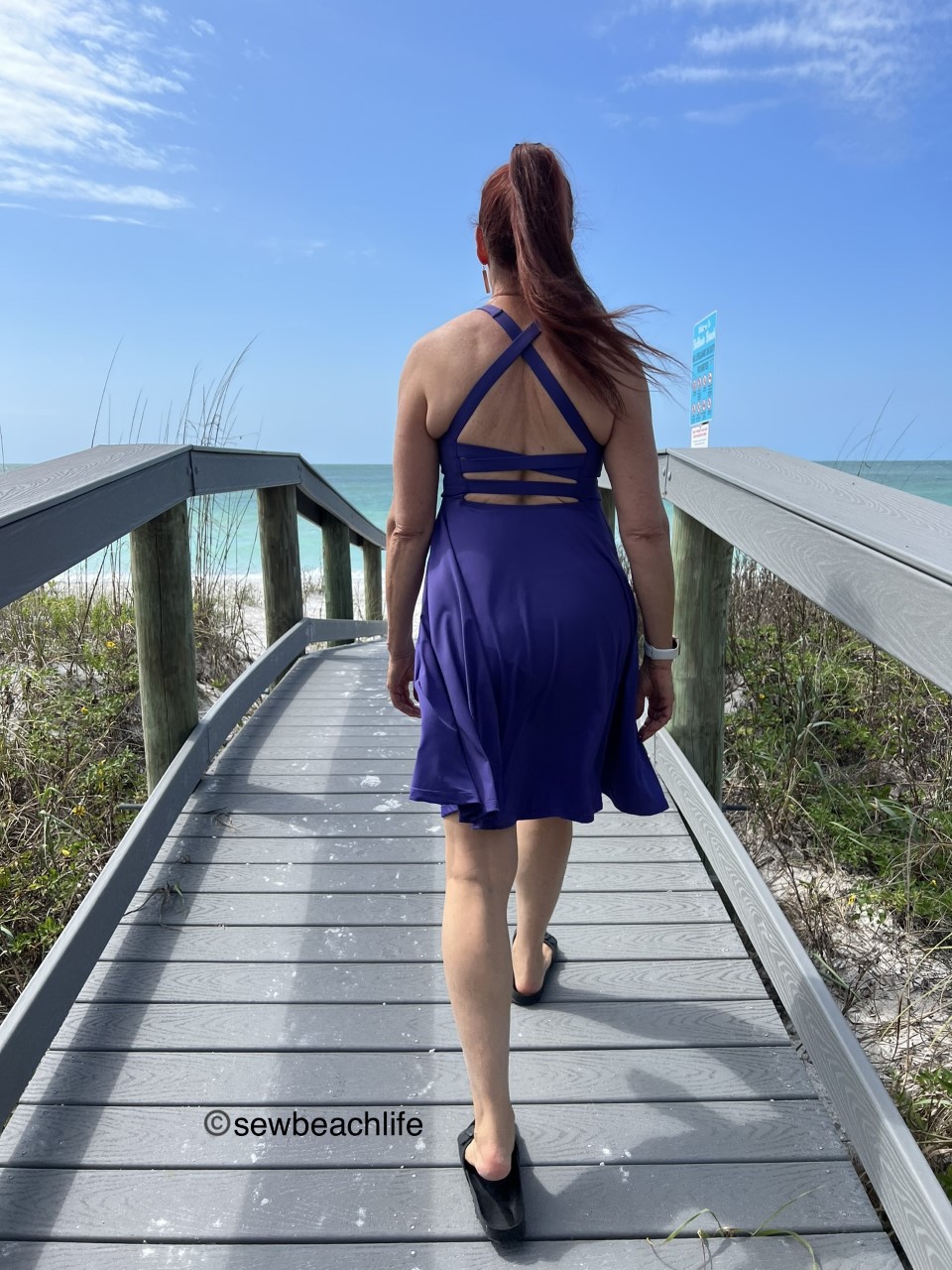
I’m pretty discerning when it comes to pattern testing, and only test when a pattern looks like something that would get a lot of wear. When I saw the tester call for the Stitch Upon A Time Spellbound Bra and Dress, I applied right away. That criss cross back is exactly what I’ve been looking for!

When you’re a bit busty, you’ve got to love a pattern that has cup sizes. Seriously! There don’t seem to be many designers in the .pdf (or paper) pattern world that include multiple cup sizes. Including cup sizes makes a pattern fit so much better. The Spellbound includes sizes XXS to 6X, along with cup sizes A-G (determined by the difference between your full bust and upper bust). Per the measurement chart, I made a size small D cup. The size chart on this is spot on, and did not require any grading. The strap lengths were perfect (which seems amazing to me because obviously there is a lot of math involved to get all five strap pieces the proper length for each size).

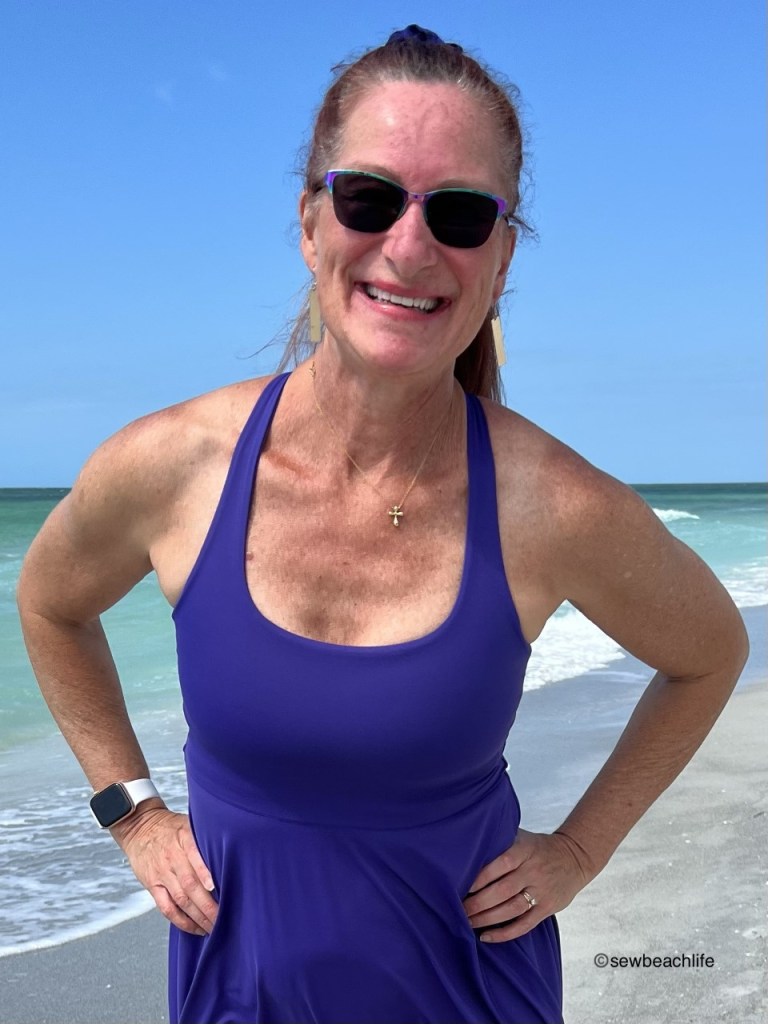
Although it is a shelf bra and relies upon compression, I feel quite comfortable with the amount of support. If you wanted to, I suppose you could add bra cups during construction, but I don’t feel the need to do so. This is coming from a girl whose regular bras have underwires, so that is saying something!

Pretty and supportive!

There are usually changes and updates during testing, which is kind of the point. A designer wants to ensure a great fit on real bodies in a wide range of body shapes and sizes. A higher neckline option was added for anyone that prefers a little more coverage. Another tester and I commented that we wanted to hack the bra into a dress, and Kelly (the designer) made that happen!

Why does it always seem to be windy when I try to take photos of a new make?

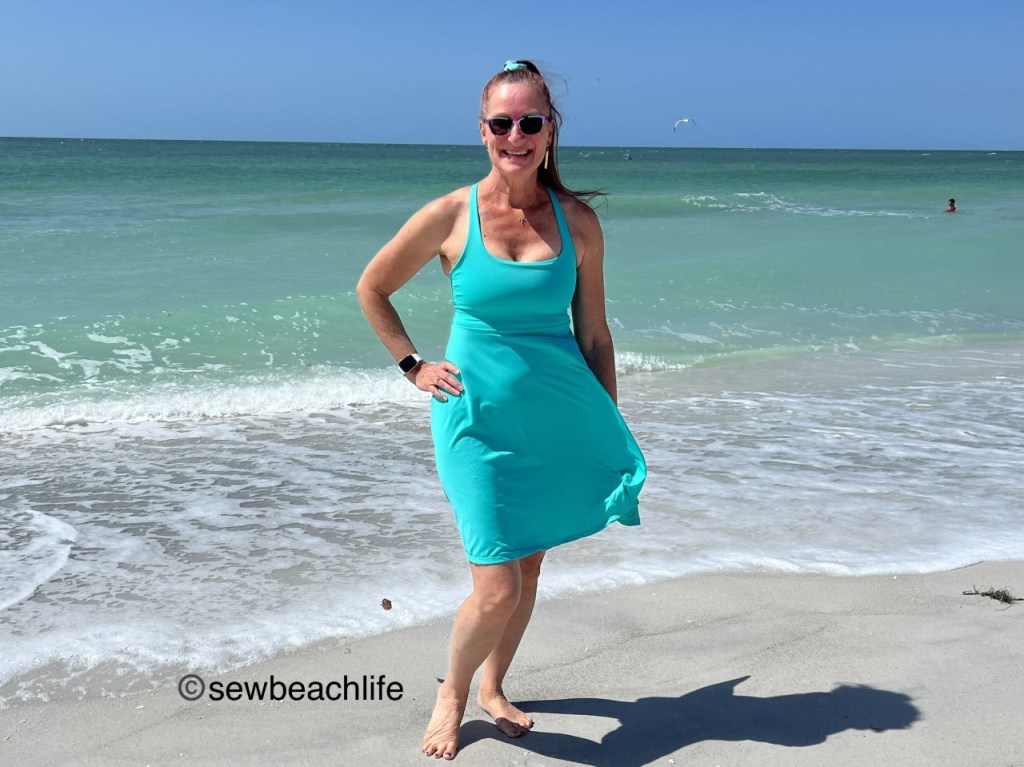
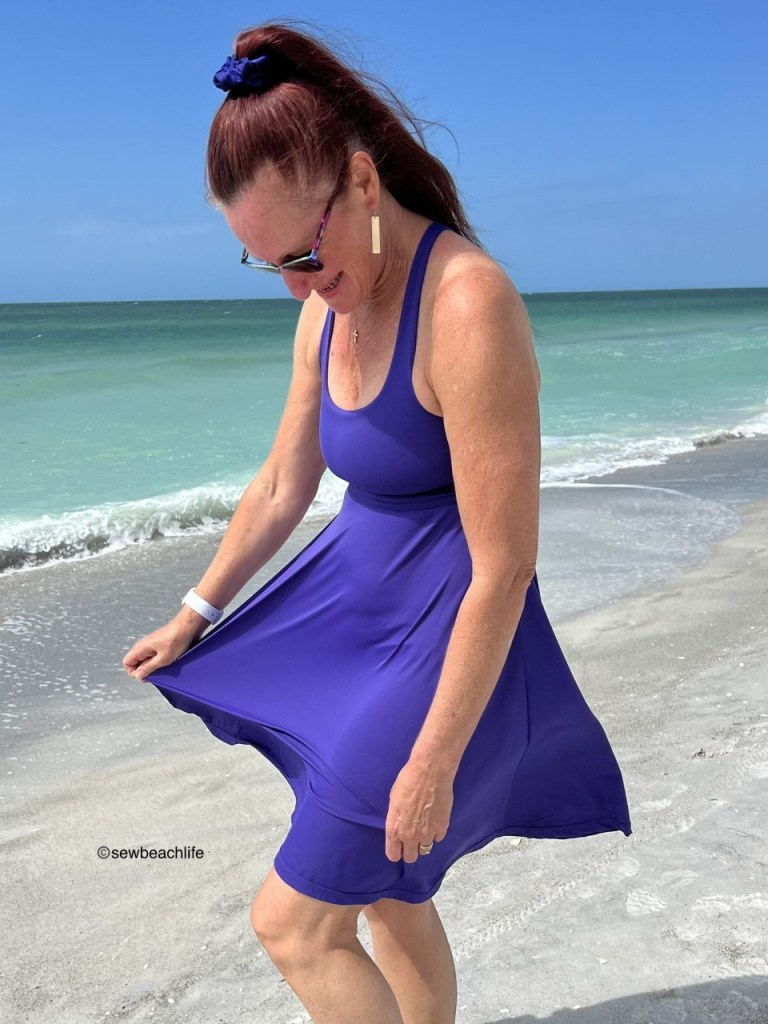
Having this bra pattern turn into dress just makes me so happy! I love, love, love it! The half circle skirt is swishy, but not too full. It’s super easy to get dressed for the day when you can wear a dress with a built-in bra. The knee-length option hits in just the right place, even on a taller girl like me.

I know some people get frustrated when trying to hem a knit skirt with a curved hem, but here’s my not-so-secret tip to make it easy: serge around the raw hem of the skirt with a 4 thread overlock with a stitch width of M, stitch length of 2, and up the differential to 1.5. This will slightly gather the hem, curling it up, which helps it to lay flat to hem. Then I like to pin up a 5/8″ hem and coverstitch it. It turns out perfect every time. Make sure to follow up with a nice press for a professional finish.

The criss-cross straps show just enough skin to look and feel sexy. Combined with the supportive front, it’s definitely a confidence boosting look for me.

Obviously one dress wasn’t enough for me, 😉 so I’ve already made two. I’m contemplating over what fabric I should try next. The turquoise dress is a nylon spandex tricot (swim) fabric. The purple dress is a nylon spandex circular knit. Both fabrics were purchased from Phee Fabrics a while back, so I don’t know if these particular colors are still in stock. It’s important to use fabric with good stretch and recovery (rebound factor) so that the bra fits well and stays somewhat firmly against the body. If you have a larger cup size, I also recommend using powernet. Though it is optional, I like the extra bust support it provides.

No matter how far forward I lean, I still feel supported.

I can wear my dresses to walk the beach, or go to the grocery store, or out to dinner. (If it’s at a restaurant that has gluten and dairy free food that’s safe for me to eat!) which is quite the challenge for me. My journey of food allergies deserve a discussion of their own on Sew Beach Life, and will probably be my next post.

The Spellbound Bra and Dress is flattering whether I’m sitting or standing. Even on a windy day! 🙂 There is a peplum top cut line on the skirt that will turn the bra into a cute, casual top. But I go to yoga class four days a week, and a flowy top isn’t practical for forward folds and headstands! 🙂
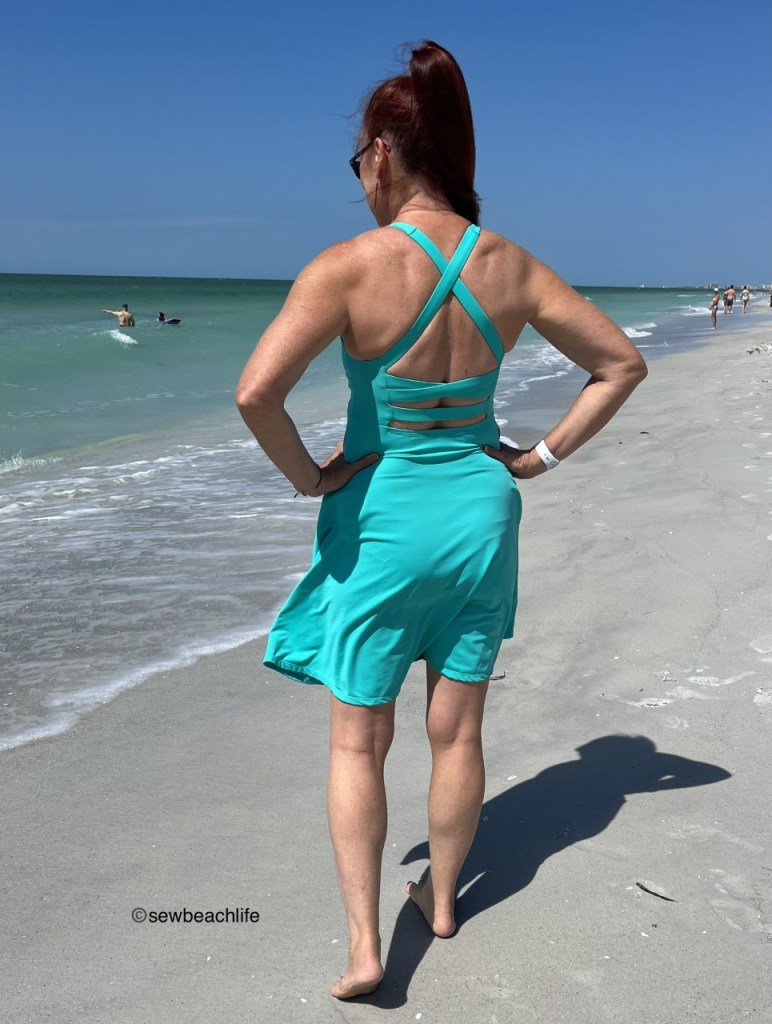
If you follow my page, you know that I can never leave a pattern well enough alone. Especially a pattern that I love as much as this one! So I had to turn this bra into a workout top. I mashed it with the Versa Cami and came up with something fun.

I wanted the front to be one piece, without a seam between the bra and body of the top. The back of course, has to have a seam.

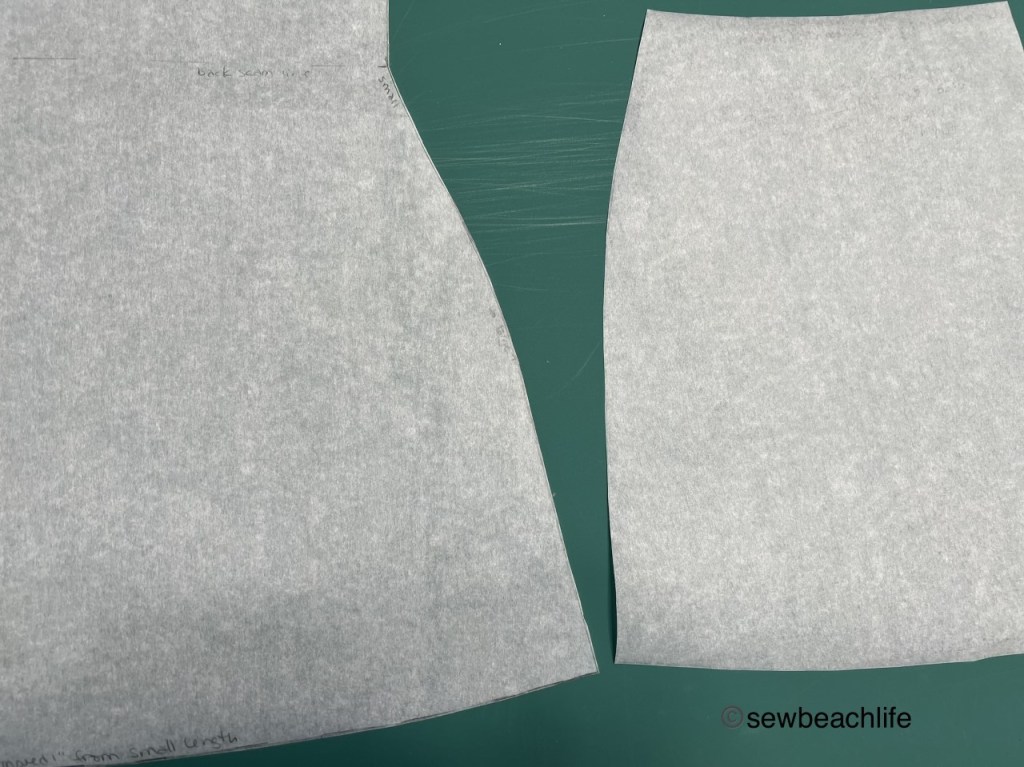
To get the front pattern piece, I lined up the front of the Spellbound at the lining cut line with the front of the Versa Cami at the shorten or lengthen here line on the pattern piece. Once I traced down to the bottom of the bra front piece, I started grading out for my hips. My grading went from small to large, and I removed one inch from the small length and large width at the hemline.

To get the back pattern piece, I started at the shorten or lengthen here line on the Versa Cami, and graded out for my hips. Originally, I just went straight across and cut on the shorten/lengthen line. But after sewing it up, I realized that the straight line gave me too much fabric at center back, and didn’t show the same amount of skin that the dresses show in that area. So I refined the pattern piece and used the curve from hem of the Spellbound skirt at the top of my back piece. In hindsight, I’ll probably just use the top curve of the skirt for the top curve of my top on the next one. My grading went from small to large, and I used the small length and large width at the hemline. You may be wondering why I shortened the front piece an inch but not the back. Two reasons: I like my workout tops to hit at hip level (the Versa is a bit longer than that); and because the back has a 1/2″ seam whereas the front doesn’t.

The pattern pieces I created to hack the bra into a workout top.

As always, I don’t show full pattern pieces out of respect for the designers hard work in creating a pattern. But I am showing enough for you to see the smooth curves of my grading. The front pattern piece is on the left, and the back pattern piece is on the right. A French curve ruler is a very helpful tool for grading and adjusting pattern pieces.

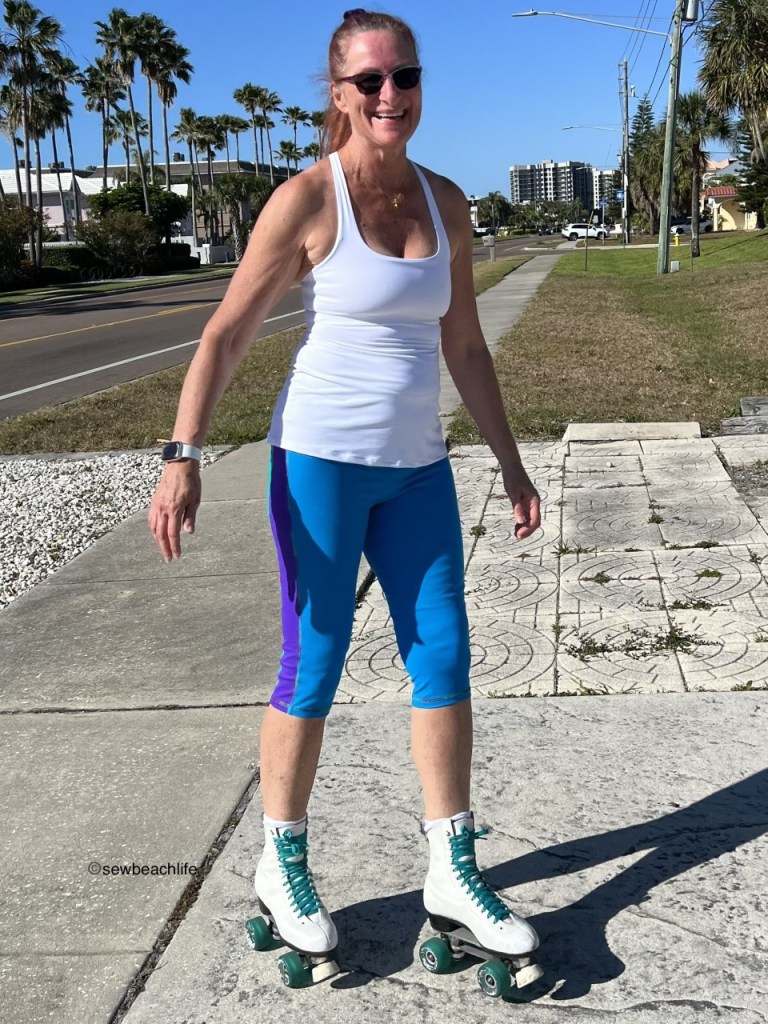
I wear my workout top to skate around the neighborhood as well as to yoga class.

The top is sewn together by following the tutorial for the Spellbound bra up to the point of hemming, except for one thing. When sewing the bra front (turned into a workout top) piece to the bra side piece, don’t sew all the way to the bottom of the side piece. Stop 1/2″ from the bottom to leave yourself fabric for the back seam. Then snip to but not through the stitching line. This will allow you to press the seam toward the back and top or coverstitch as per the tutorial. You’ll sew the bra lining front and side pieces together as per normal.

I changed the construction of the Spellbound bra lining piece a tiny bit to suit my preferences. I am longer than average from shoulder to bust point and needed to add 5/8″ in order for the elastic to land in the perfect spot under my bust. Although a higher cut line was added to the pattern, my unique body shape requires the elastic lower because I needed the entire bra to slide up, not just add height at the front. This is a common alteration I have to make on a lot of tops and dresses, not just this specific pattern. Just one more reason that I sew- I can make clothing that fits my body. Because I don’t like elastic touching my bare skin, I added another inch so that I could flip the elastic up and have fabric against my skin.

I cut my powernet at the original lining and powernet cut line and the bra main fabric is cut at the original bra cut line. The bra lining is the only piece that I lengthen.

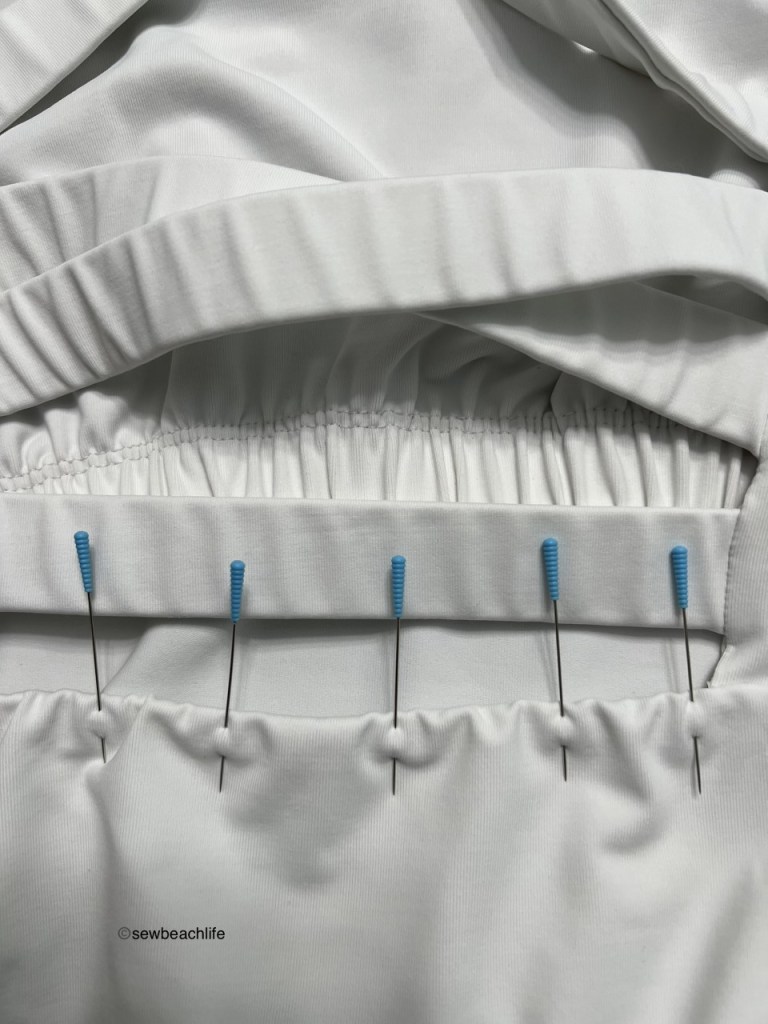
As per the tutorial I basted the powernet to the wrong side of the lining piece. Here’s where I go rogue from the pattern tutorial: I serge the elastic to the wrong side of the lining, then flip it up to fully encase the elastic. Use plenty of pins to hold the elastic in place and coverstitch.

Notice how the serged elastic overlaps the bottom of the basted-in-place powernet?

After top or coverstitching the edge of the elastic in place, remove the basting stitches along the bottom of the powernet. I purposely don’t lengthen the powernet to the same length as the lining because I don’t want the bulk and stiffness of the powernet in the enclosed elastic. It just needs to be long enough to get caught in the topstitching.

My other tip involves the straps. Once you’ve threaded the elastic through the straps, zig zag both ends of the straps to ensure that the elastic stays aligned with the ends of the straps.

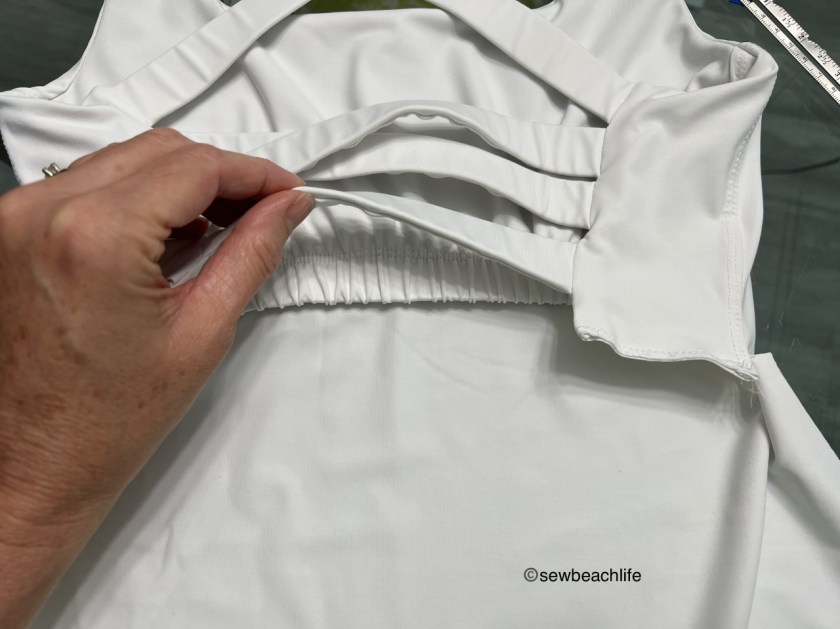
You’ll notice how helpful the zig zag basting is when you are pulling the top straps through the bra, and when you’re criss-crossing, pinning, and stitching all the straps at the back.

Here’s how the straps on the workout top hack look once they’re stitched in place.

There are a couple of things to notice in the photo above. First is the clean finish of the enclosed elastic on the liner if you choose to go rogue like I do. The second item of note is the snip on the side seam that will allow the back bottom piece I made be stitched in place.

I add 3/8″ knit elastic along the top of the back workout top or skirt piece. I don’t take the elastic all the way to the side seams, because I don’t want bulky seams. It’s just there to give a little stability to the top of the back of the skirt or workout top bottom back piece. Once the seam connecting the bra to the skirt or workout top back bottom is complete, I fold the elastic down, pin it in place and coverstitch it.

Coverstitching is probably trickier than topstitching in this small area, but I’m so used to working with my machine (I coverstitch a lot) that it isn’t a big deal to me. Either method works and will give nice results.

After that it’s just pinning and stitching the bottom half of the side seam and hemming your new top! You can wear it to the gym, to yoga class, or to skate around your neighborhood.

Even though I skate on a somewhat regular basis, it’s hard to keep from rolling when you’re trying to get photos on the slope of a bridge!

In case you’re wondering what capri length leggings I’m wearing, they are the Stitch Upon A Time Legend Leggings, posted about here. They’re getting a little too big, but I still like them. I should take them apart and make them in a smaller size.

Trying to get nice photos on the beach on a super windy day when it’s not even 60 degrees F makes for some interesting shots!
Luckily the next day was warmer and I got to go for a little skate around the neighborhood.

Whether you make the Spellbound bra, peplum top, or dress version, or play around with my idea of a Versa Cami hack, I’m pretty certain that you are going to love this pattern as much as I do!

Thank you for reading and sharing my love of creating, sewing, serging, great patterns, pattern hacking, fabric, and making beautiful, well-fitting garments! ❤

The links to Stitch Upon A Time may be affiliate links, which means that at no extra cost to you, I may receive a few pennies if you purchase through my link. As always, I only give my honest opinion. After all, it is my blog, which represents me!

Sage Top and Cinder Skirt

An Easy, Breezy Summer Outfit

A fitted strappy top or crop (with an optional shelf bra!) is the perfect complement to a light breezy skirt. I love it when Stitch Upon A Time brings an on-trend look to life!

About a month ago, I was sitting at the beach with family and friends and noticed the skirt a woman walking by was wearing. I know people watching is a common “sport”, but garment sewists, we tend to clothing watch. 🙂 Whenever I see a cute dress, top, skirt, or outfit, I start thinking: do I have a pattern for that? Anyways, the maxi length skirt she was wearing was made of a white gauzy fabric, had overlapping sides, and an elasticated waistband. It looked so cute, but I had never seen a pattern like it. About a week later, the testing call for the Cinder Skirt popped up and I was so excited to sign up for it! The Sage Top was also being tested, and I couldn’t resist the opportunity for a cute new summer outfit.

It’s a perfect beach walking outfit!

The design of the Cinder Skirt is perfect, with beautiful, clean finishes. There are no exposed raw edges, all the seams are enclosed. With quality finishes like this, no matter how many times you wash and wear this woven skirt, it won’t fray. The secret to the hem on the curved sides is the facing. My best tip for the facing is to serge along the inner curve with a four thread overlock, then press that inner curve to the wrong side of the fabric. This will make it easier to press, and keep your fabric from fraying inside the hem, even when using fabric that tends to fray a lot, like linen.

The facing is pinned to the skirt panel right sides together. See how smoothly that inner curve lays? And how badly the linen fabric (along the outer cuve) frays before serging?

When serging the facing to the skirt panel, up the differential to 1.3 or even 1.5 when serging the outer curves. This will help the curved seam lay flat when the facing is flipped to the inside and pressed. Just don’t forget to put it back on N for the straight sections!

I love the beautiful details of the elasticated waistband and overlapped panels on the sides of the skirt!

The waistband calls for either two rows of 1″ elastic, or one row of 2″ elastic, stitched in the middle. The directions call for top-stitching the upper edge of the waistband, inserting the elastic, then top-stitching below the elastic, and inserting the second row of elastic. I followed the rules on my first test version, but decided to try using my coverstitch and a different method on my second skirt.

I thought it might be easier to leave an opening for elastic, stitch the waistband, then insert the two pieces of elastic. To prepare the waistband for this, I serged along both short ends to finish them. Then I sewed the short ends together 1/4″ past the halfway fold of the waistband. I stitched the bottom 1/2″ of the short ends together too. This left me an opening for the elastic on the inside of the waistband. I pressed the seam open and stitched along the opening to finish it.

Notice how the bottom of the waistband is serged and pre-pressed? This will make it easier to do the final top/cover-stitching on the waistband.

Since even a narrow coverstitch is wider than a single row of top stitching, I had to make small changes. Rather than top-stitching 1/2″ from the upper edge of the (folded in half) waistband, I coverstitched 1/4″ from the upper edge. Leaving 1″ of room for the 1″ wide elastic, I ran the next row of coverstitching. As per the pattern tutorial, the raw edge of the waistband was serged onto the gathered skirt. The pre-pressed bottom of the waistband was folded over the serged waist seam, carefully pinned in place, then coverstitched.

It’s important to stitch slowly, and pause to remove pins to avoid breaking a needle or damaging your machine.

I love the beautiful clean finish on the waistband, and the professional look of coverstitching. I will admit though, that it took a bit of work to get both pieces of 1″ elastic threaded evenly through the waistband with this lightweight fabric! It’s such a fun skirt though! And I love that there are three length options- mini (which is what I made), knee, and maxi length. I still need to find some white gauzy fabric to duplicate the maxi skirt that I saw at the beach!

Here’s what the inside of the waistband looks like before adding the skirt and elastic. I could have hand-stitched the openings closed after adding my elastic, but because I finished the edges, I don’t feel the need to get out a needle and thread! Also, my cat obviously likes to hang around and requires petting while I am sewing! 🙂
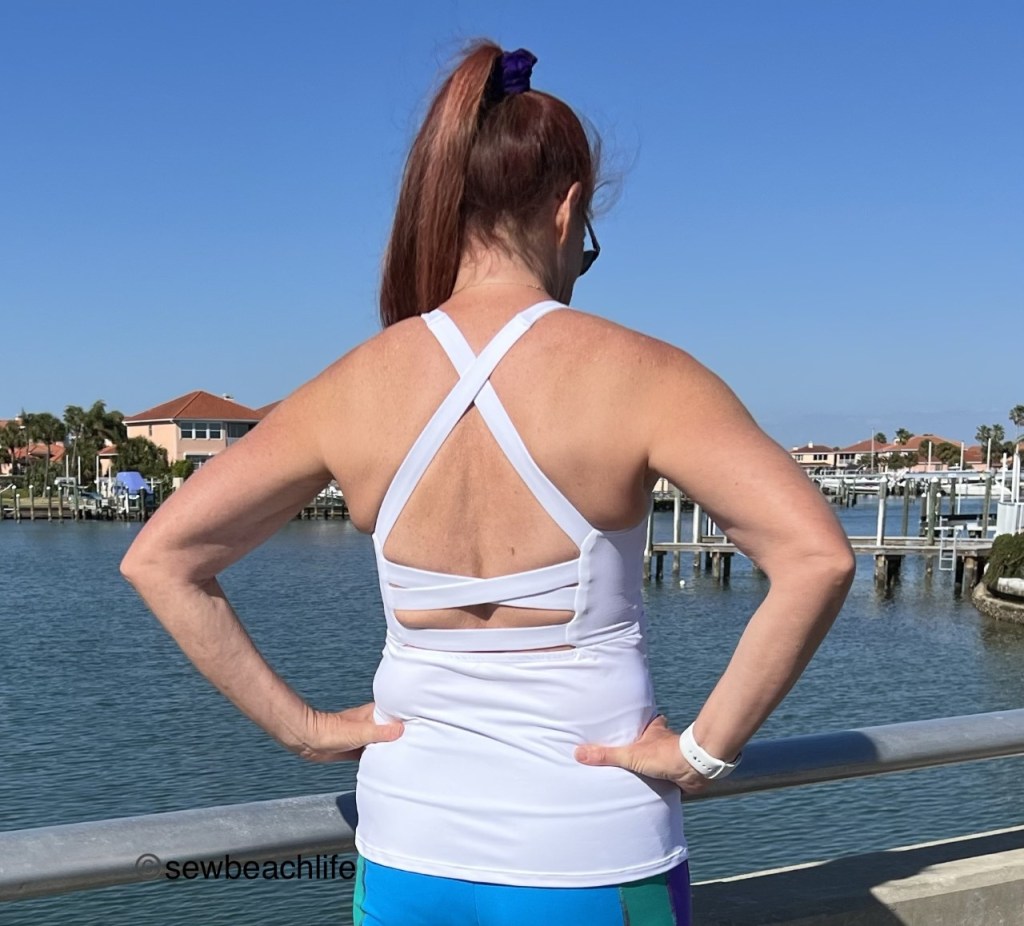
The Sage Top is such a great companion to the Cinder Skirt! Being a fitted tank, it skims the body and works well with the gathered skirt. I love that it has a built-in shelf bra so that I don’t have to wear an uncomfortable strapless bra.

The shelf bra is surprisingly supportive and comfortable.

The Sage Top with shelf bra is not designed to wear as workout top (unless of course your bust doesn’t really need support for exercise). But for casual wear, it provides adequate support to wear comfortably. Because I have a larger cup size, and have a “grandma” bust, I always use powernet in every bra/shelf bra/swimwear/workout top I make.

The main fabric I used is a lighter weight nylon/spandex circular knit. It is super soft and comfortable, but doesn’t have as much recovery as say an athletic or swim knit. So I used a nylon/spandex swim fabric, and a layer of powernet for the shelf bra. And, I snuck some clear elastic in on the strap section of my binding.

I love that it’s so easy to thread 1/4″ clear elastic through the presser foot of my machine, and it feeds evenly as it’s serged into the seam.

This photo makes it obvious that I didn’t follow the pattern tutorial and do a double folded binding. When doing binding on a knit garment, I just find it easier to use 1/4″ seam allowances, and use the faux binding method. Should I be advising people to not follow the tutorial and go rogue? Possibly not, but it’s what works best for me, and gives such beautiful results that I’m unlikely to change my faux binding habit! 🙂 To accommodate the method, I cut the binding strips at 1-1/4″ wide, instead of the called for 2″. (1/4″ seam allowance + 1/2″ wide binding + 1/2″ folded under).
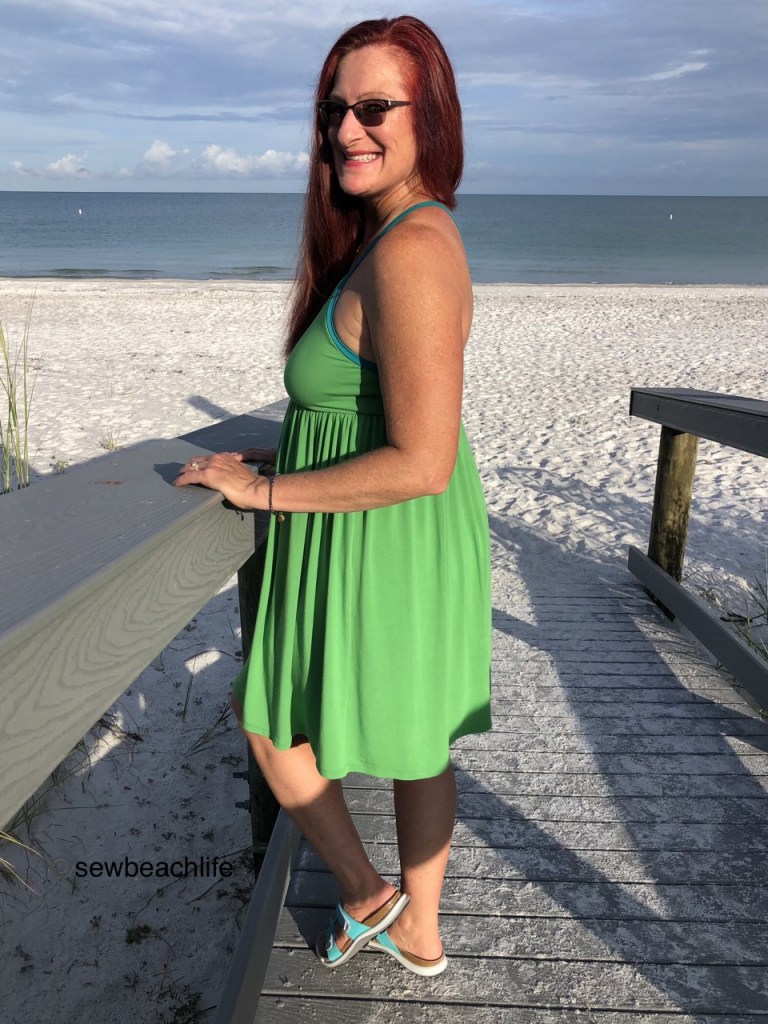
To prep my binding strips, I serge along one long edge of the binding, using a four thread overlock with a stitch width of M, and a stitch length of 2, upping my differential to 1.3 to add stability to the straps. Then I serge the binding to the garment right sides together, and press the binding up. Then I fold the binding around to the back until the raw serged edge aligns to cover the seam. Use plenty of pins to keep the binding in place, and coverstitch.

I love finding random designs, sandcastles, and messages left by beach-goers. I don’t know who drew this cool design in the sand, but I admire the precision and time it must have taken! It added an interesting background for my photos. So, thank you to whoever made it!

The design of the Sage Top and Crop is so elegantly simple- a seam up the center back, and binding. Easy breezy! Center back seams are great for shaping. In for the waist, and curving out to fit smoothly over the bum.

Yoga has given me some rather serious lat muscles 😉 even if this isn’t the most flattering photo. We were losing the light and it was a cloudy evening, so Dan (my sweet accommodating husband) just took a quick snap.

I’ll wear my Sage Tops with shorts to go skating. It’ll be nice to not have to wear a bra on hot, muggy Florida days. Since we’re busy working on a home updating project, I haven’t had time to skate in weeks. It’s killing me to miss out on my normal Wednesday morning skate around the neighborhood, but such is the life of avid DIYers! It’s also taken away pretty much all of my sewing time, which is why I don’t have any more of these outfits made yet.

The wind didn’t blow the overlapped sides on the skirt open. So there is enough modesty for general wear. Along with knee and maxi lengths if mini length isn’t your style.

So, I’ll have to content myself with this cute outfit until I get some more sewing time! I’d also like to hack the Sage Top, by cutting the crop length, and adding either the Max Top and Dress skirt, or the Wylde Dress skirt. Ah, so many possibilities!

The details:

The Sage Top and Cinder Skirt are new patterns from Stitch Upon A Time.

I used nylon/spandex circular knit, nylon/spandex tricot swim knit, and powernet from Phee Fabrics for the Sage Top.

The 1″ wide knit elastic for the shelf bra in the top and the waistband of the skirt was purchased at Wawak, along with the MaxiLock serger thread used for construction.

The navy lyocell twill fabric for the skirt was a surprise clearance section find at JoAnn Fabrics. I would definitely buy it again, as it was the perfect weight and drape for this skirt.

Thank you for reading and sharing my love of creating, sewing, patterns, patterns, fabric, and making beautiful, well-fitting garments! ❤

The links to Stitch Upon A Time may be affiliate links, which means that at no extra cost to you, I may receive a few pennies if you purchase through my link. As always, I only give my honest opinion. After all, it is my blog, which represents me!

Stitch Upon A Time Max Crop, Top & Dress

Pattern Hacks To Personalize For Your Style

I love pattern testing in the spring and summer, because I love summer clothes! This makes sense since I live in Florida, which has about eleven months of summer, and a month or so of cooler temperatures. 😉 Patterns that have multiple options mean I can make multiple looks with one pattern. I could have gone for the simple scoop or V-neck tops, but I gravitated to the cross-front tops.

Cross-front tops are such a fun, flattering look if they fit well. It’s important that the cross-over doesn’t cut across the bust, but rather, falls below it. Yet the cross-over needs to be high enough to cover your bra. I want to look a little sexy, but don’t want super revealing clothes. This can be a tricky balance, especially if you have a smaller ribcage and shoulders, but a larger bust size. Thankfully, the Max Crop, Top, and Dress patterns includes regular and FBA cross-over pieces.

I love how the cross-over hits at just the right spot!

Testing for designers that listen to feedback from the testers, and make changes accordingly gives me more confidence in their skills. Yeah, they may have made samples, and done some pre-testing, but nobody is going to come up with a “perfect” pattern that fits every unique body. And something that works in theory, may need a little bit of tweaking in the real world. I’m not saying that designers should change everything about their designs, but if a similar issue is noted by several people, it’s probably worth taking a look at.

That being said, it’s important to be a good tester. Take accurate measurements so that you can choose the proper size. Use fabric with the correct stretch requirements (if garment is for knits) and drape/weight (for knit or woven patterns). Be honest in your fit assessments. This doesn’t mean rude or demanding, because hey, the designer is a human being, worthy of respect and kindness. It just means pointing out any and all areas of concern in an appropriate manner. For example, explaining that your shoulders slope more or less than the pattern; or that the bust is too tight/loose/low/high, etc., but the waist fits perfectly. It’s important to take good fit photos so that the designer can see whether the side seams are vertical, whether it’s pulling to the front or back, how the shoulders and sleeves fit, etc. Every body is unique, and though we may fall into the same size, even if sewn exactly per directions, the garment may look different on you than it does on me. The best a designer can do (when designing for a mass market) is get the best possible look on the most bodies in each size range.

See the nice vertical side seams?

That’s why it’s important, (and something you’ll learn as you sew and grow) to know your body. For instance, my shoulders slope a bit, and I am longer than average from shoulder to bust point. Some designers use a more sloped shoulder seam than others, but when I see a shoulder seam that’s nearly square, I automatically know that I’m going to have to increase the slope by raising the seam at the neck edge. If I just angled down from the original shoulder point to the shoulder edge, then the armscye won’t be deep enough for me, and the garment is going to cut into my armpits. This fit issue is way more common than you’d think. It’s worth the time to make tiny tweaks to a pattern so that it fits your body.

The Stitch Upon A Time Max has sleeve options ranging from cap sleeves, short sleeves, mid sleeves, to long sleeves. It doesn’t however, have a sleeveless option. When you live in a tropical climate, sleeveless is a favorite choice, and it’s not hard to hack to be sleeveless. You can do this to your pattern piece, but if you think you may want to use your pattern for a sleeved version later, it’s easy enough to do to with your garment already cut and sewn. Simply make marks around the armscye 1/2″ in from the raw edge. Trim off that 1/2″ of extra fabric.

A rotary cutter and self-healing mat make cutting and trimming so much easier!

I chose to finish my sleeveless looks with a faux facing. First, measure the new edge of your armscye and multiply that number by .95. I know that sounds weird, since bands and bindings are generally 87.5% of a raw opening. But keep in mind that this pattern was designed for sleeves, which have a much closer fitting armscye that doesn’t need to be “brought in”. The faux facing is just to keep the opening from stretching out of shape. Cut two strips of fabric 7/8″ high, with a width of 95% of the length of your armscye. (In other words, cut the strips so the greatest stretch of the fabric will be going around the opening.)

Using a four thread overlock with a stitch width of M, stitch length of 2, and the differential up to 1.3, serge along one long edge of each strip. Sew the short ends of each strip together with a 1/4″ seam allowance, and mark the quarter points of the raw edge. Mark the quarter points of each armscye and pin the facing to the armscye, only slightly stretching the facing to fit. Add additional pins as needed, then serge, right sides together with the same settings as above, using a 1/4″ seam allowance. Fold the seam allowance to the inside, slightly rolling it so that the facing will be completely hidden, and pin the facing in place. Then coverstitch from the right side.

Notice how you can see just a little bit of the bodice along the top edge of the pinned armscye at the bottom of the photo, while the facing is completely hidden in the coverstitched armscye at the top of the photo? It looks even better once it’s pressed!

One of my favorite looks from the pattern was the cross-front ruffle crop top. But I’m not comfortable wearing cropped length tops. And the height of the waistband piece was a bit too long on my body, looking more like a dropped waist. So I decided to shorten the waistband height so it would end at my natural waist. Then I added length to the ruffle so that it would fall at my high hip, rather than be a crop top. Of course I also made it sleeveless #becauseflorida, and it turned out so cute!

I immediately wore it out skating, and love the fun, flirty ruffle!

Besides yoga, skating is my favorite exercise. It’s great cardio, burns plenty of calories, and is just so fun! My neighborhood doesn’t have sidewalks except for out at a main road with busy traffic. So everyone walks, runs, rides bikes, or skates in the street. My skating route is determined by which streets have newer asphalt, and are therefore smoother to skate on. 🙂

Cul-de-sacs are always fun!

My husband usually rides his bike while I skate. He did a good job of snapping photos while riding! He keeps commenting on how fast I skate lately. I think I’ve gained confidence in skating on rough outdoor surfaces after only having (mostly) skated indoors on a smooth maple wood floor at the skating rink I grew up in. Although I recall skating in more than a few outdoor parades back in the day, the parade pace was definitely slow. I had forgotten how freeing it feels to have the wind in your face, listening to music and flying along like I used to fly around the rink as a child and teen.

Sleeveless tops are more comfortable when skating on a hot day.

The back view of the Max top is just as good as the front. It’s such a nice, smooth fit. I’m quite pleased with the bodice shaping on these tops. Adjusting the shoulder slope to fit my body means the back lays smooth with no wrinkles or pulling.

I am loving the sleeveless look!

My next hack idea is to add a skirt to the cross front bodice without adding the waistband. I think it would look super cute too, although I’d probably serge clear elastic into the seam line when attaching the skirt to help keep it pulled in against the weight of a longer skirt. And perhaps a tiered skirt… Ah, so many ideas swirling in my head with this cute pattern! Which I guess sums up my feelings about the pattern. It’s a great base pattern with so many options, from simple V-neck or scoop neck, to cross-front, with cap, short, half or long sleeves. (Although it’s obviously easy to hack into sleeveless) 🙂 With lengths from crop, top, and ruffle crop, to dress.

Obviously I need more fabric to try all my pattern hack ideas!

Even the bird approves of my Max Top and Treasure Hunt Skirt! 🙂

The details: The Max Crop, Top and Dress pattern from Stitch Upon A Time includes sizes XXS-6X. For reference, my hacked green ruffle crop top is size Large, using the Large FBA bodice. My purple cross-front top is a blend of Medium and Large FBA bodice with size Large lower top. The purple top is worn with the Treasure Hunt Skirt, which is blogged about here.

The lime green (and plum shown in my sleeveless hack photos) rayon spandex was purchased from Phee Fabrics. The purple rayon spandex is a lighter weight from my stash. It was probably purchased at JoAnn Fabrics years ago. Can you tell that I love bright, fun colors?

Thank you for reading and sharing my love of creating, sewing, patterns, pattern hacking, fabric, and making beautiful, well-fitting garments! ❤

The links to Stitch Upon A Time may be affiliate links, which means that at no extra cost to you, I may receive a few pennies if you purchase through my link. As always, I only give my honest opinion. After all, it is my blog, which represents me!

The Corset Look

Sewing Tips And A Fun Hack

The new Corset Bra and Top from GreenStyle Creations is so fun! The princess seaming gives it shaping, the pattern design is clean finished, and it includes small, medium, and large cup options in every size.

According to the measurement chart, I need the large cup option, so those are the pattern pieces I printed. I’m so glad that the high hip length was added during testing. It’s not like the bra length wouldn’t get used, but why hide a pretty new make? And that leads me to the corset or crop length and my rant about tankinis.

Have you ever been super excited about the idea of buying a tankini because hey, a tankini will cover more skin than a regular bathing suit top. And you’ll feel more confident in a tankini. Until you try it on. How come tankinis and crop tops look so cute on some people, but when I put one on, all it does it highlight the bit of no-longer-flat belly between the bottom of the top and the top of my bottoms? 😦 I’m sure it has something to do with the combination of my size, height, and/or body shape, but let’s get real. I’m not going to be rocking a crop top. Ever. I make and wear two piece swimsuits because they are much more flattering on my body.

Which brings me back to my excitement about the hip length top being added to the pattern. First off, I could wear it as a tankini because it’s actually long enough to cover the top of my swim bottoms. 🙂 It’s a versatile top and looks cute with Warrior Pants.

A slim, fitted top is a great contrast to flowy Warrior Pants.

I love that the straps of the Corset Top easily cover even the wide straps of my bras. The clean finish of the bra and top is so professional looking, and is accomplished by using either the included shelf bra or lining pattern pieces. The pattern tutorial has clear instructions on how to do the “burrito roll” finish. By the time you make a top or two, you’ll feel quite accomplished using the finish!

I love that my bra straps are hidden, front and back.

You can insert clear elastic in the neckline and around the arms, and it would probably be helpful if you were making a bra for the gym. In which case, I’d probably add powernet too. But since mine is just a casual top, simply upping the differential on my serger to 1.3 was enough to keep the neck and arms from being baggy. (Having the correct fit also helps!) Another tip I figured out is that if you have the main fabric on top while sewing the neckline and “burrito roll” the fabric is less likely to roll outward and show the lining. You can under-stitch if you want, but by serging with the main fabric on top I didn’t feel the need to do so.

I must have been talking with my hands when my husband took this photo.

Another thing to consider when making the Corset Bra, crop or top is that fabric will make a difference in the fit. Fabric with a lot of spandex, and excellent rebound properties will fit tighter to the body, and will be super helpful when making the bra. Fabric with a lighter weight, but still a decent amount of spandex (at least 5-10%) will be less form fitting (which may be preferable in the hip length) then something like supplex or swim fabric will be.

The flattering fit of this top makes me happy. And taking plenty of yoga classes made it easy for me to balance on the railing without falling backwards into the seagrass!

Can we just talk about the beautiful princess seaming on this pattern? It’s a great opportunity to color-block, but I really wanted to bring out the lines a different way. I figured that a reverse triple cover-stitch would almost give the illusion of boning channels, which seems appropriate on the corset style. I recently ordered some Fantastico variegated thread from Superior Threads, and I am super impressed with it! It has a beautiful sheen, and the color repeat is only one inch. That means that you get see all of the colors in the thread cycle through frequently.

I love how the thread highlights the seamlines and makes them pop!

I know a pattern is good when I start dreaming about how I can hack it. And the Corset Bra and Top was just begging to be made into a top and/or dress. I’ve seen some advertisements for knit tanks with a chiffon “skirt” and I knew that it would be an easy hack. I had made a corset length top during testing, and it was easy to trim off the bottom so that it would end at my natural waist. I find tops and dresses most flattering if the narrowest part falls at the natural waist.

Then I cut a strip of chiffon 12″ high by the width of the fabric (approximately 58″ wide). You want the width of your strip to be between one and a half to two times the width of the bottom of your top. Depending on the width of your fabric and the size you are making, you may need to cut two strips, giving you a front and a back to get the width you want. Serge the two short ends of the strip together as a side seam, then serge the bottom edge to help prevent fraying. Fold the hem up 3/8″ then another 5/8″ so that the serged edge is completely enclosed. Cover or top stitch the hem. Gather the top edge of the skirt, and match the quarter points up with the quarter points of the bodice. Baste the skirt to the bodice and adjust any gathers as needed before serging.

The simple gathered chiffon skirt gives the top a whole new look!

The fun floaty look of the chiffon combined with the fitted bodice of the Corset Top looks great over a skirt. Lengthening or adding a second (one and a half times wider) tier of chiffon would totally change the look. As would making the skirt out the same knit as the bodice. I’ve got so many top and dress ideas floating through my brain!

It’s such a fun hack!

And that’s the beauty of a pattern like this. It’s a bra, it’s a top, it’s a swim top, it’s the bodice of a dress. I’ve got some GreenStyle Power Flex fabric just waiting to be sewn into Spark Tights and a cute new workout top. It’s time to sew all the things!

The details:

The navy top is nylon/spandex tricot from Phee Fabrics. It is accented with reverse triple coverstitching using Superior Threads Fantastico #5028 Peacock Plume. Worn with Warrior Pants and Moxi Shorts.

The fully lined purple top is a lightweight nylon/spandex circular knit from Phee Fabrics. It is accented with Fantastico #5154 High Society. The chiffon in my stash came from an estate sale. Worn with a Pace Skirt.

The links to GreenStyle are affiliate links, which means that at no extra cost to you, I may receive a small commission if you purchase through my link. As always, I only give my honest opinion. After all, it is my blog, which represents me! Thank you for reading and sharing my love of creating, sewing, patterns, fabric, and making beautiful, well-fitting garments! ❤

Mix It Up With The Moxi Shorts

Moxi Shorts and a hacked Power Sports Bra make a fun summer outfit!

The Moxi Shorts pattern just got updated into the extended GreenStyle Creations size range, the pattern received a few tweaks, and a youth size version of the pattern was released! The Moxi’s are one of the few GreenStyle patterns I hadn’t tried yet. I think I was afraid that they’d be too short, or hard to fit, or something. But living in sunny (although currently rainy, thanks to the tropical storm) Florida, I need all the shorts patterns!

Color me very pleasantly surprised with the fit. I mean, look how cute these shorts are!

Although they are shorter shorts, they’re not too short if you know what I mean. When I cut out the first pair, I figured that I’d want to make the optional bike shorts as a lower layer to cover a bit more leg. But once I sewed them up, I was happy with the coverage and decided I didn’t need either the bike short or briefs under layer. There is a great FIT TIP in the tutorial to help slim the lower back leg, and it worked perfectly to curve in under the booty. I narrowed the lower back one size and it gave me just the fit my booty needed!

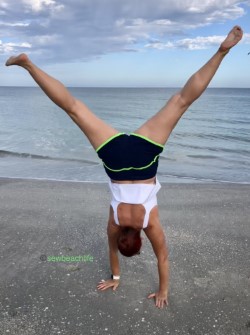
Everything stays in place whether I’m jumping into a cartwheel…
…or completely upside down, no one can see my panties!

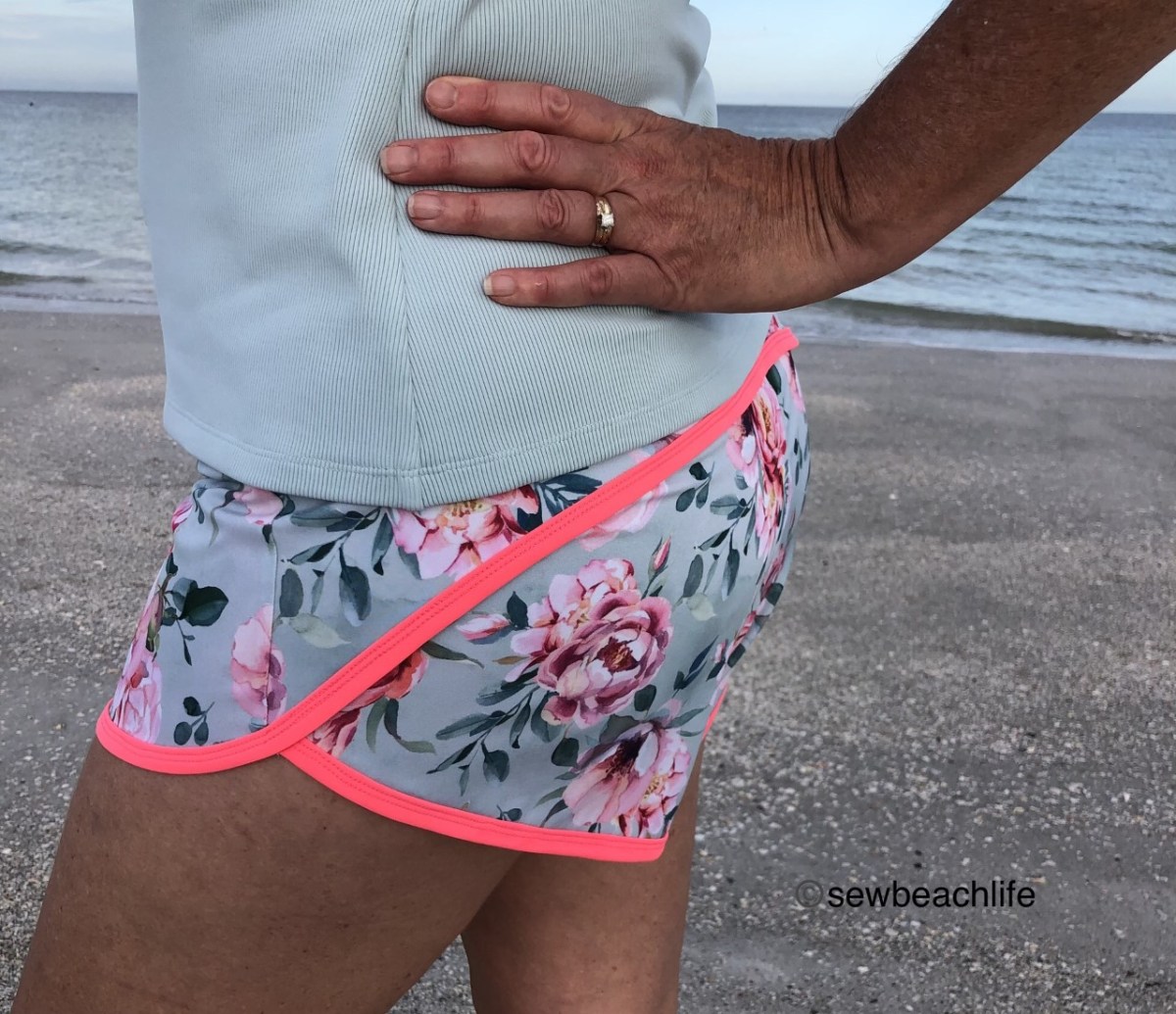
The Moxi shorts have a unique method of construction, and the wide binding is a great opportunity to add a pop of color whether you’re using a solid or patterned stretch woven fabric. Here’s my little tip for binding: although you can use stretch woven cut on the bias, I think it’s easier to use a high quality knit with plenty of spandex. That way you don’t have to cut on the diagonal and stitch a bunch of strips together. I chose a nylon spandex swim fabric for my binding, and cut it with the greatest stretch (across the “grain”) and it worked great!

Here is another sewing tip for the Moxi’s: although stretch woven is just that- a woven fabric, since it does have stretch, it’s a good idea to up the differential to 1.3 on your serger to keep the seams from becoming wavy. It seems like such a small change, but it can be the difference between a good sewing job and a much more professional looking job.

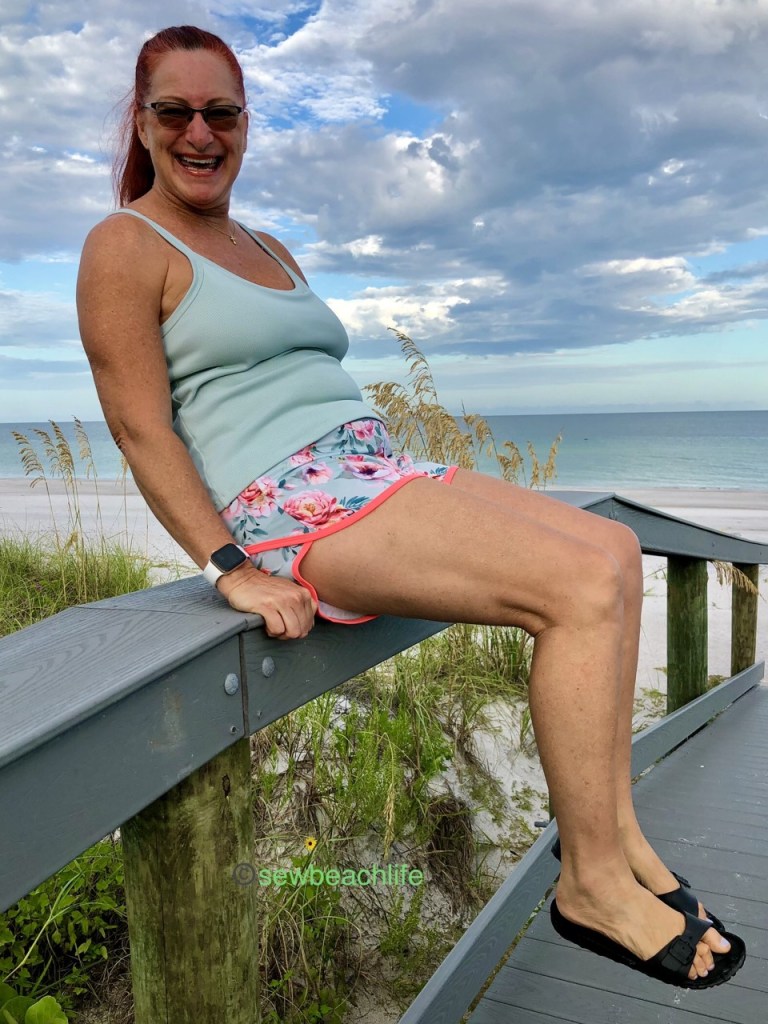
Isn’t that pop of coral fun against the floral print?

I used GreenStyle stretch woven “Mint To Be” and absolutely love that it coincidentally matches one of my Cami Tanks blogged here. When my husband first saw the fabric, he was surprised that I bought a floral print. I tend to wear a lot of solid colors, and floral is generally not my gig. But once I had them made up, he kept commenting how cute they look. And here’s the proof- the photo he snuck while we were walking.

Husbands take the best sneaky booty shots! 😉

I also like that the shorts are comfortable while sitting. Or preparing to jump off of railings! 🙂

The Moxi’s also look super cute when paired with a Power Sports Bra hacked into a workout top. I hacked this one similarly to the one I made to match my Spark Tights with photo instructions blogged here. Except I used a powernet insert in the back panel, and used two strips of bra strapping for my straight straps.

The Power Sports Bra really does give great support, and looks super cute with Moxi’s!

And no, I didn’t use bra cups in my top, even though it’s white. The design of the bra, thickness and support of the Supplex and powernet is sufficient. Like the Power Sports Bra, the Moxi Shorts are another brilliantly designed pattern that’s definitely worth sewing.

And let’s talk about the updated waistbands. There is an elasticated waistband meant to be used with stretch woven fabric. There is also a nicely contoured waistband meant for knits, with a high and low rise. I ended up making both my waistbands 1/4″ higher than low rise. I know, I know, I’m generally a high rise waistband girl, but going just slightly higher than low rise gave me a perfect fit.

The details: as noted earlier, the mint Moxi Shorts are made of GreenStyle stretch woven. The mint Cami Tank fabric, and the mint waistband fabric came from JoAnn Fabrics.

The navy shorts are Phee Fabrics stretch twill, the neon green and neon coral binding and the navy waistband are nylon spandex tricot, also from Phee Fabrics.

The links to GreenStyle are affiliate links, which means that at no extra cost to you, I may receive a small commission if you purchase through my link. As always, I only give my honest opinion. After all, it is my blog, which represents me! Thank you for reading and sharing my love of creating, sewing, patterns, fabric, and making beautiful, well-fitting garments! ❤

Frolic Dress Fun All Summer Long

Tips for adding support and sewing the binding

Summer clothes are so much more fun than winter clothes. They’re light and comfortable, and tend to be more colorful. Swishy sundresses that you can throw on and head out the door are a great summer look.

The new Frolic Romper and Dress by Stitch Upon A Time is perfect for summer breezes. The wrap around skirt is full and swishy, and the top can have a halter tie or cross back straps. Mine started out as a halter top, which I thought was really cute.

The open back of the halter, is certainly sexy (so says my husband!)

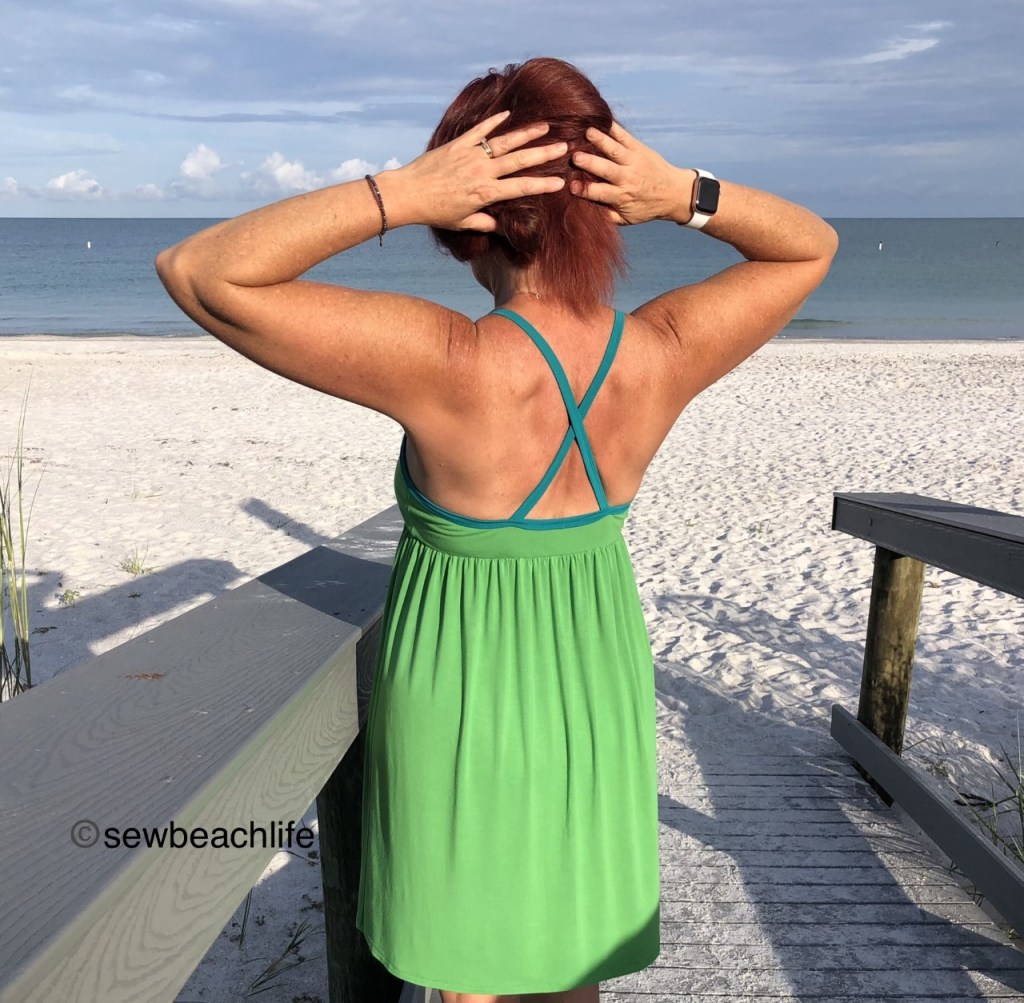
But after wearing it a while, the weight of my bust pulled on my neck too much, so I turned it into a cross back.

I love the cross-back!

I think it’s just as sexy, and it’s certainly more comfortable for my neck. The wrap skirt is perfect for skimming over the belly, without being tight or revealing.

It’s such a fun look, I can’t help but smile!

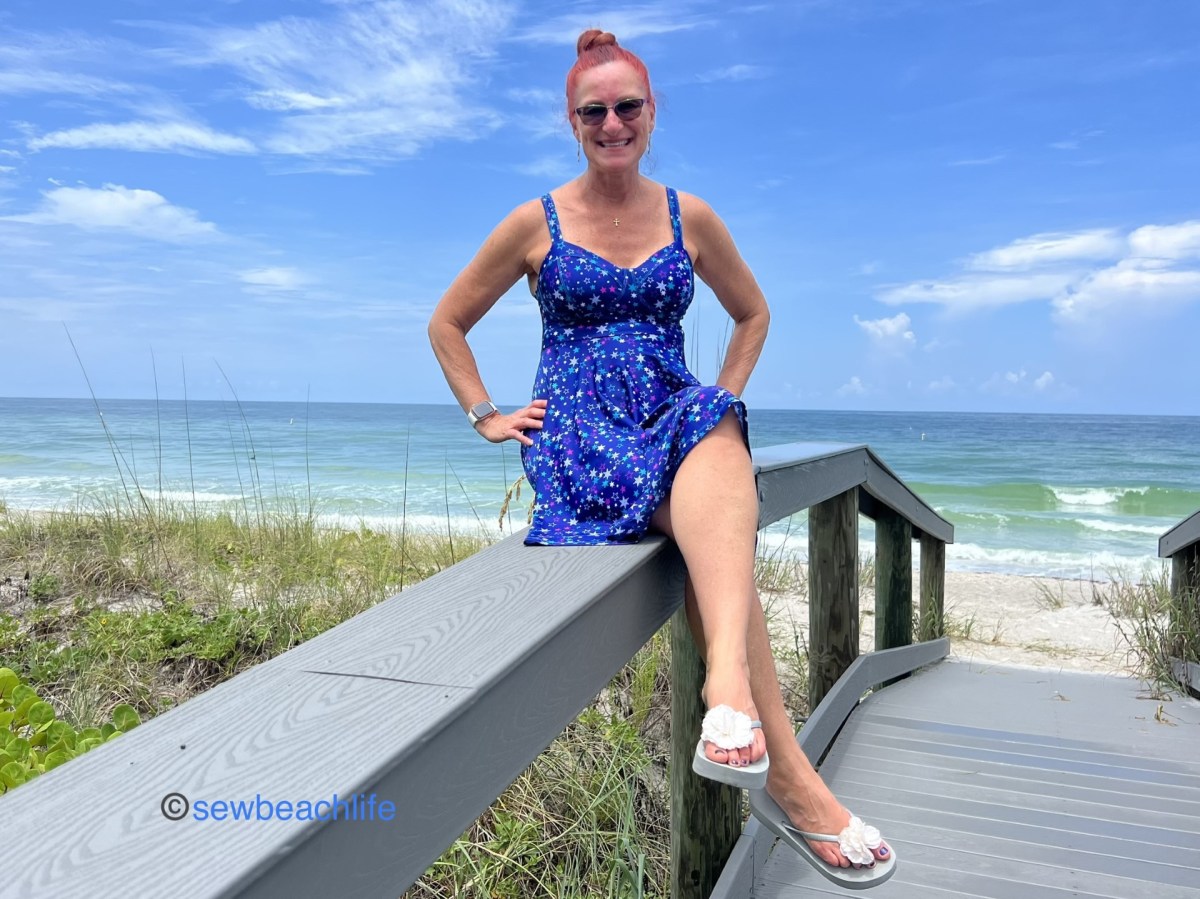
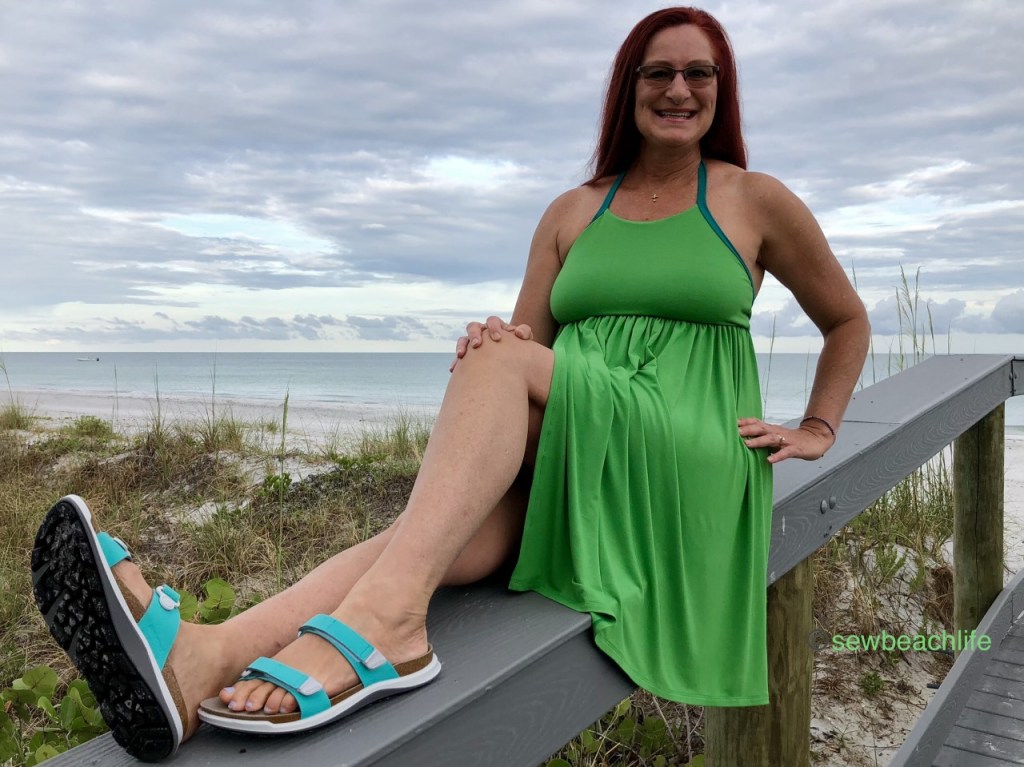
I thought it would be fun to climb up on the railing for a photo, to show the slit of the wrap around skirt. Try not to laugh at my version of a “sexy pose”. Hahahahahaha! Of course after climbing up on the railing, I had to jump down, in a perhaps not quite so lady-like fashion. 🙂

As you can see, it overlaps pretty far in the front, so there won’t be any wardrobe malfunctions!

I love the drape of high quality rayon spandex, it’s perfect for dresses. As I am not small-chested, I decided to use a nylon spandex tricot swim fabric as the inner layer on the bodice. The stronger rebound of the swim fabric gave me extra support and coverage. During testing, it was suggested to add elastic at the bottom of the bodice, sandwiched between the inner and outer layers for more support. Since I need maximum support, I used 1″ knit elastic.

To help keep the elastic in place (and give myself a guide for sewing the skirt on), I basted the main and lining layers wrong sides together, 1″ from the bottom edge of the bodice. I cut the elastic to fit snugly, yet comfortably under my bust, overlapped 1/2″, and zig-zagged the elastic to form a loop. Then I slid the elastic in between the fabric layers, and pinned at the quarter points.

I added more pins to ensure that the elastic would be evenly stretched before serging along the bottom edge.

After I serged the elastic around the bottom, it was time to add the binding. Since this is a summer dress, I wanted a fun pop of color for the binding, and decided to use the same teal nylon spandex tricot as I did for the bodice lining layer. To give my bust even more support, I added clear elastic when serging the binding to the bodice.

I always serge along the unfinished edge of binding before adding it to my garments. It adds extra stability when you wrap the binding and top or coverstitch it.

Then I pressed the binding up toward the seam allowance, wrapped it around the inside and pinned it in place. Then it was time to coverstitch.

You might think I use too many pins, but, I like everything to stay perfectly in place so I can do a good job of coverstitching the first time, and not have to spend any time seam ripping!

Next came gathering the skirt. Have I mentioned that I dislike gathering? I like the look when it’s done well, but it is so time consuming to gather and pin in place! This is where that basting line above the elastic came in handy. The skirt got pinned to the bodice, right sides together, leaving the (encased) elastic below. Because I wanted to ensure that the skirt was even, I hand-basted the skirt to the bodice. Can I just mention how very grateful I am to live in this era of fancy sewing machines, sergers, and coverstitch machines? I cannot imagine how long it used to take to sew all your clothing by hand.

The hand-basting paid off with pretty perfect gathers!

While I love the result, it was a bit time consuming to sew the skirt to the bodice above the elastic, rather than just serging it on. The next time I make this dress, I plan to add an inch to the bodice lining so that I can serge the 1″ elastic on, flip it up and coverstitch it. Then I’d take an inch off the main fabric bodice so that the skirt could just be serged to the outer bodice (and still line up with the bodice lining). It’s important that the seam line falls right under the bust to give the most flattering shaping.

The Frolic Dress just screams summer!

Suffice it to say that I love this dress! It’s comfortable and flattering, while hiding my love of buttered popcorn! 🙂 It’s going to get worn all summer long. Ok, did anybody else just start singing?

The details: the Frolic Romper and Dress, along with all their other patterns and fabric are available at Stitch Upon A Time.

Technically, the cross back straps should have gone through loops, and then just tied in a bow. But I am long from shoulder to bust, and the straps didn’t seem quite long enough for a bow. And well, I like things clean and simple. So I just sewed them into place. It works for me!

I purchased the rayon spandex and nylon spandex tricot from Phee Fabrics.

The links to Stitch Upon A Time are affiliate links, which means that at no extra cost to you, I may receive a small commission if you purchase through my link. As always, I only give my honest opinion. After all, it is my blog, which represents me! Thank you for reading and sharing my love of creating, sewing, patterns, fabric, and making beautiful, well-fitting garments! ❤