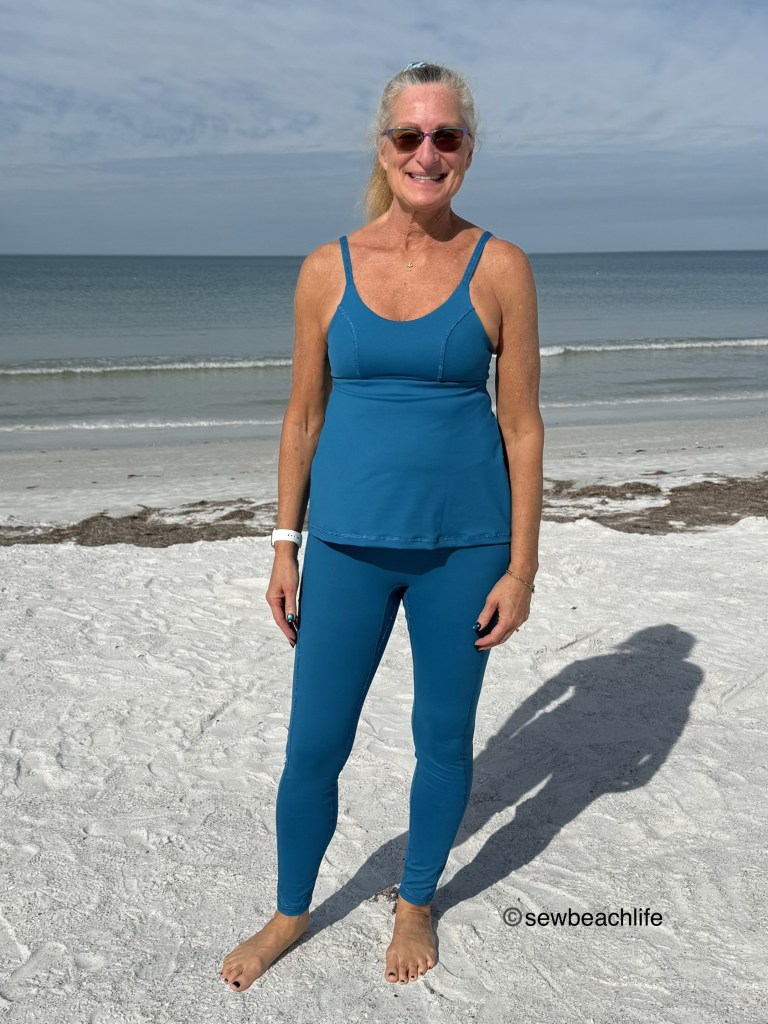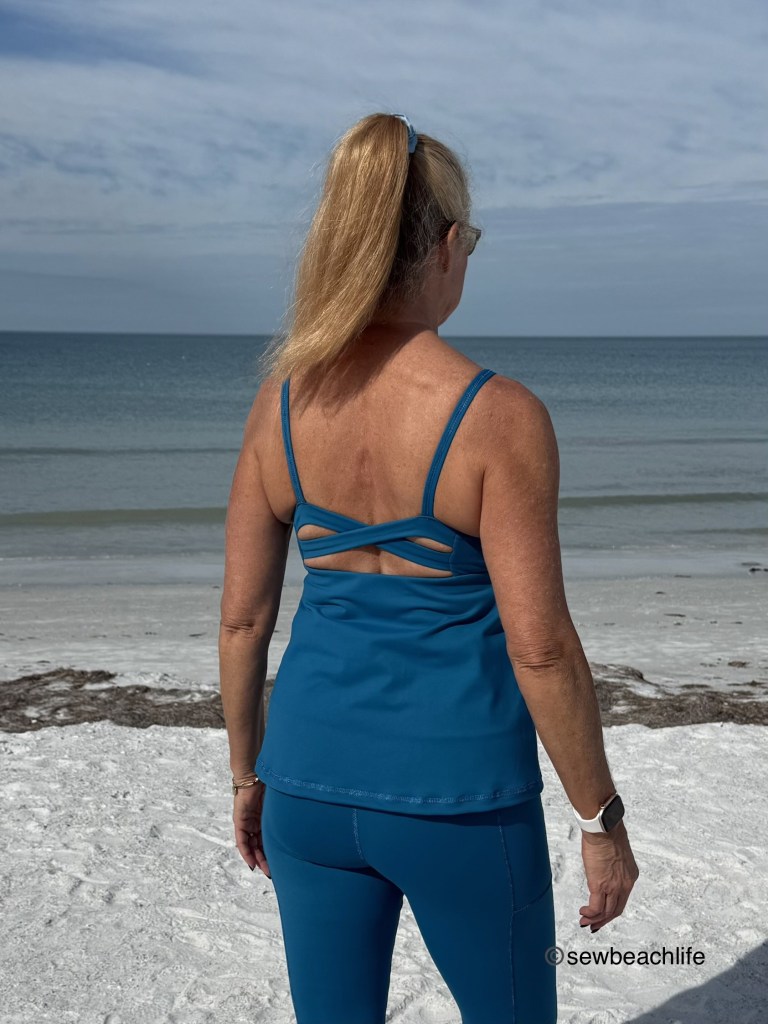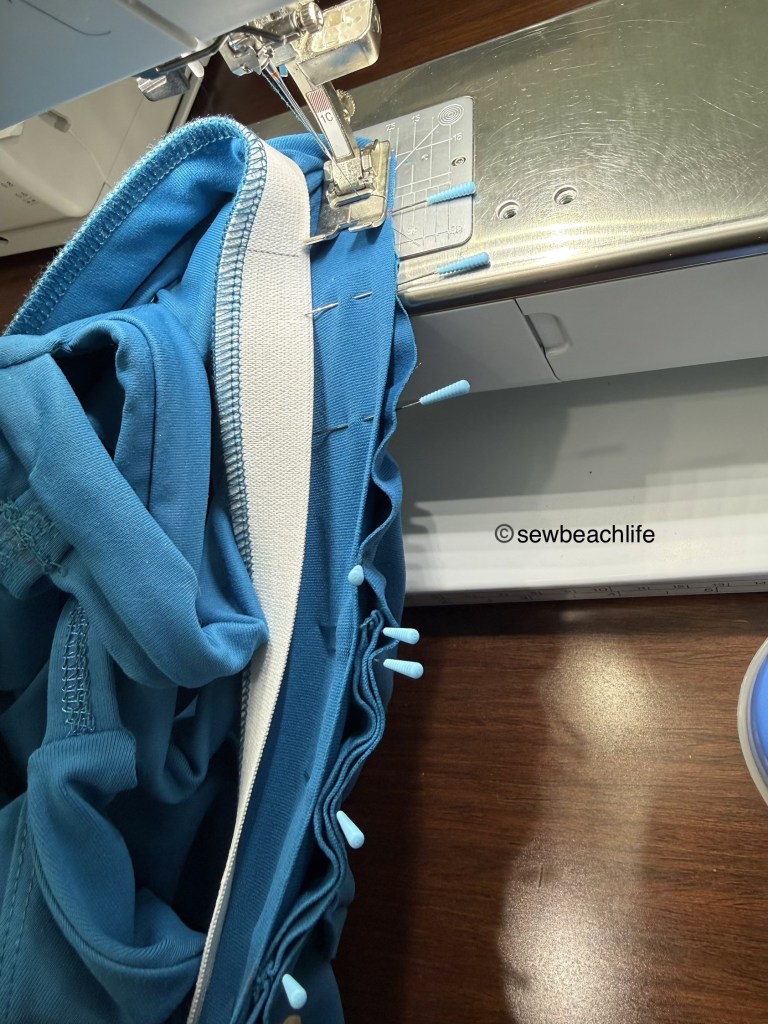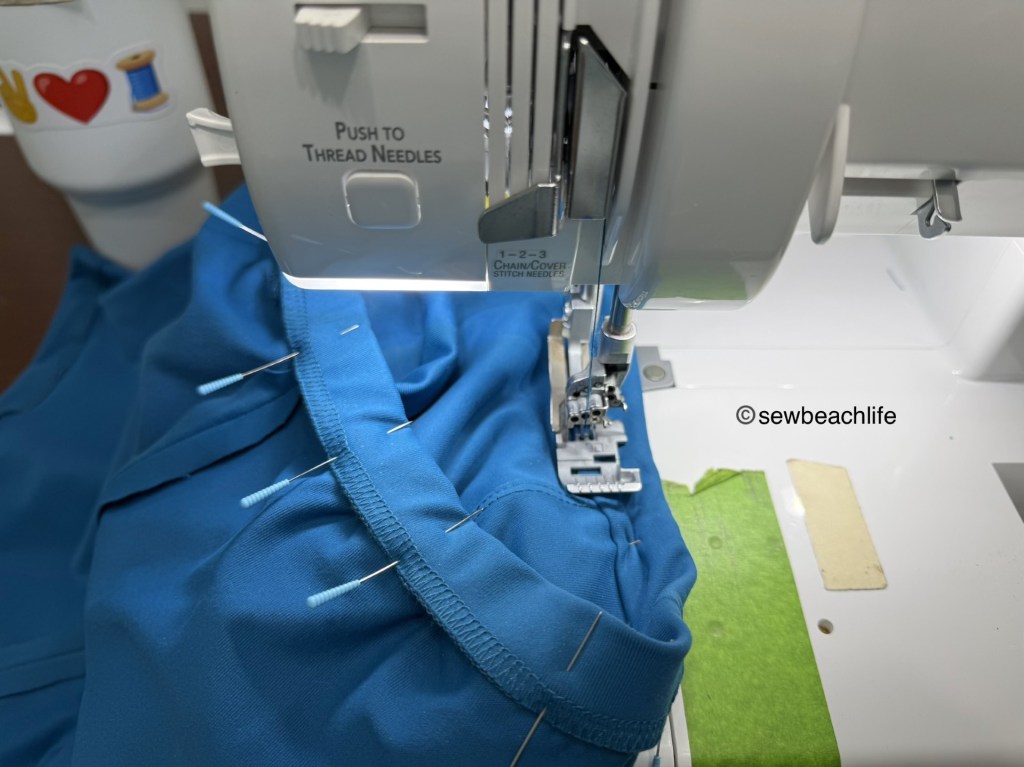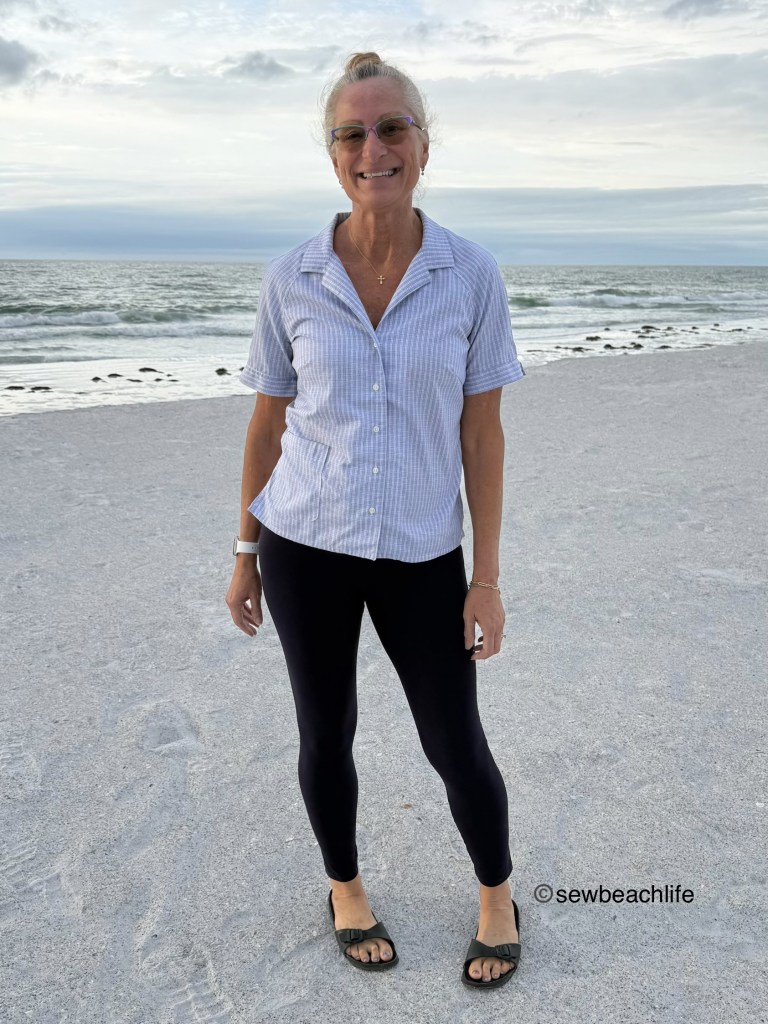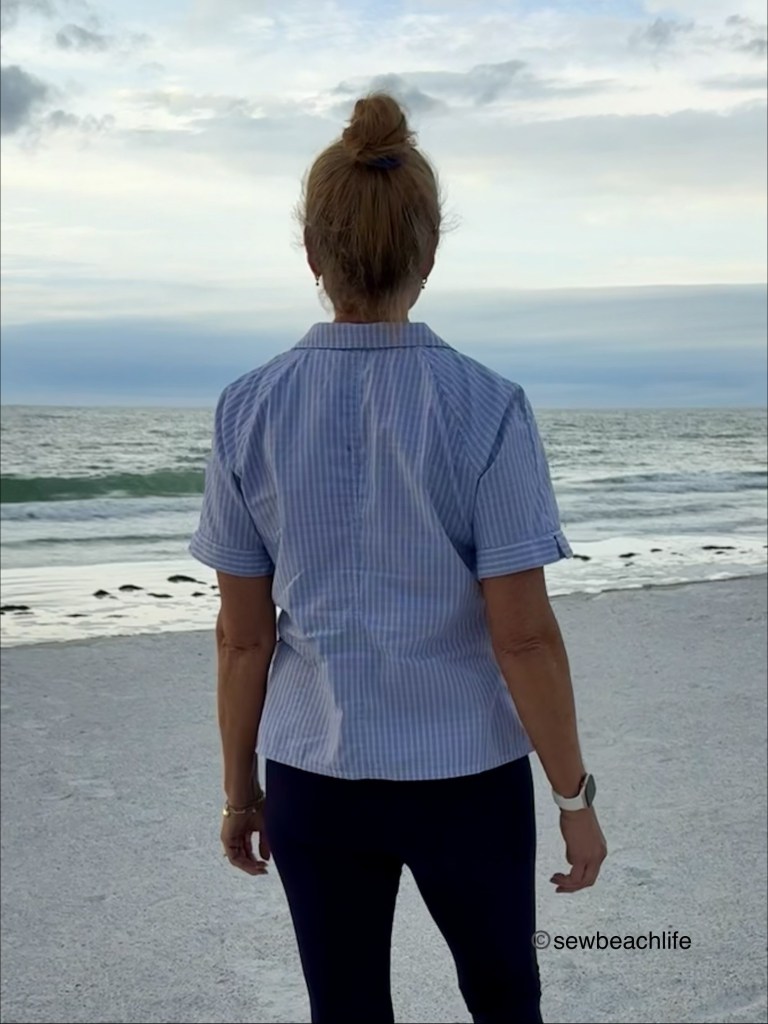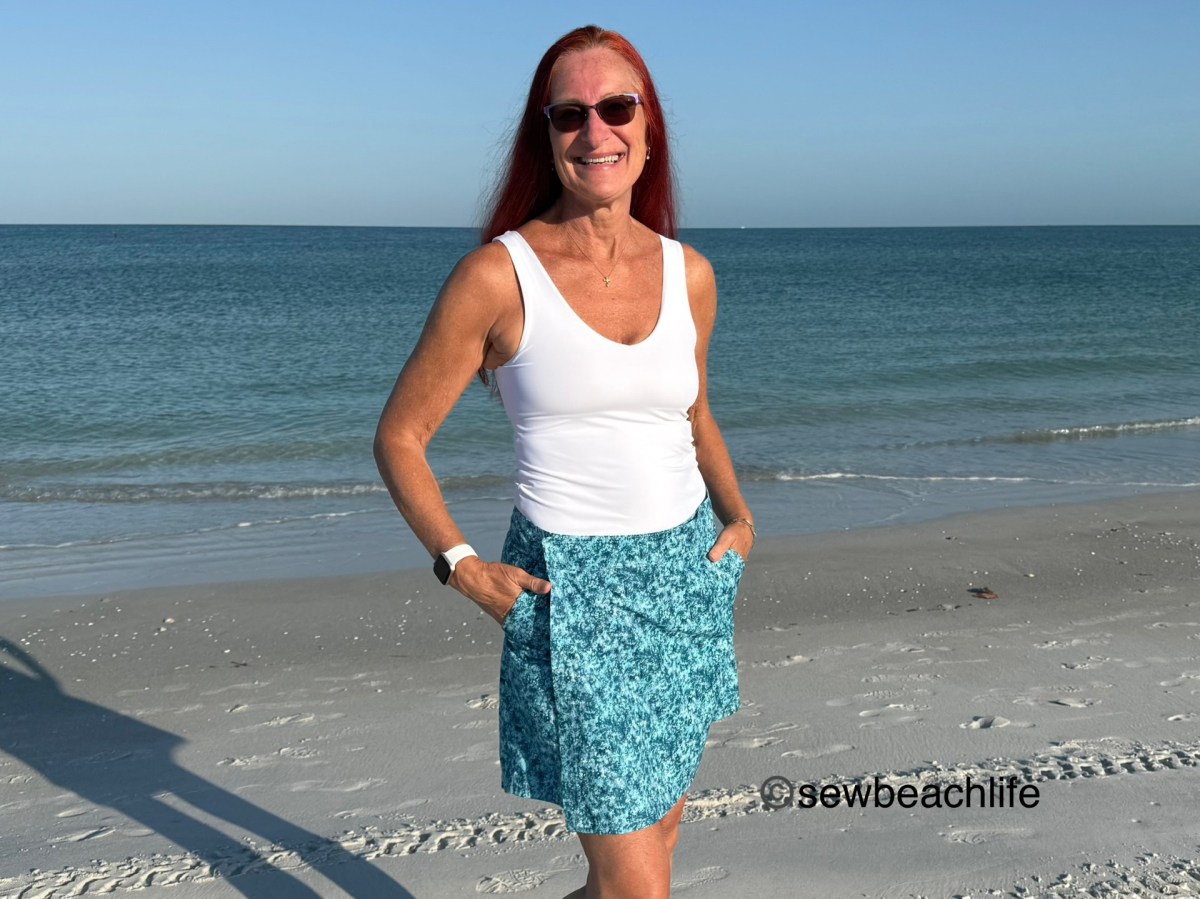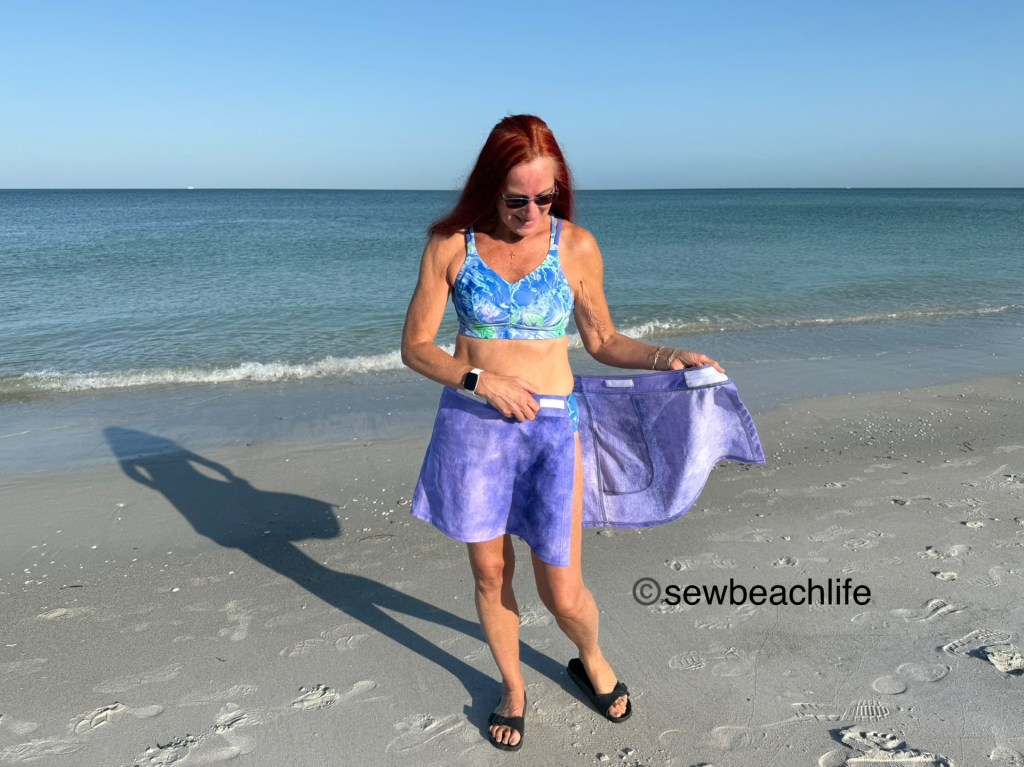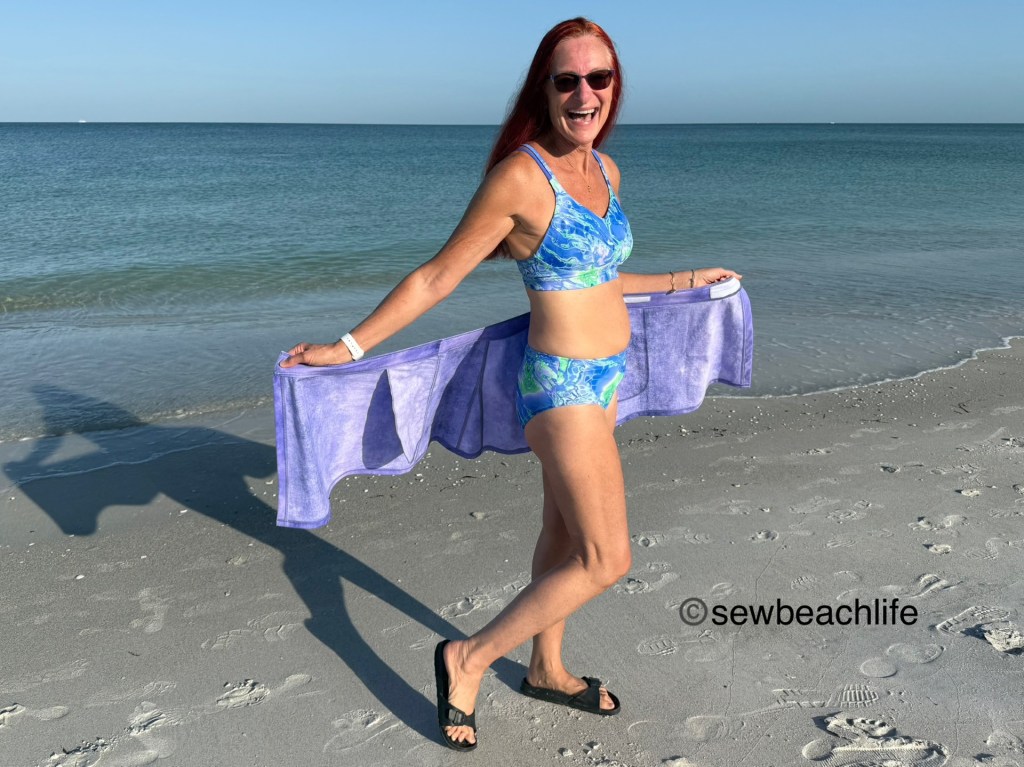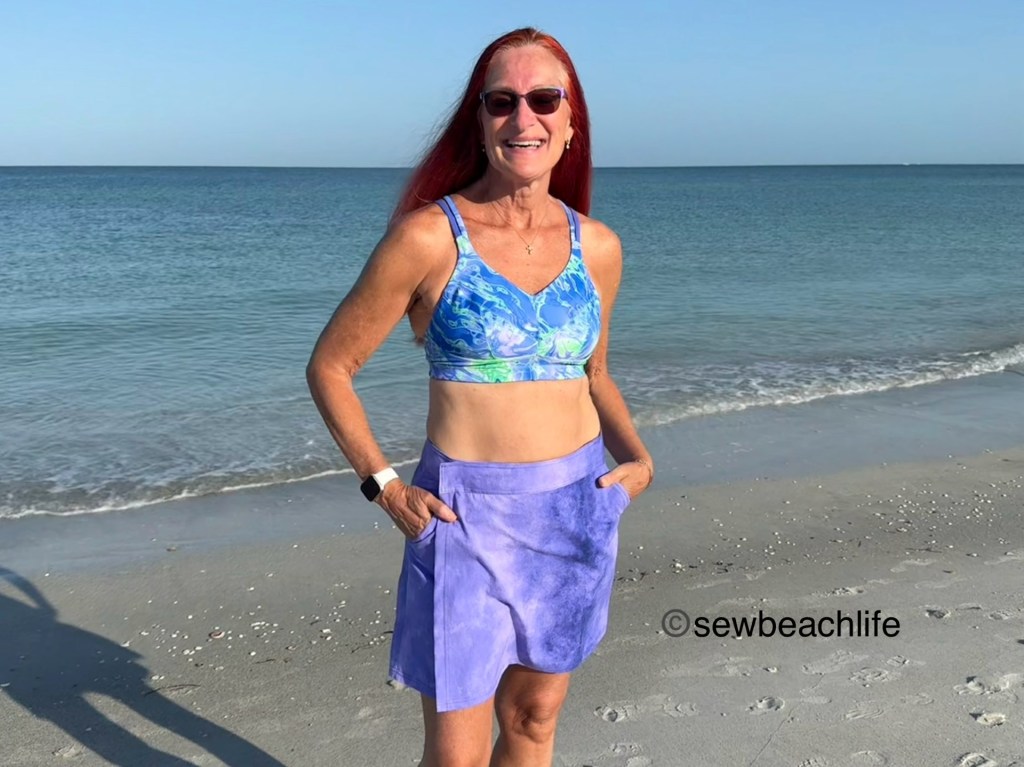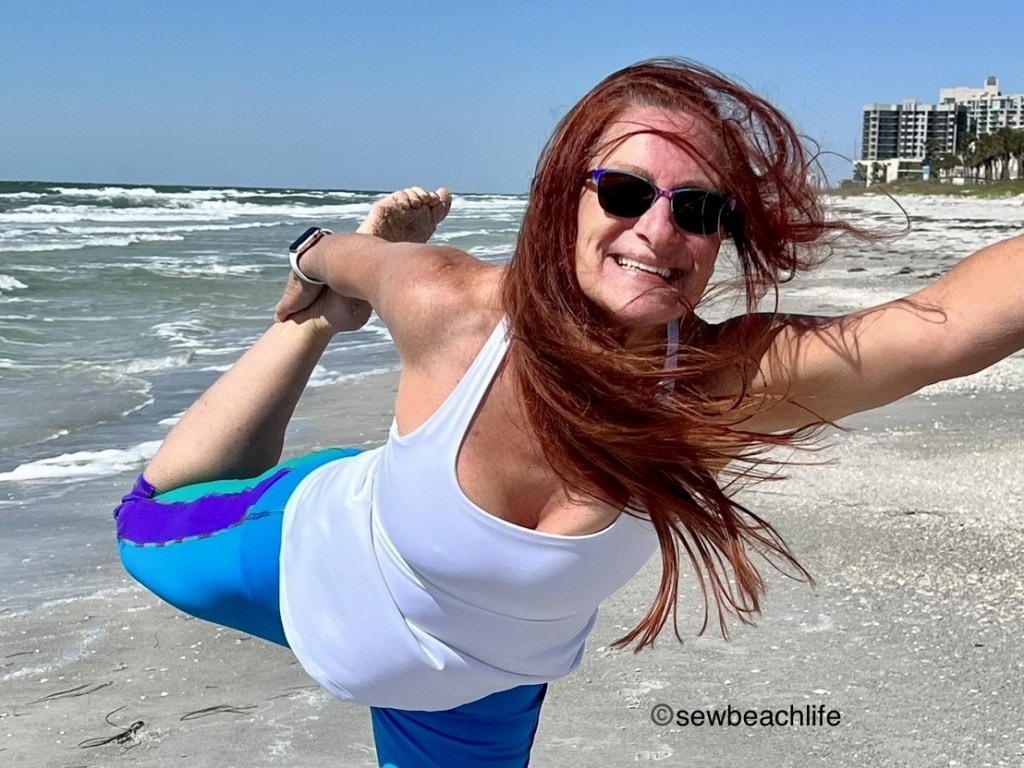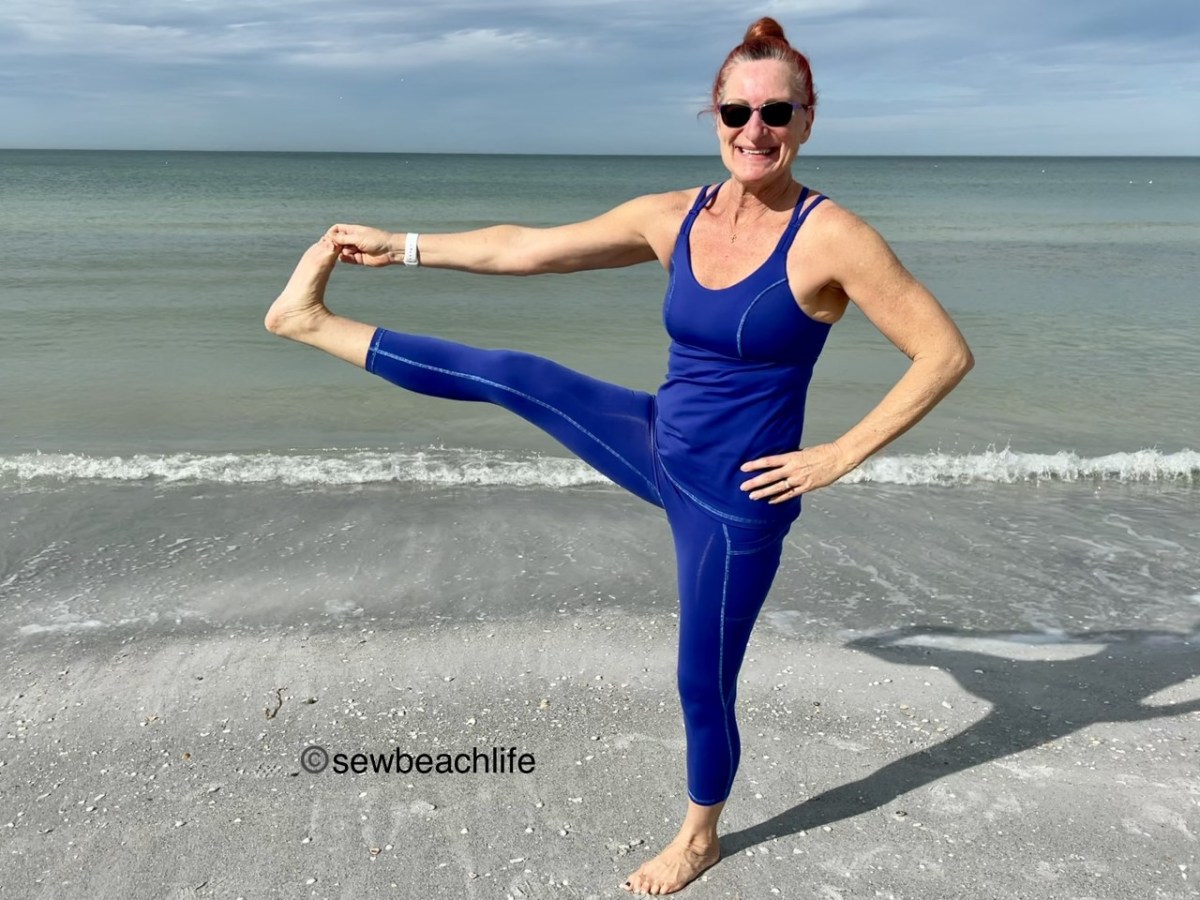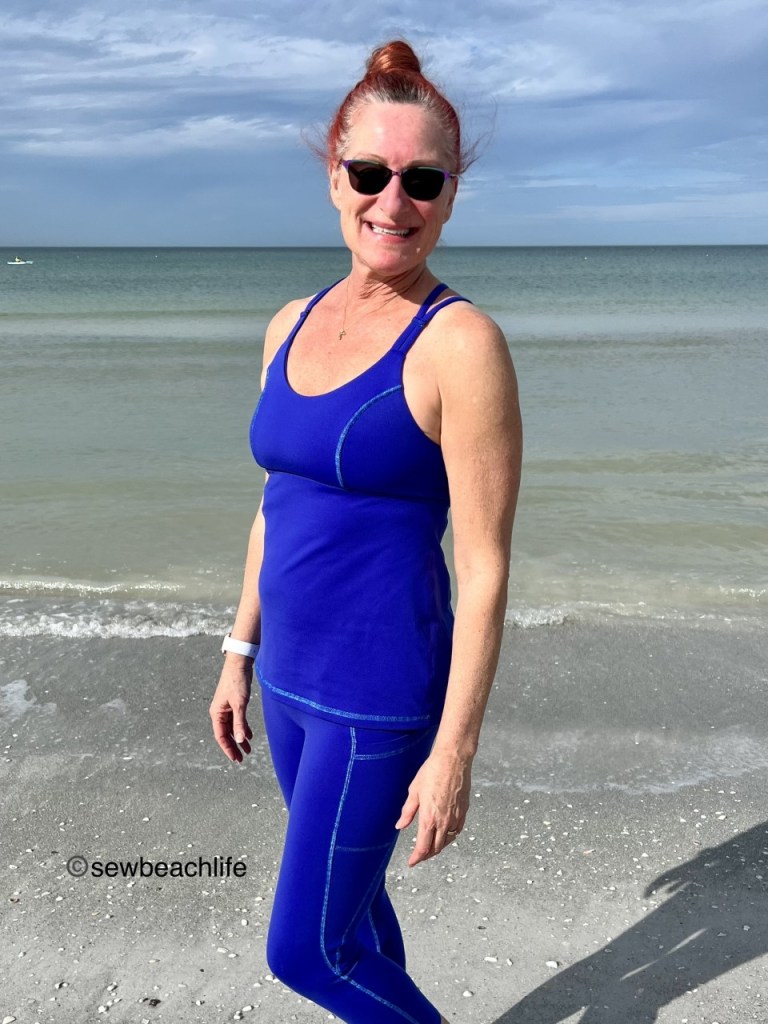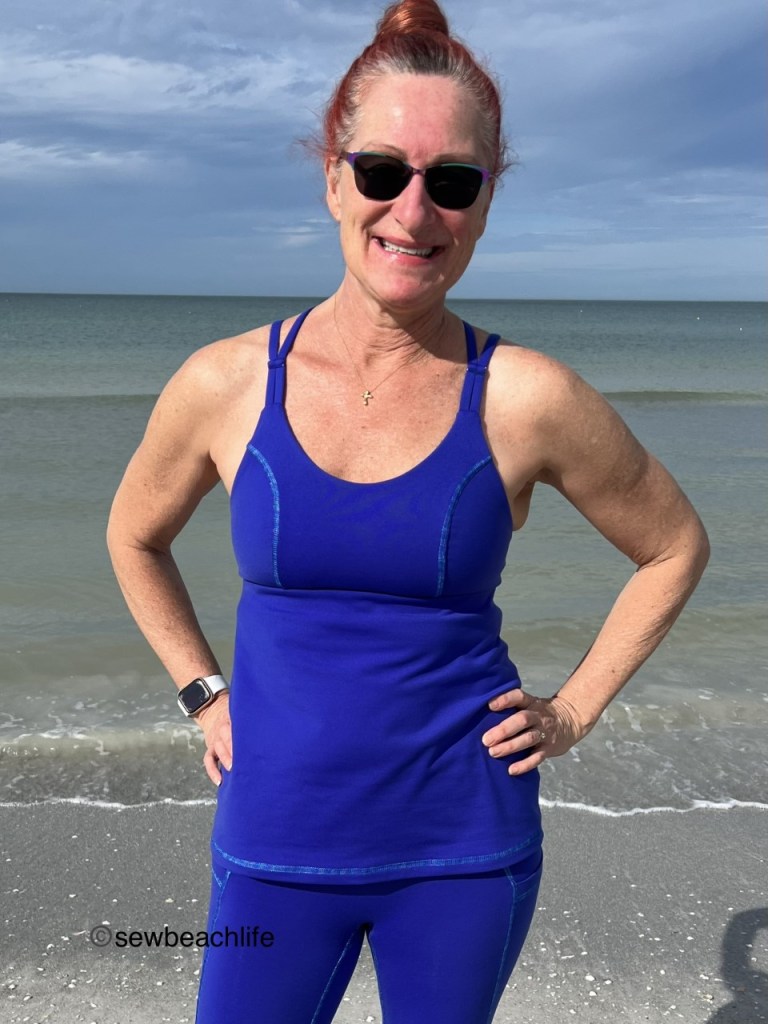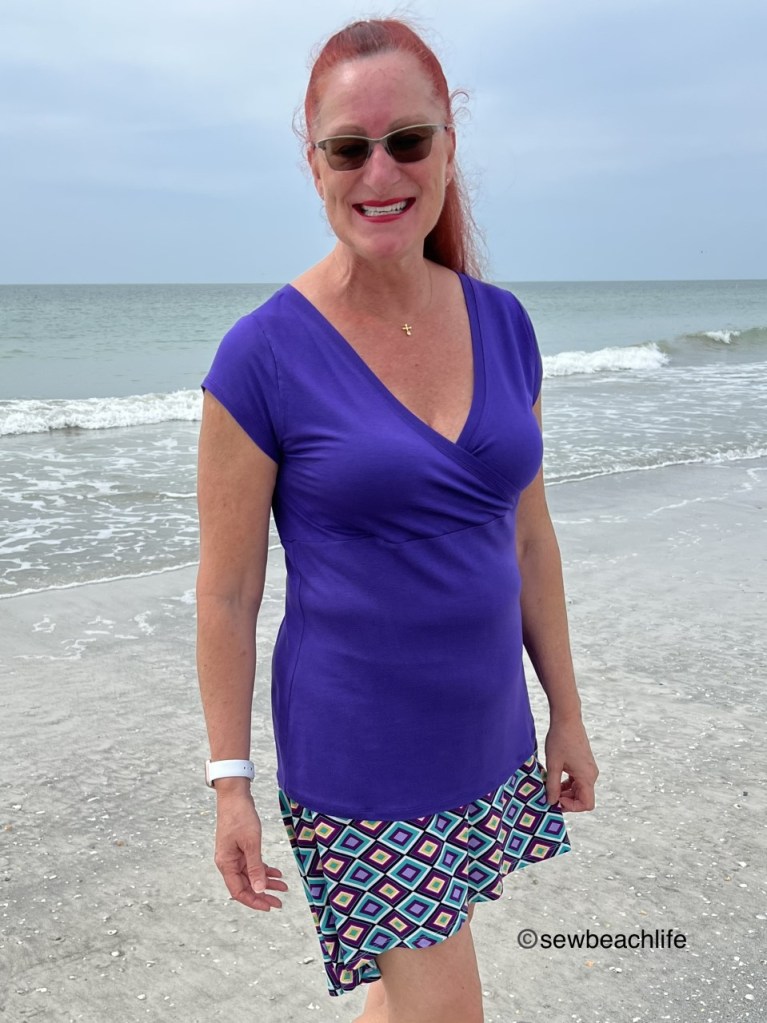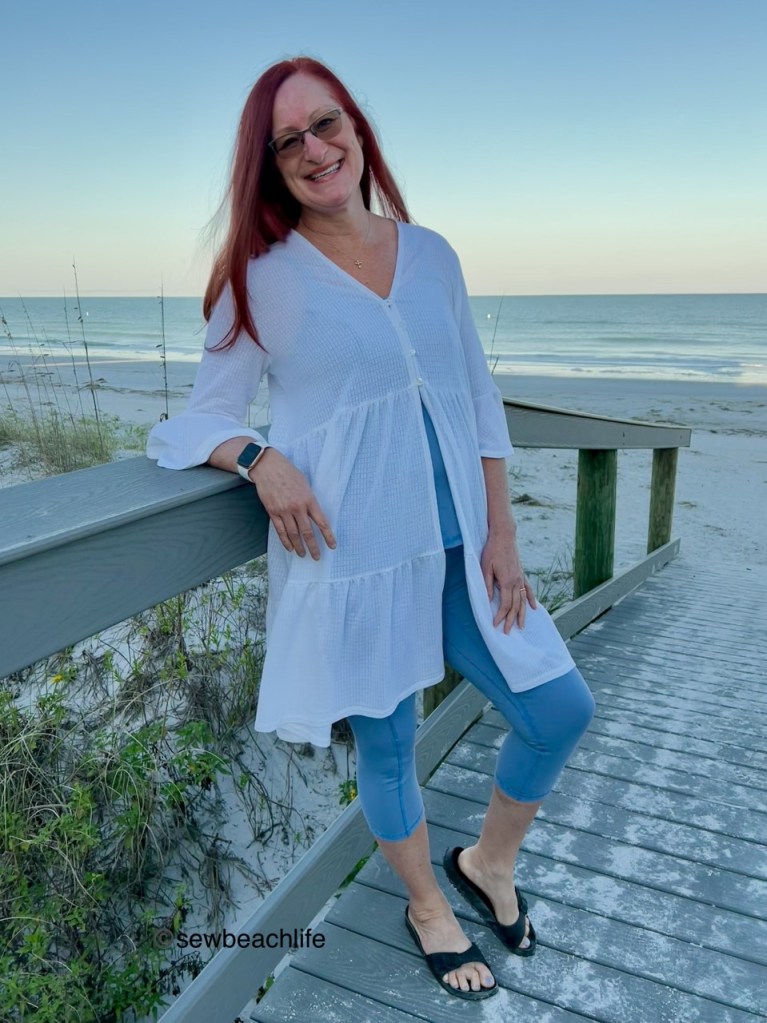
Who doesn’t love a pattern with multiple uses and lots of options? While originally designed as a swim cover up (like the Ripskirt Hawaii), I wear my Tidal skirts for daily use. With 14″, 16″ or 18″ length options, you can go as short as you dare! The pockets are deep enough to safely hold your phone or stash your cards, ID, or a house key.
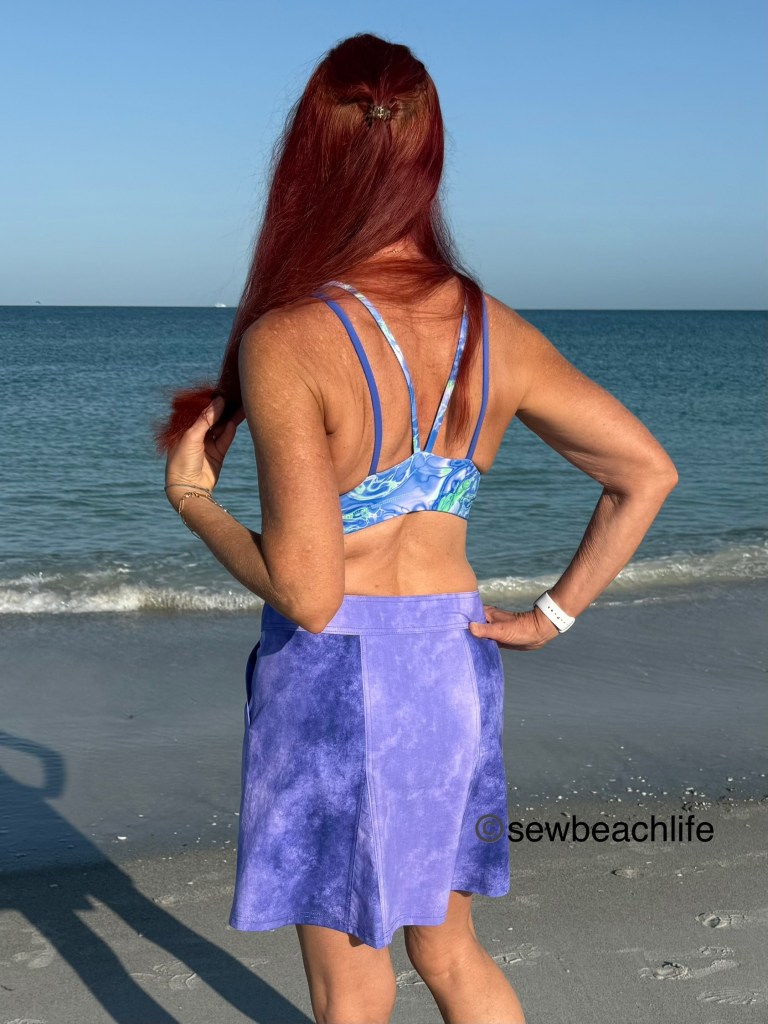
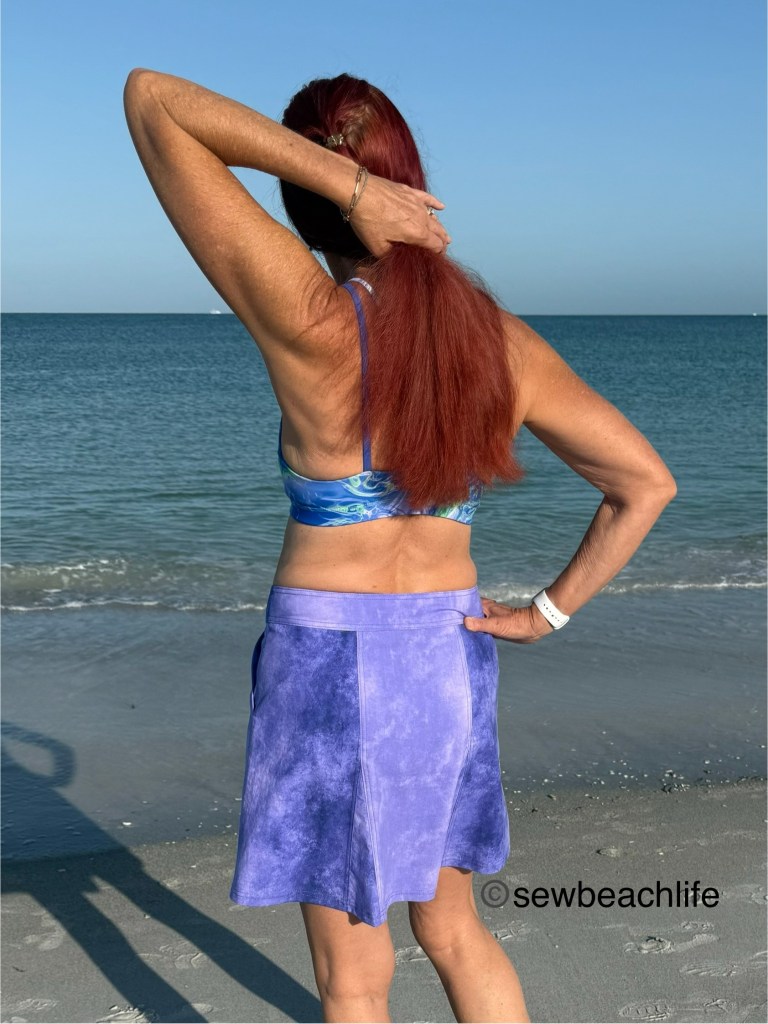
It’s a fun wrap skirt with godets in the back and a contoured waistband for a perfect fit. The pattern tutorial calls for Velcro closures, but you could use buttons or snaps if you prefer. I chose Velcro, and found Sleek & Thin sew on low profile fastener at Michael’s. It truly is sleek and thin, and is so soft that you could use it for children’s clothing. Even the “hook” side of this variety of hook and loop fastener isn’t scratchy at all. I was surprised and impressed at how different it is from the industrial version.
It’s easy to put on or take off the skirt:
And just like that, you’re ready to lounge in the sun, or go for a swim! You’ve got modesty for walking to the beach or pool, and can quickly prep for beach time. It’s simple to slip back on if you’re going out to dinner or walking the neighborhood.
I love the clean finish on the inside of these woven skirts, which is achieved by serging the raw edges of the seams, and top-stitching with a coverstitch. I chose to sew each 3/8″ seam with my sewing machine, then serge the raw edge with a stitch length of 2-2.25 and a stitch width of M without cutting off any of the seam allowance. The seams were pressed in the appropriate directions as per the pattern tutorial, and top-stitched with a wide coverstitch.
I generally use a narrow coverstitch with the needles in C2 and C3 when hemming or wanting a subtle look. But with the fun angles and seams of the Tidal Skirt, I wanted to try the bolder look of a wide coverstitch (with needles in C1 and C3) and accented every single seam!
See how carefully I mirrored each pattern piece on the ombre fabric? I love how the wide coverstitch really pops on all of the seams!
Here are a few tips to make sewing the Tidal Skirt even easier:
When attaching the inner pocket to the outer pocket, I find it helpful to slide my quilting ruler between the pocket pieces and the skirt so that when pinning the curved section of the pocket pieces I can’t accidentally pin into the skirt front.
Ignore the glare of the overhead light fixture reflecting in my ruler, but smile with me at the knowledge that I have a nice bright light fixture to help me see to sew.
To help “tame” the curves when pressing up the hem of the skirt or the bottom of the inner waistband, turn the differential on your serger up to 1.3 (or even 1.5 depending on how deep the curve) and serge the raw edge of the fabric. This will slightly gather it so that when it’s pressed up, the fabric will lay smoothly.
See how smoothly the pressed up hem lays?
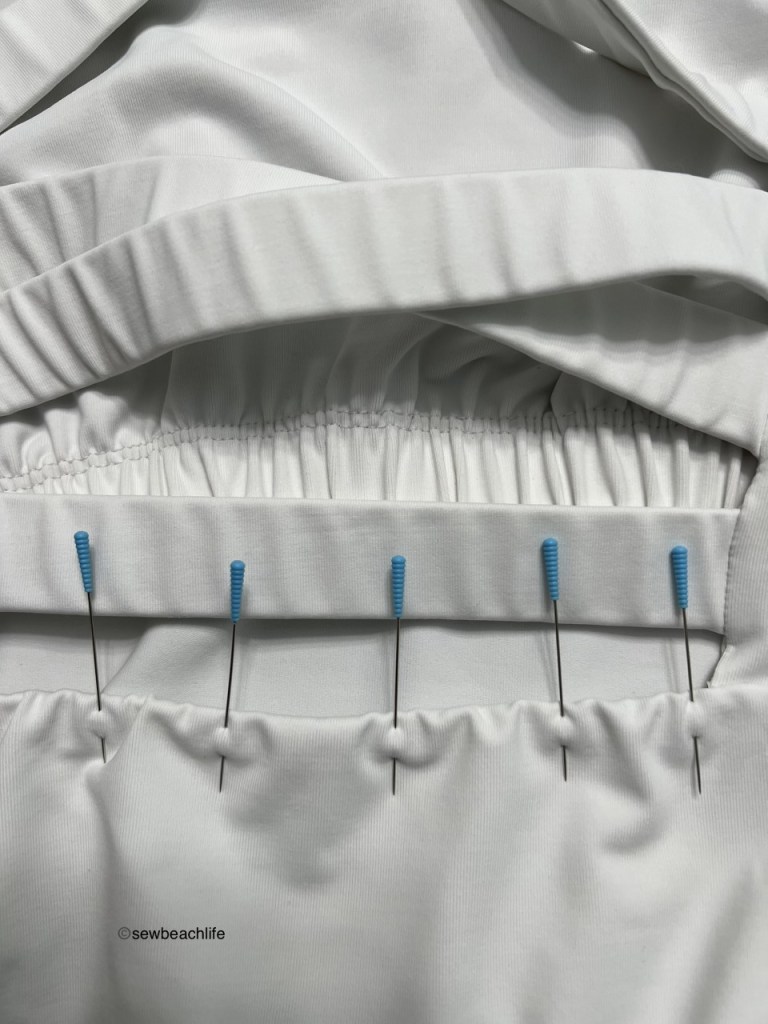
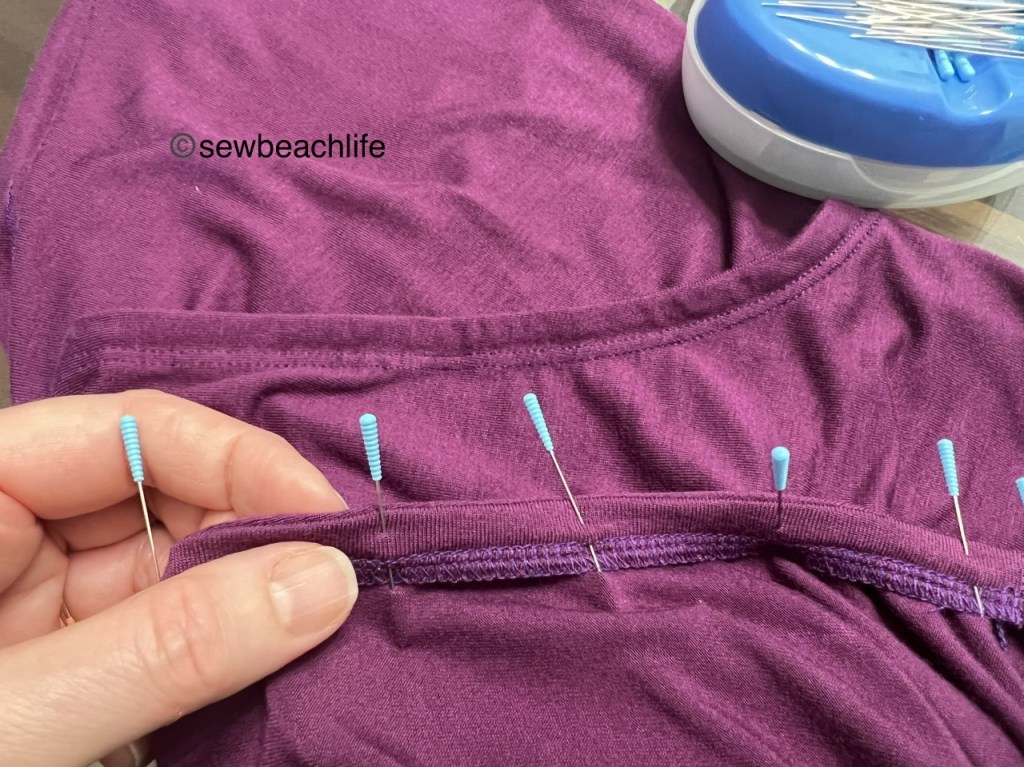
The pattern tutorial has you attach the Velcro by sewing through both layers of the waistband. It’s the simplest way to do so. But the perfectionist in me didn’t want to see those stitch lines on the outer waistband. I wanted the Velcro completely hidden. As per the tutorial I attached the outer waistband to the skirt. Then I attached the inner waistband to the outer waistband along the top seam, but I did not sew the short sides at that time. I tried the skirt on, and carefully marked where the Velcro needed to go with pins. (The pattern piece has markings, but it’s always good to try on and adjust placement if needed.) I folded the waistband open so that I could attach the Velcro through the single layer of either the inner or outer waistband. At that point I folded the waistband back down right sides together and stitched the two short edges. Then it’s back to the tutorial and turning right sides out, pressing, and stitching in the ditch.
*Note: it is very important that you top-stitch or coverstitch all the way around your waistband if you use my method to attach the Velcro as it adds the needed stability.
The Tidal Skirt pattern by Greenstyle uses their new, updated size chart that includes sizes A1 through M3 with waist measurements from 24″-53″ and hips from 33″-62″ so it’s very size inclusive.
The details:
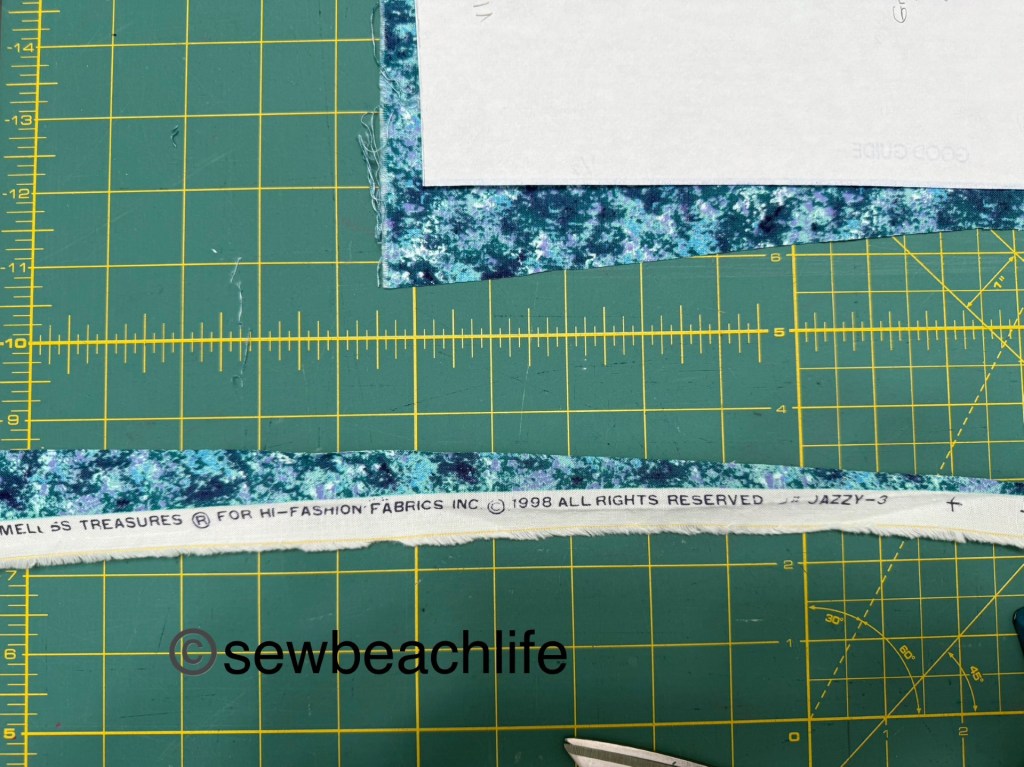
I made size D1 and love that the Tidal Skirt can be made with quilting cotton. I don’t own many woven garment patterns that recommend quilting cotton, so this is a great way to use a fun print or some fabric that’s been languishing in your stash for far, far too long…
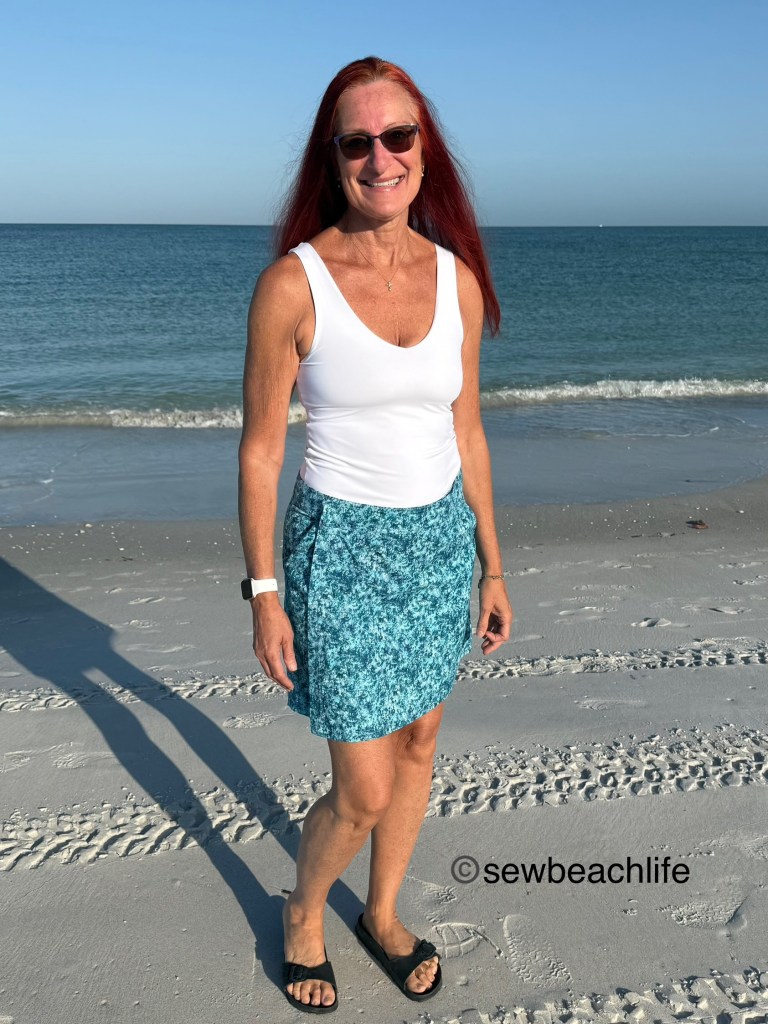
This teal print may be 27 years old, but it worked perfectly for this pattern!
There is a bit of purple in the teal print, so I chose to accent it by coverstitching with MaxiLock thread from Wawak in orchid. I wore my teal skirt with a Bobby Brami, which you can read more about here.
The purple ombre cotton print came from my local(ish) quilt and sewing machine shop in Tampa a couple of years ago. I used Sergin’ General from Superior Threads in periwinkle to serge and coverstitch it. I wore my purple skirt with a slightly hacked Endurance Sports Bra (made with Greenstyle fabric), which you can read more about here. I’ve also worn it with an Azure Tank, shared here.
The links to GreenStylemay be affiliate links (if I did them properly!) which means that I may earn a few pennies if you use my links to purchase, without it costing you anything extra. Since this is my blog and represents me, I always give my honest opinion about any patterns, fabric, or supplies that I talk about. I hope that the time I spend writing posts and sharing sewing tips interests people enough that they take a look at the patterns I review. I write to share my love of sewing, patterns, and fabric, and hope that it encourages others to love sewing as much as I do! ❤
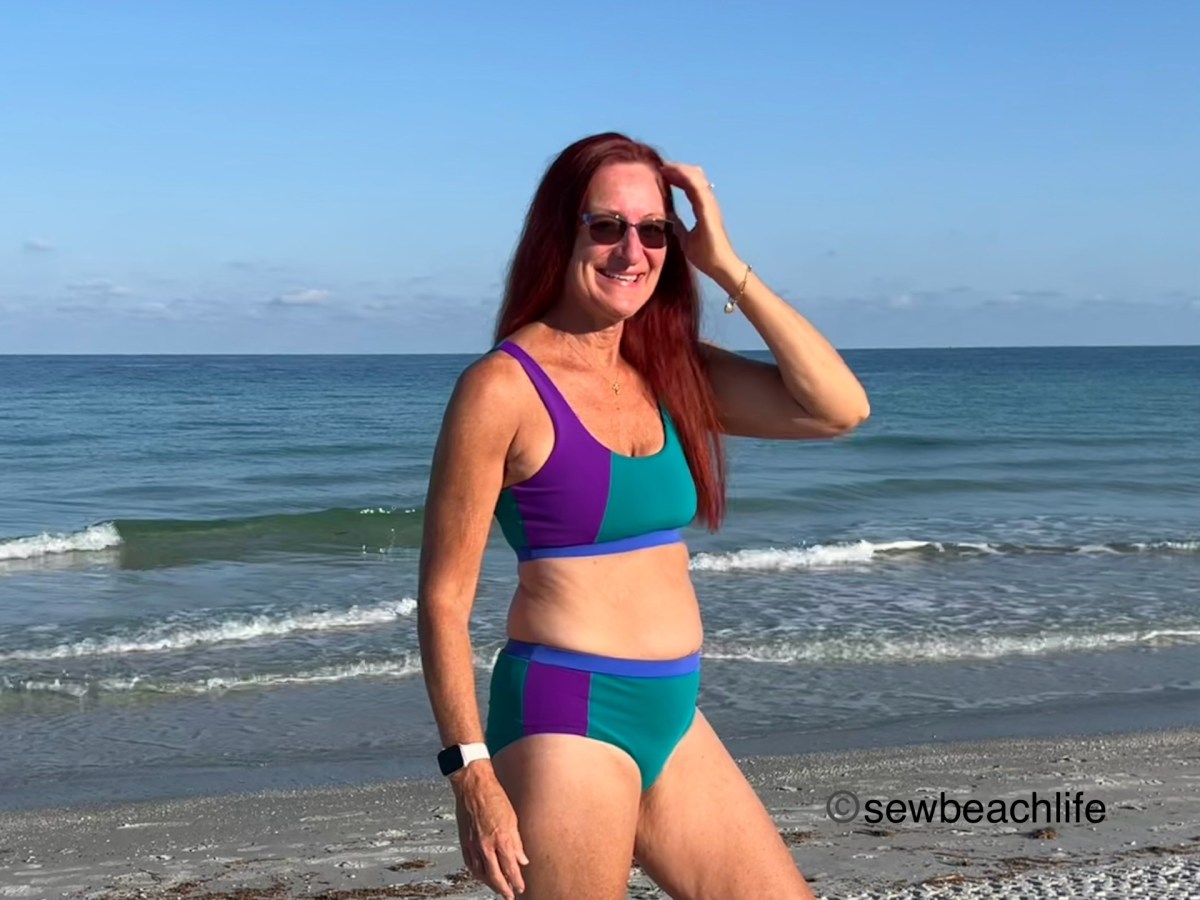
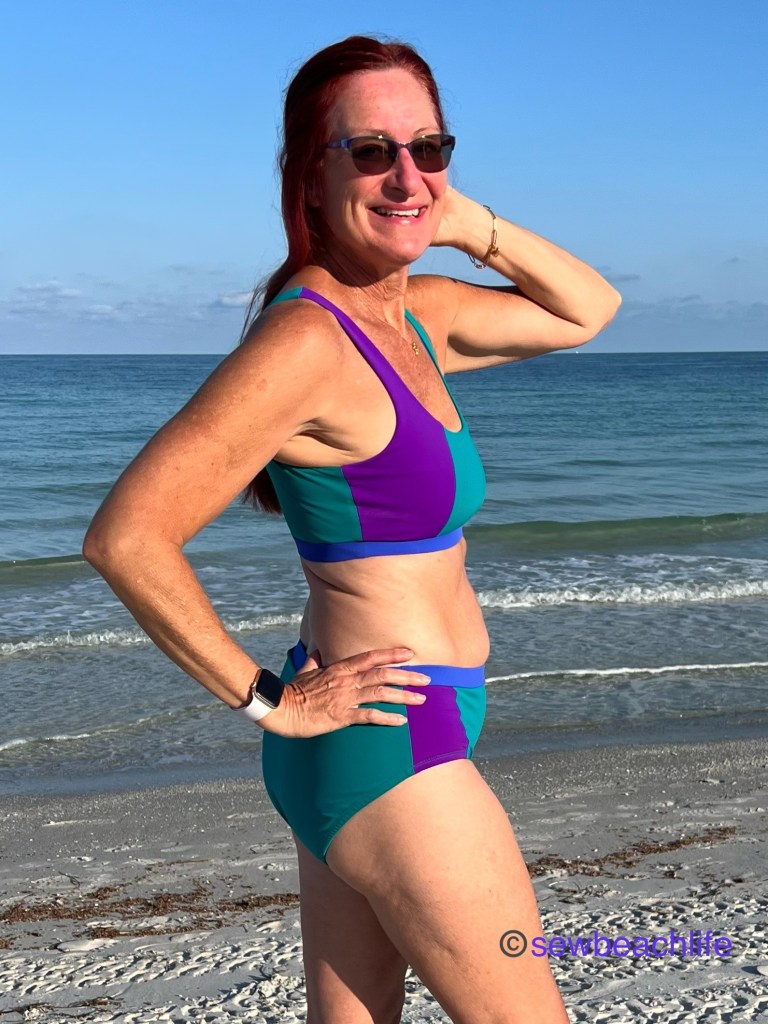
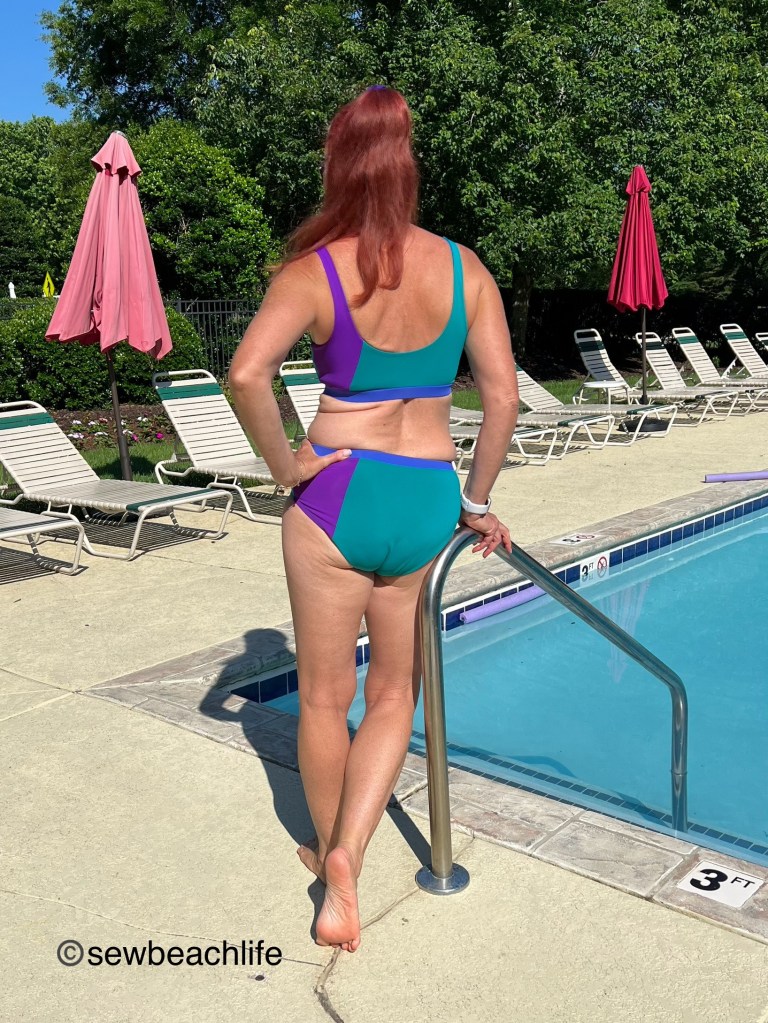
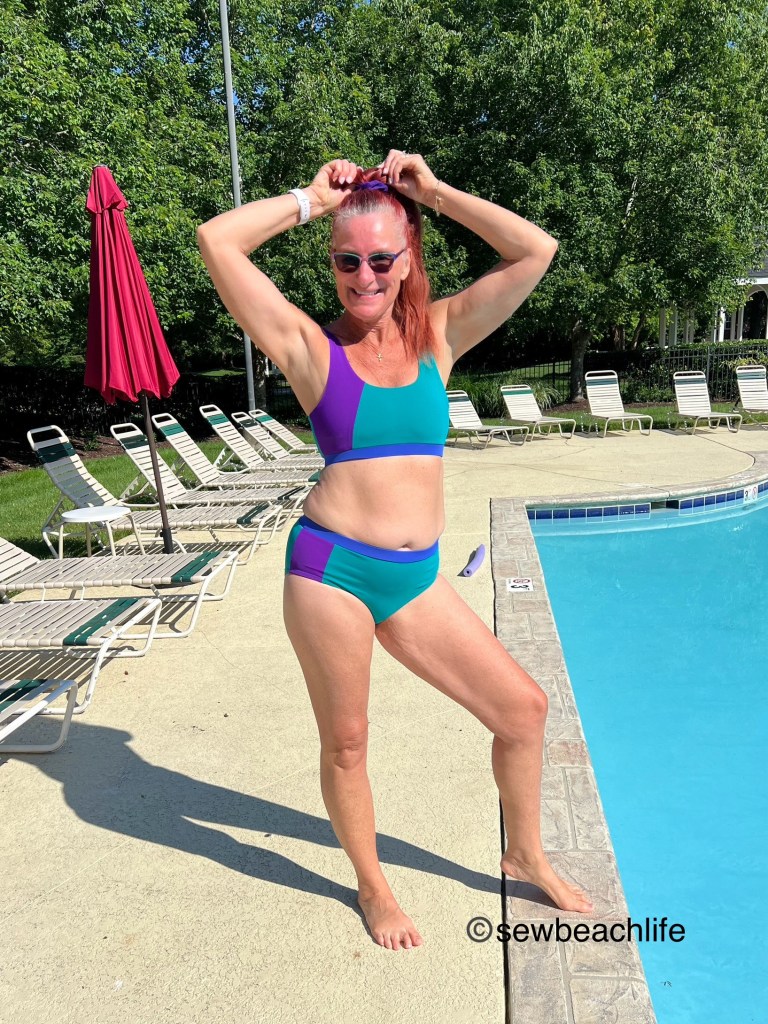
Summer time means new swimwear is in order, and the Tangled Swim Top and Tangled Swim Bottoms have some super fun color-blocking options! The hardest part will be choosing which fabrics and options to use. The top has a scoop neck front, with back options of full coverage, high scoop, and low scoop. Everything from a simple front and back to multiple color-blocked designs give you the chance to use those smaller scraps of fun swim fabrics you’ve been saving.
This shot makes me feel skinny. 🙂 That intermittent fasting is starting to pay off! Don’t get me wrong, healthy eating and exercise are part of the deal.
The Tangled swim bottoms have even more color-blocking options than the top! I chose the asymmetrical two-piece color block design for the front and the back, and I love being able to use three fun colors for a nice bright suit. The bottoms have a full coverage and a slightly cheeky back coverage, along with high or low rise options. I used the high rise, elastic waistband option, but there’s also a contour waistband that would make the rise even higher.
I like showing how patterns look while you’re seated too. Because you’re not just going to stand around when you’re out of the water!
I like the lowest back option, and wanted to make the back have the same asymmetrical two piece look as the front and the bottoms. So of course I had to hack it. 😉 I can never just leave a pattern alone.
Don’t you love the way the design carries from the top down to the bottom?
It was super easy to transfer the design from the front to the back. So, my method of tracing patterns is to consolidate the options I plan to use onto one pattern piece if feasible. I knew I was going to make the simple version of the top and bottoms which I did before moving onto the color-blocked versions.
I didn’t bother adding powernet in the front of the green top, which I kind of regret.
Once I had the simple front and back traced, it was super easy to trace the cutting lines for the asymmetrical two piece front right onto my simple front. That way I don’t have smaller pattern pieces floating around in my pattern envelope. I like to use different colored pencils to mark the left side cutting line and the right side cutting line. I also use arrows to ensure that I cut on the proper line so that I have adequate seam allowance! The marked cutting lines should end up 3/4″ apart (3/8″ seam allowance + 3/8″ seam allowance = 3/4″).
To hack the back to have the same asymmetrical two piece look, I simply laid the simple back pattern piece on top of the marked front piece, and traced the left and right cutting lines, again labeling with my colored pencils.
I always mark my pattern pieces with any changes or notes (as you can see, version 2 of the pattern testing lowered the bottom of the armscye by 1/4″) and always mark the grainlines.
I love how the two-piece asymmetrical back hack brings that extra pop of color to the back and side. And that the angled cut of the top flows right down to the angled cut of the bottoms.
Even though this isn’t a super revealing swim suit, I love that it still looks and makes me feel sort of sexy.
GreenStyle is listing the Tangled Swim Top and Tangled Swim Bottoms patterns separately, so if you want to mix and match with any of their other swim tops or bottoms, you can choose the styles and patterns you want to use.
If you’ve never sewn swimwear before, I encourage you to try it. My best tips are to use fresh needles in your sewing machine and/or serger. Use plenty of pins to line up seams. I like to baste my swim lining to the main fabric of the swim bottoms before attaching the waistband or leg elastic. It keeps the fabric smooth and even, and ensures that you won’t have to rip out the elastic because you somehow didn’t catch a layer of fabric.
Speaking of elastic, the amount of stretch can vary from manufacturer to manufacturer. So rather than just looking at the elastic cut chart, I literally wrap the elastic around my waist and leg to choose a comfortable yet snug length. Then I mark that information right on my pattern piece for the next time I want to make it.
If you’ve ever had leg elastic “flip out” on you, then this next tip will really help you. Once you’ve sewn your leg elastic into a circle, mark the quarter points. I just use a pencil. Then I mark the quarter points of the leg opening with pins. I like to serge on the elastic using a stitch width of M, and a stitch length of 2.25, stretching the elastic so that the mark lines up with the pin. Then I turn the elastic under, and pin in place. Whether you use a coverstitch or a zigzag, be sure to sew along the serged edge, NOT along the fold. This will keep the elastic firmly in place, rather than allowing it to flip out.
I’ve worn my suits in the pool and played in some nice waves in the ocean. Everything stayed in place, even in the big waves. So whether you hit the pool, the lake, the ocean, or a river, the GreenStyle Tangled Swim Top and Bottoms are a fun addition to the season!
The pool photos were taken at a community pool, and I sometimes wonder what other people think when they see me acting silly and posing for the camera. Probably nothing more than they think when I pose at a crowded beach. 🙂 Honestly,I don’t worry about it because A. I’m having fun, and B. There will always be people who look better, or perhaps less fit than me. And we’re all here to enjoy the sunshine, enjoy being near the water, and to have fun! And face it, most people are so caught up in their own lives to even think or worry about what you look like. So get out there in a swimsuit and enjoy life!
Thank you for reading and sharing my love of patterns, sewing, fabric, pattern hacking, and cute swimwear! ❤
The links to GreenStyle may be affiliate links (if I did them properly!) which means that I may earn a few pennies if you use my links without it costing you anything extra. Since this is my blog and represents me, I always give my honest opinion about any patterns, fabric, or supplies that I talk about. I do like knowing whether the time I spend writing posts actually interests people enough that they take a look at the patterns I review, but I write for me. It’s one more creative pursuit that I hope is helpful or interesting to others. I write to share my love of sewing and to encourage others to love it as much as I do! 🙂
Sports Bras are kind of a staple in a lot of women’s wardrobes. Whether you wear them for sports, exercise, work, or just because they’re cute and comfortable. The challenging part is finding one that fits properly. Ready to wear sports bras often only come in basic sizes like XS, small, medium, large, and XL. While sizing like that may give an okay fit on some people, I think that it is unlikely to get a great fit with such limited sizing. Which is why I like making my own.
I started making GreenStyleEndurance Sports Bras this summer, and now have three, customized for my style. Funnily enough, none of them are made exactly per pattern directions with a front zipper and bound edges. What can I say? I’m no stranger to pattern hacking, and think it’s fun to try different looks by playing with a pattern.
The great thing about the Endurance bra pattern is that it has specific band and cup sizing. It’s designed to fit a full range of band sizes 28-40, and cup sizes B-H. You get a much better fit when you have cup size options! Speaking of fit, following the measurement chart is the best way to choose your size. My 32″ underbust (ribcage) measurement put me in a 32 band, and my full bust measurement put me in the E cup. The band is a good fit, but I neglected to take into account that the pattern cup pieces are intended to fit over bra foam pieces formed into cups, and I was not using the bra foam layer. So, the 32E sports bra fits, but it’s not snug. I don’t know about you, but I like my sports bras to fit snugly.
It’s still super cute, and I wear it all the time, but I knew that a 32D would fit better, at least with the way that I hack the pattern to use powernet basted to the wrong side of the main fabric, rather than using bra foam. So I made my second Endurance in a 32D.
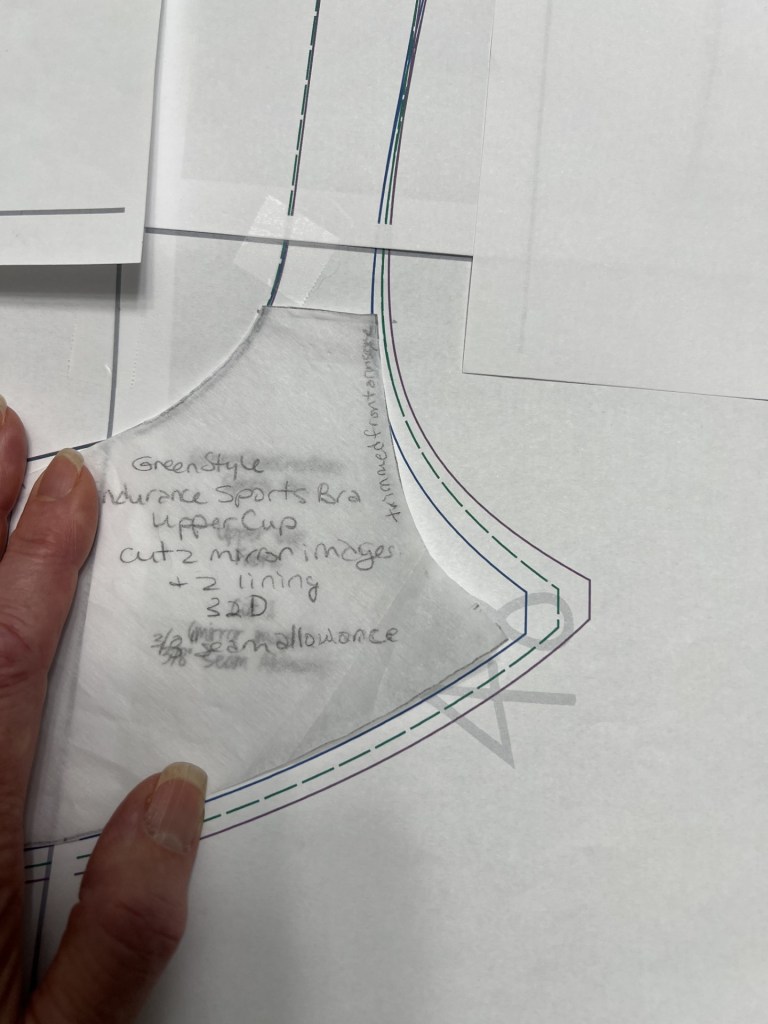
As you may have noticed, beyond hacking the pattern to not use foam, binding, or a zipper, I also changed the straps. Rather than using the all one piece upper cup and strap, I trimmed the strap off about 3/8″ above where the strap starts. Since my bust is fuller at the bottom than the top, I also trimmed back the curve at the armscye.
I don’t show full pattern pieces out of respect for pattern designers hard work, but you can see where I trimmed off the strap and trimmed back the upper portion of the upper cup piece.
I thought it would be fun to have double straps, so I made straps out of 1-1/2 wide strips of fabric folded in half right sides together, zig-zagging over 3/8″ wide knit elastic that was aligned with the raw edge of the fabric, so that the zig just goes off the edge of the elastic and into the middle of the fabric, with the zag into the elastic, then turning the straps right side out and pressing.
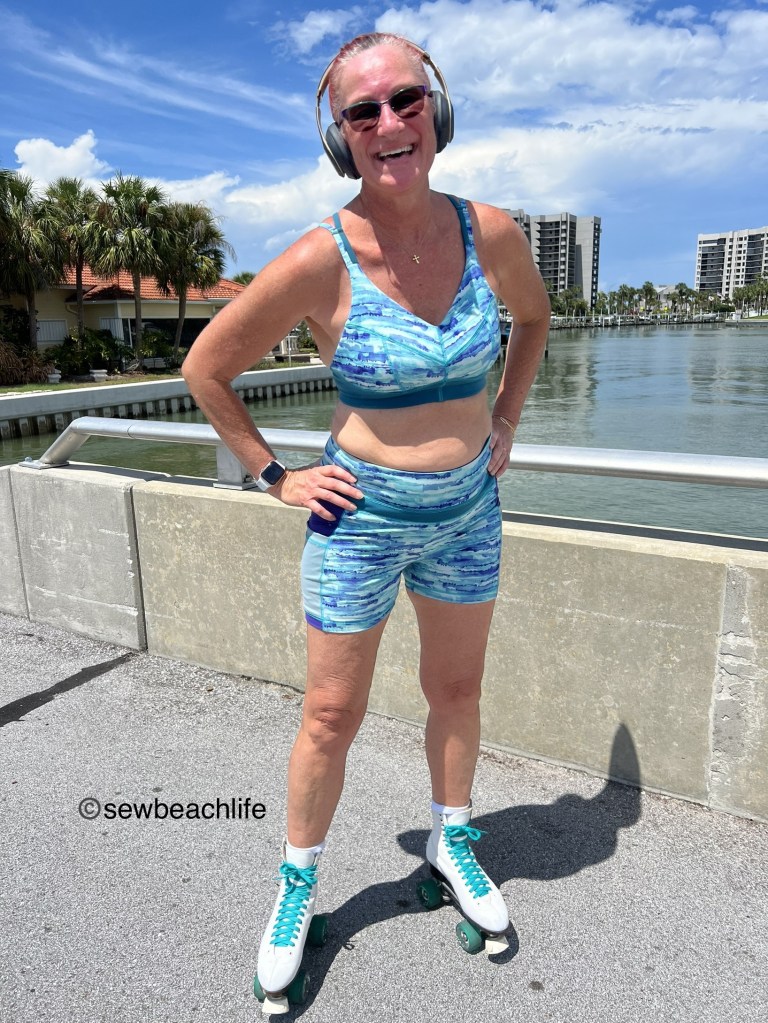
The V and straight combination of straps is a unique look, along with providing additional support.
I basted two straps at center back, and placed the other two straps at 2-1/2″ away. After sewing the main and lining together along the top edges (except at the strap opening) and turning right side out, I tried the bra on to judge strap lengths. The center V straps ended up about 15″ long, and the straight straps about 14″ long. The length you need may vary depending upon the stretchiness of your elastic. I threaded the two straps on each side through sliders because it looked cute, and to give a slight amount of adjustability.
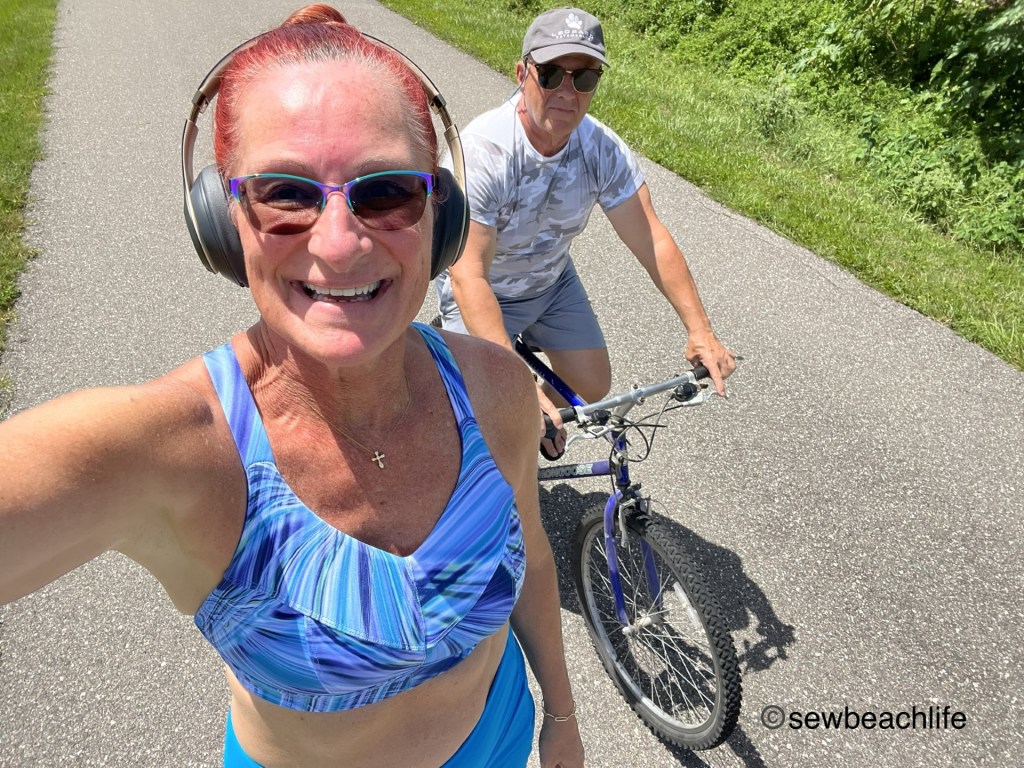
Aren’t the sliders a fun touch? And aren’t I lucky to have such a great wingman to ride along with me as I skate?
For my second Endurance I used size 32D, and again just sewed the center front together rather than using a zipper. For this version I made straps with 1″ wide knit elastic threaded through them.
The 1″ wide straps give great support!
Instead of skating around the neighborhood like I usually do, we decided to check out a county trail system. It was a workout with the little hills and elevation changes, but fun to have a change of scenery and to see the bicyclists and walkers that use the trail.
The trail is paved, and there are benches along the side every so often. It does cross quite a few busy streets though, so there are 4 way stops. You really have to watch for cars because they have a tendency to do more of a “rolling stop” than a complete stop.
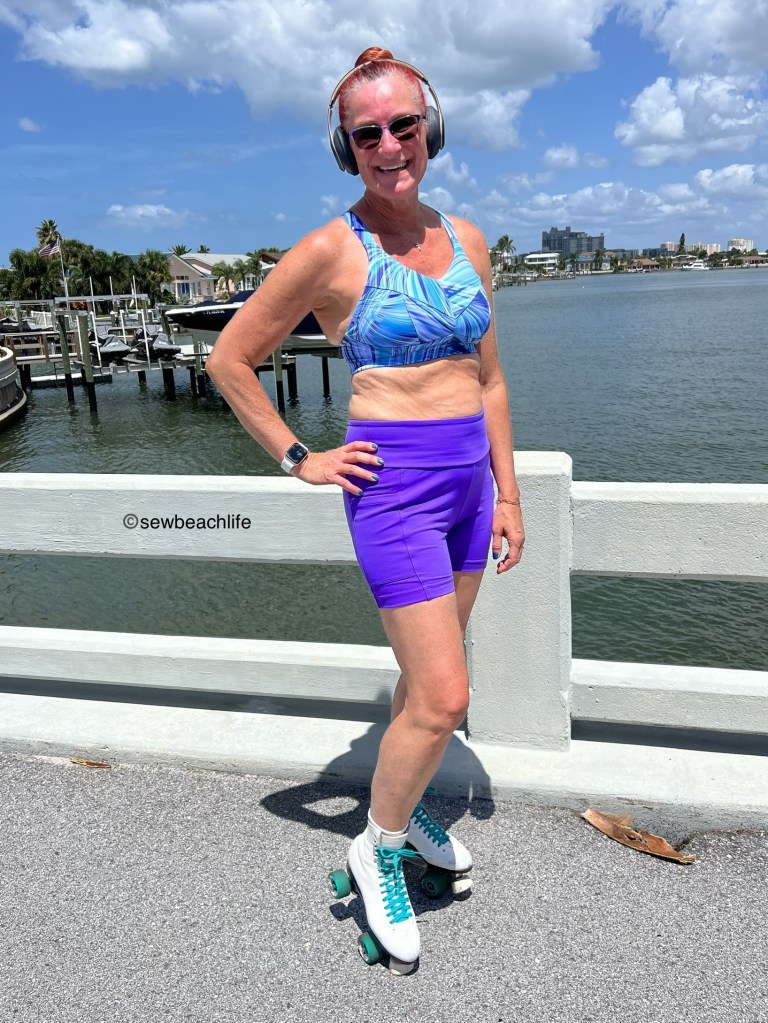
The straps are just crossed in the back for a typical X back look.
Florida sun is intense, so don’t forget the sunscreen!
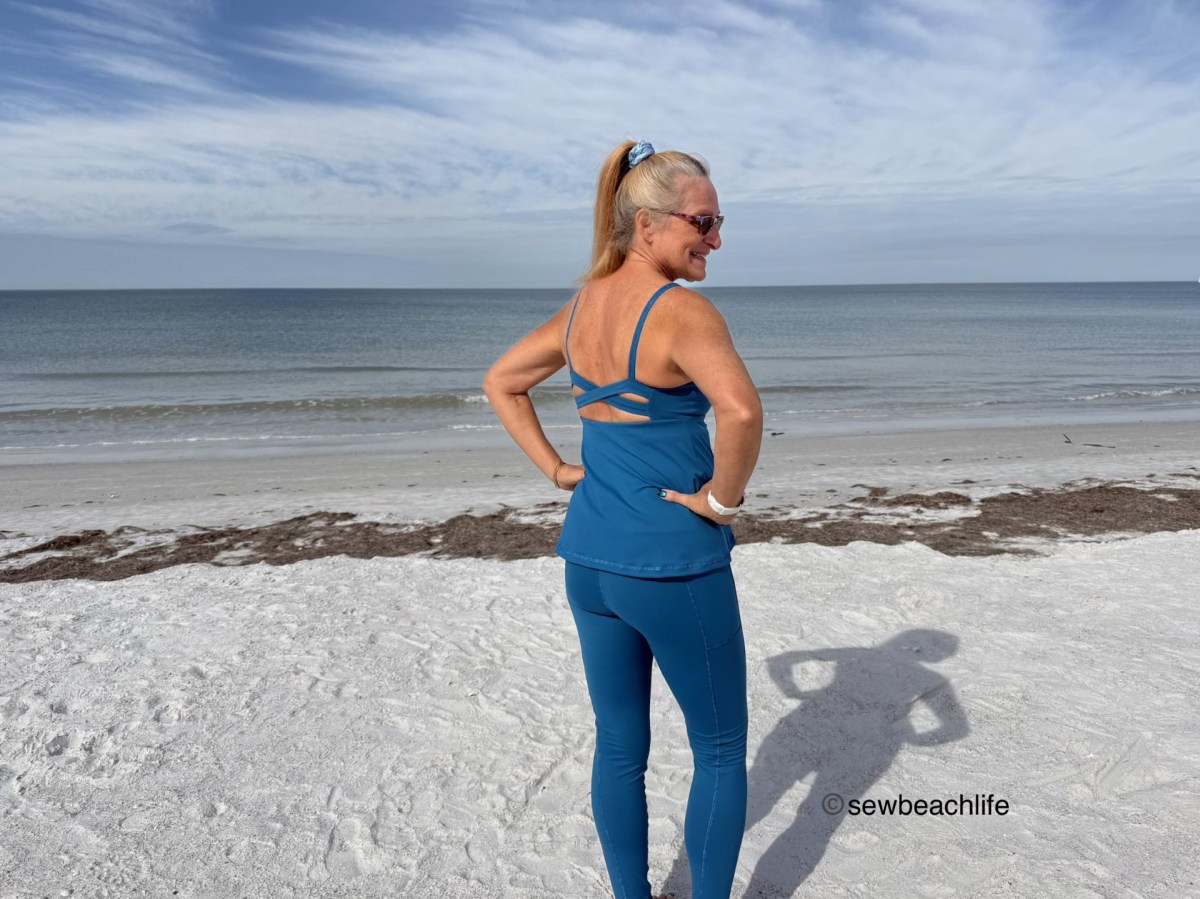
My new outfit (because of course I *needed* another outfit for skating) is an upcyle. I used some old capri length leggings and a workout top that was too big, unpicking them to salvage the pretty fabric. Working with limited fabric means that you’re going to get a scrappy look, but I tried to get intentional with it.
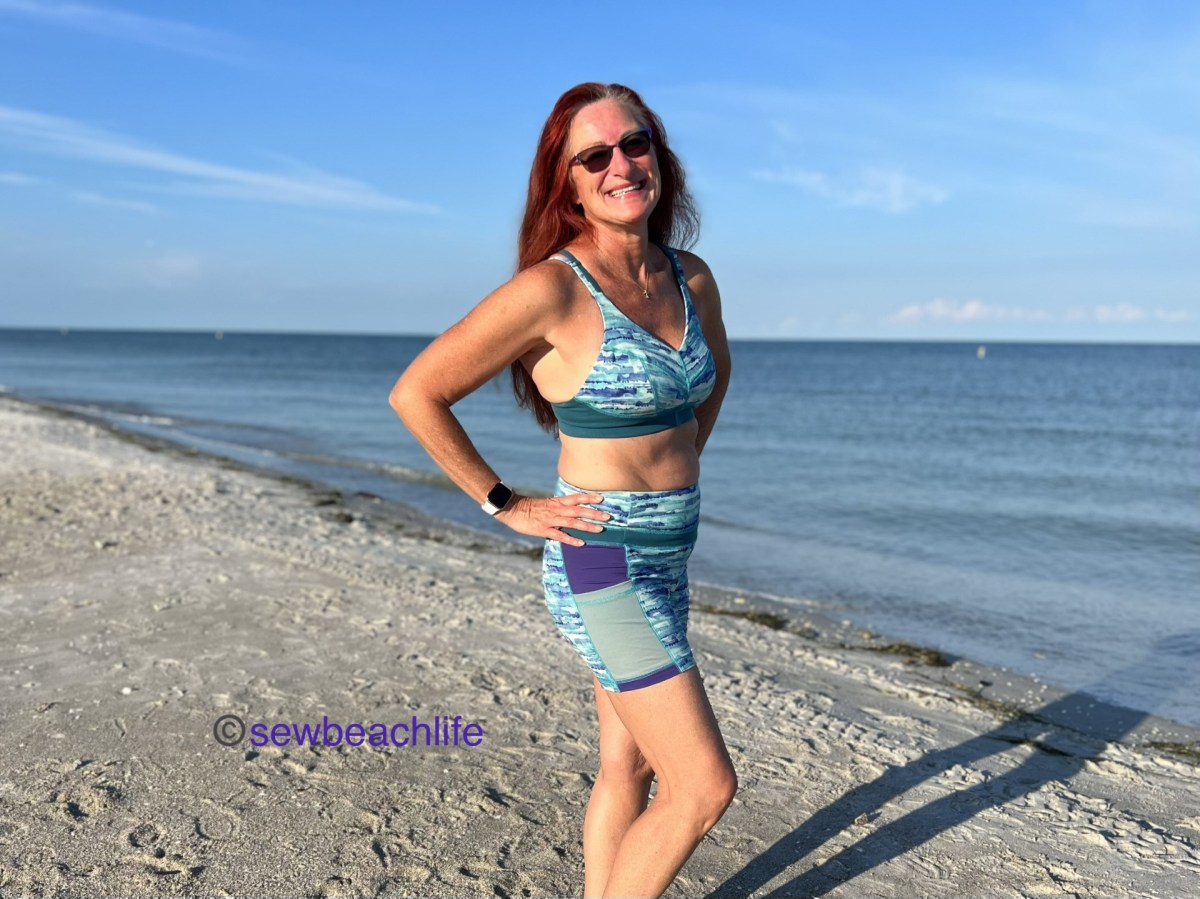
I managed to get the GreenStyle Moxi bike shorts front and back pieces, along with the Endurance Sports Bra cup pieces out of the capris. The old waistband fabric wasn’t as tall as the Moxi waistband, so the bottom 2″ of waistband was cut from the old teal workout top. Using the teal for the band of the Endurance bra gave it a nice contrast. I had to dig into my stash to cut the lining layer of the bra, along with the side panels of the shorts. The pockets were cut from the mesh panel that was in the center back of the old top. Like I said, it’s a scrappy look!
Looking scrappy (and happy) because I got to skate.
I love the support the bra offers, and the fact that it can double as a swim top. The V and straight straps are my favorite, so I used them on this bra too.
It’s fun to provide entertainment value by trying to take photos with cars occasionally driving by! 🙂 All you can do is laugh when someone rolls down their window and says, “Looking good!”
Reverse triple coverstitching helped soften the look of the multiple fabrics and bring them together. Superior Threads Sergin’ General thread in teal was a great match to the fabrics.
Don’t be afraid to upcycle, to hack, to adjust, to experiment, and to play with patterns and fabric. I also encourage you to rollerskate for fun and exercise. Even if it’s been a while, you’ll pick it back up. And like anything else, the more you practice, the better you get.
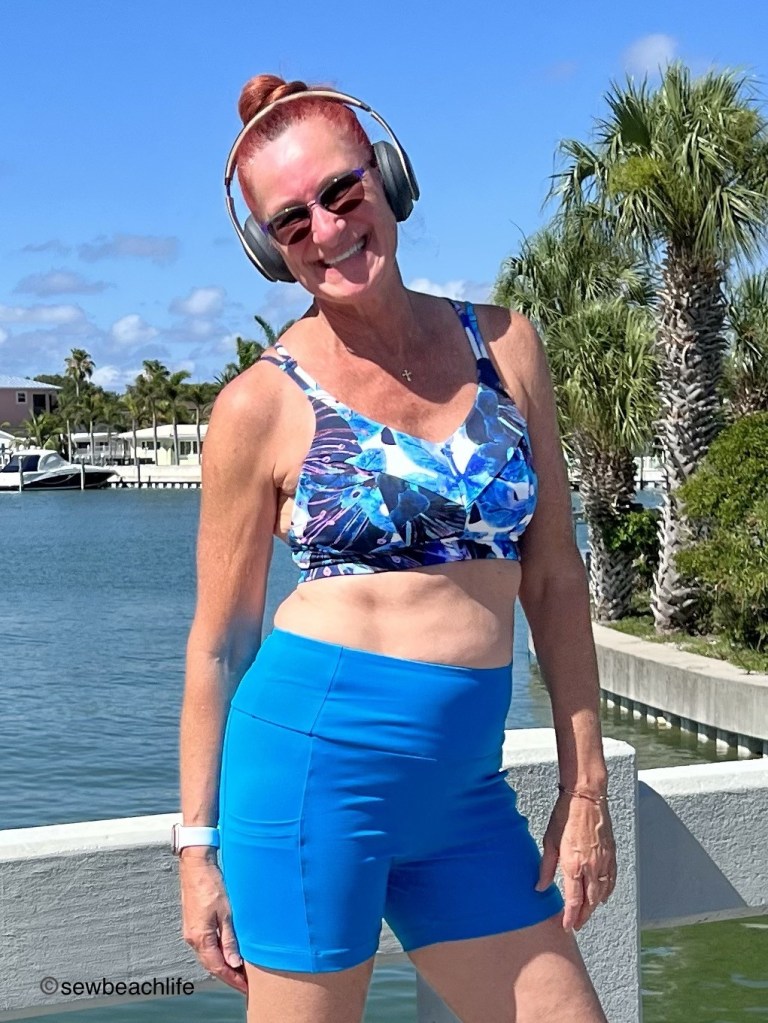
The details: I’m wearing the GreenStyle Endurance Sports Bra and the bike shorts from the GreenStyle Moxi Shorts pattern in all these photos. The navy and turquoise floral print is Align 2 fabric from GreenStyle.
Both the turquoise and purple shorts are supplex from Phee Fabrics.
The swirly print fabric used for the X back bra was secondhand fabric so I don’t have any information on where it’s from.
You can make your own sports bra, and can customize it to fit your needs. It’s worth the sew! And a few more photos just because I have so many to share. 😉
Thank you for reading and sharing my love of creating, hacking, sewing, serging, great patterns, fabric, and making beautiful, well-fitting garments! ❤
The links to Greenstyle may be affiliate links, which means that at no extra cost to you, I may receive a few pennies if you purchase through my link. As always, I only give my honest opinion. After all, it is my blog, which represents me!
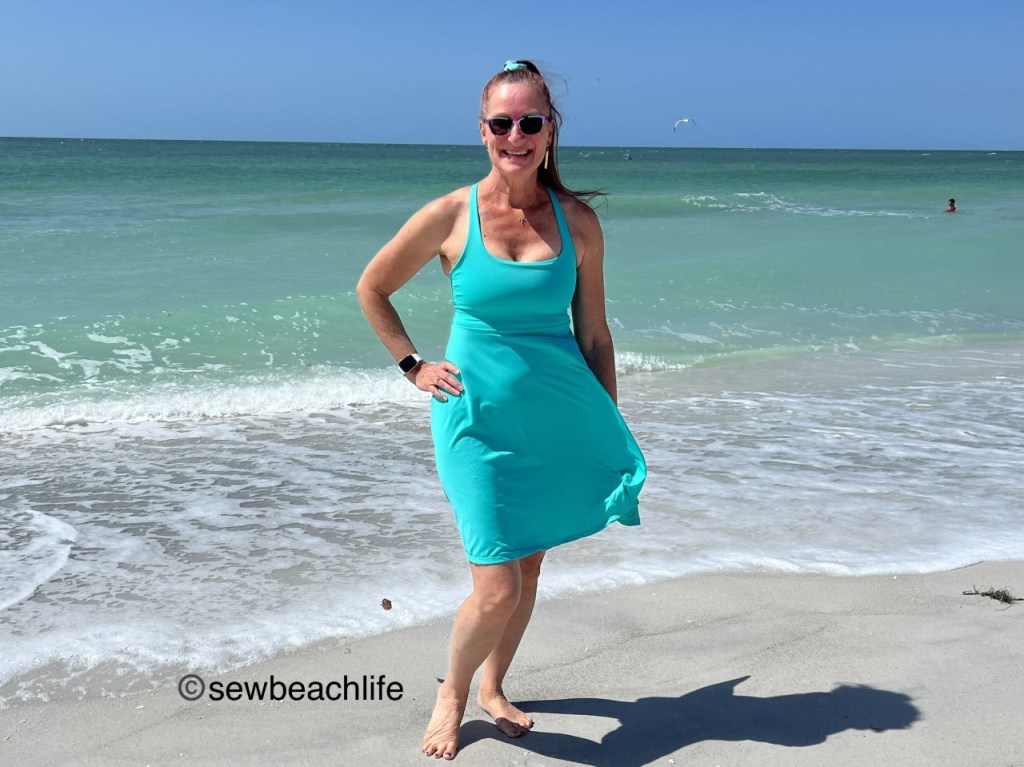
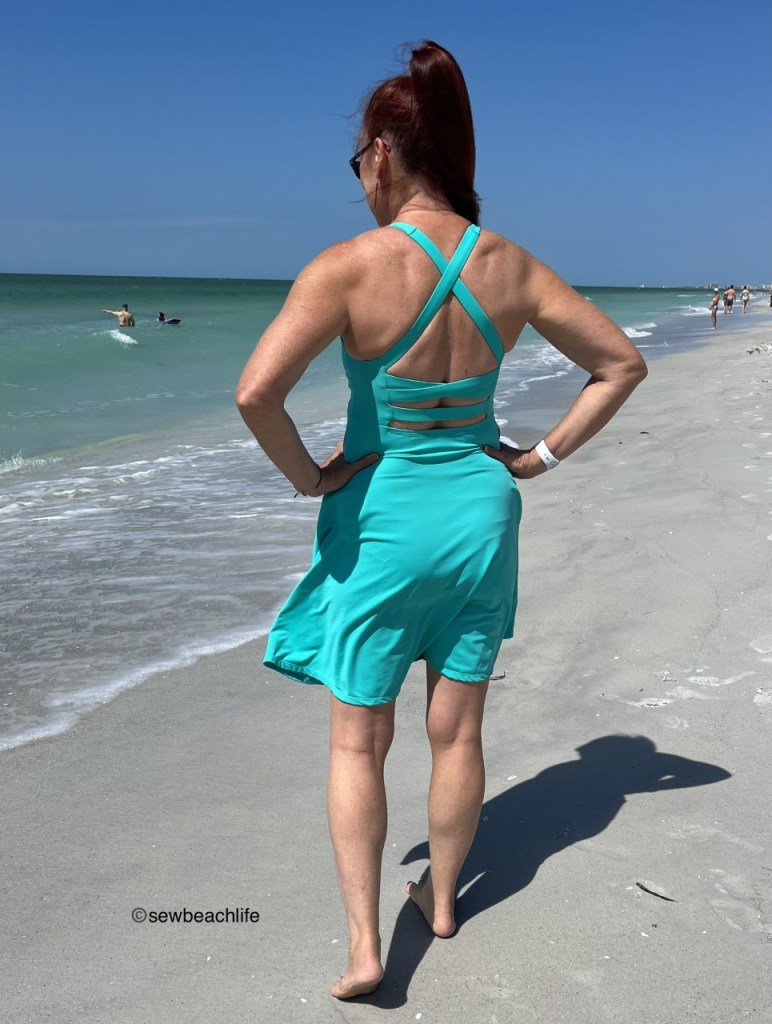
I’m pretty discerning when it comes to pattern testing, and only test when a pattern looks like something that would get a lot of wear. When I saw the tester call for the Stitch Upon A Time Spellbound Bra and Dress, I applied right away. That criss cross back is exactly what I’ve been looking for!
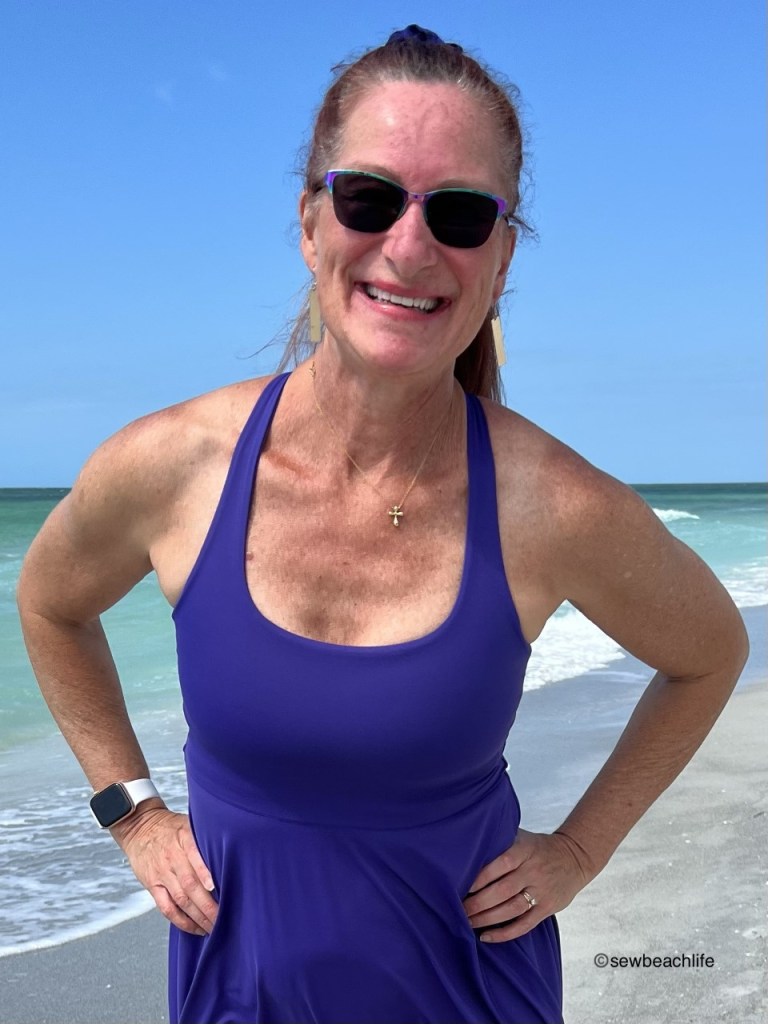
When you’re a bit busty, you’ve got to love a pattern that has cup sizes. Seriously! There don’t seem to be many designers in the .pdf (or paper) pattern world that include multiple cup sizes. Including cup sizes makes a pattern fit so much better. The Spellbound includes sizes XXS to 6X, along with cup sizes A-G (determined by the difference between your full bust and upper bust). Per the measurement chart, I made a size small D cup. The size chart on this is spot on, and did not require any grading. The strap lengths were perfect (which seems amazing to me because obviously there is a lot of math involved to get all five strap pieces the proper length for each size).
Although it is a shelf bra and relies upon compression, I feel quite comfortable with the amount of support. If you wanted to, I suppose you could add bra cups during construction, but I don’t feel the need to do so. This is coming from a girl whose regular bras have underwires, so that is saying something!
Pretty and supportive!
There are usually changes and updates during testing, which is kind of the point. A designer wants to ensure a great fit on real bodies in a wide range of body shapes and sizes. A higher neckline option was added for anyone that prefers a little more coverage. Another tester and I commented that we wanted to hack the bra into a dress, and Kelly (the designer) made that happen!
Why does it always seem to be windy when I try to take photos of a new make?
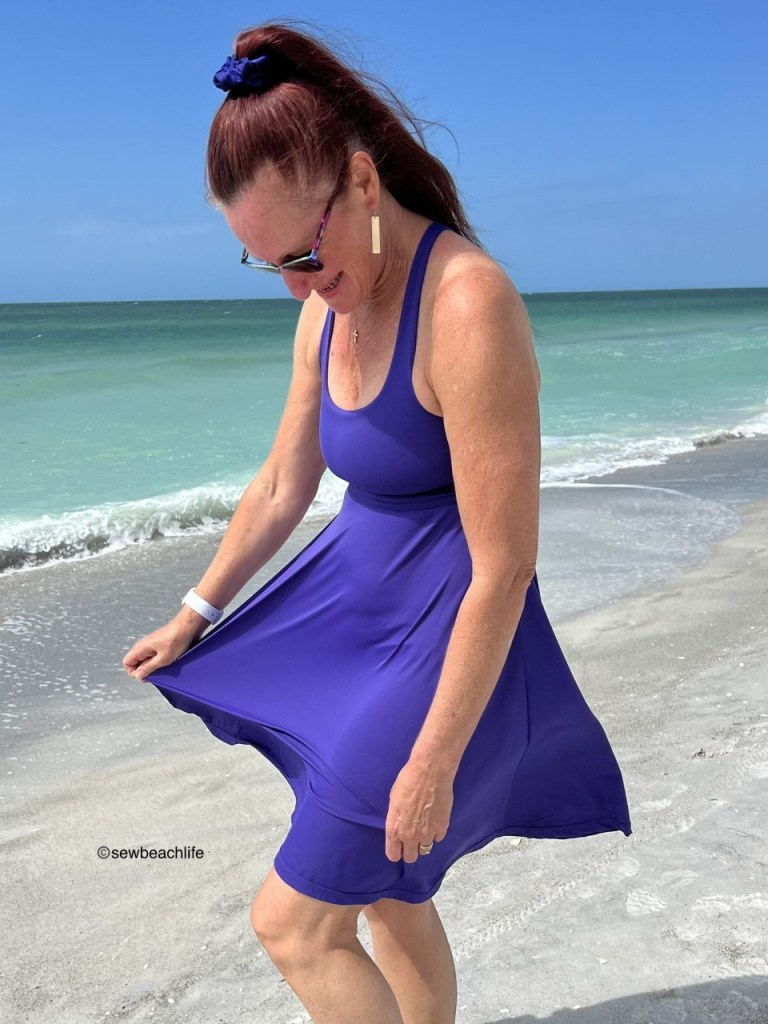
Having this bra pattern turn into dress just makes me so happy! I love, love, love it! The half circle skirt is swishy, but not too full. It’s super easy to get dressed for the day when you can wear a dress with a built-in bra. The knee-length option hits in just the right place, even on a taller girl like me.
I know some people get frustrated when trying to hem a knit skirt with a curved hem, but here’s my not-so-secret tip to make it easy: serge around the raw hem of the skirt with a 4 thread overlock with a stitch width of M, stitch length of 2, and up the differential to 1.5. This will slightly gather the hem, curling it up, which helps it to lay flat to hem. Then I like to pin up a 5/8″ hem and coverstitch it. It turns out perfect every time. Make sure to follow up with a nice press for a professional finish.
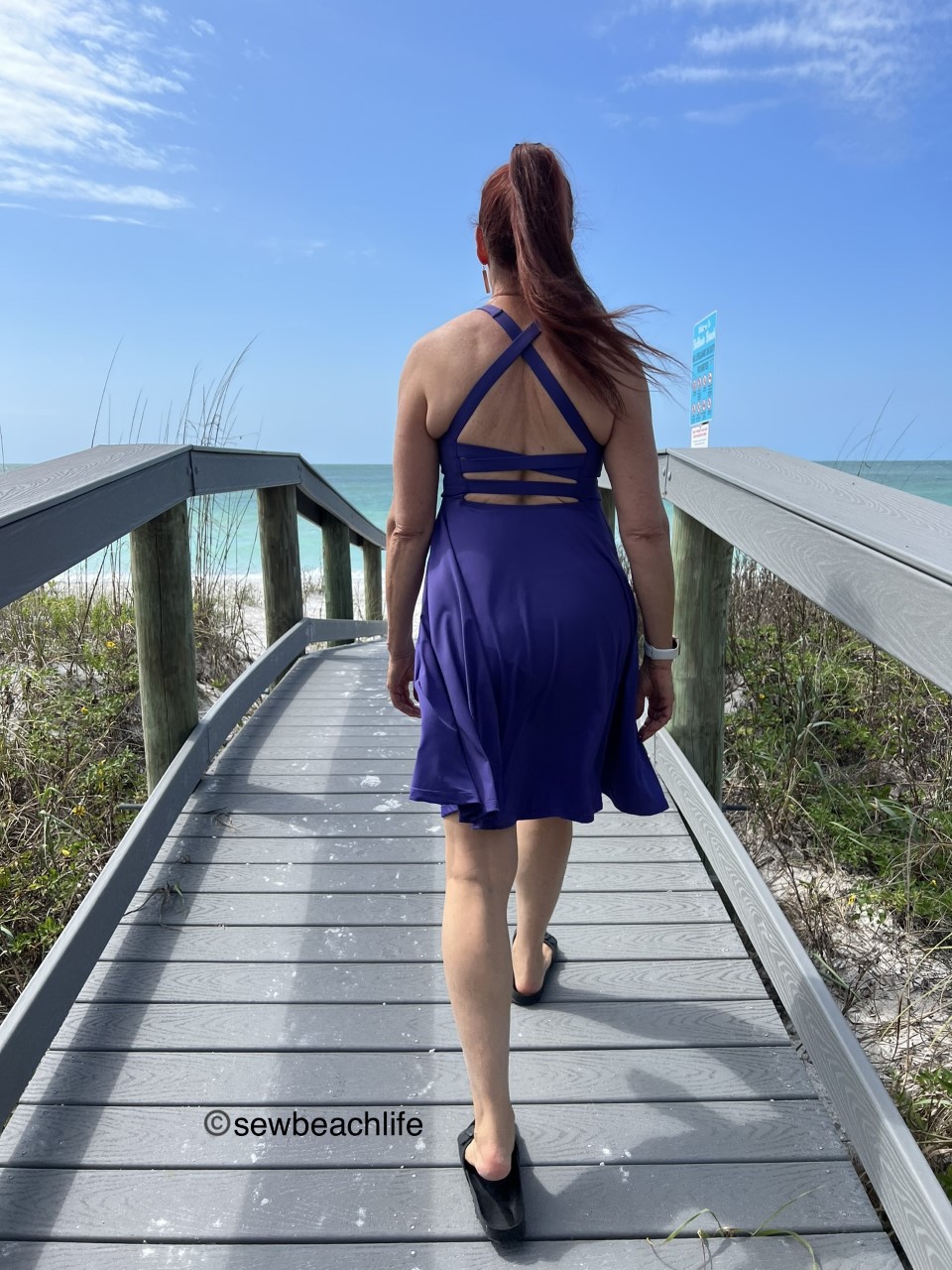
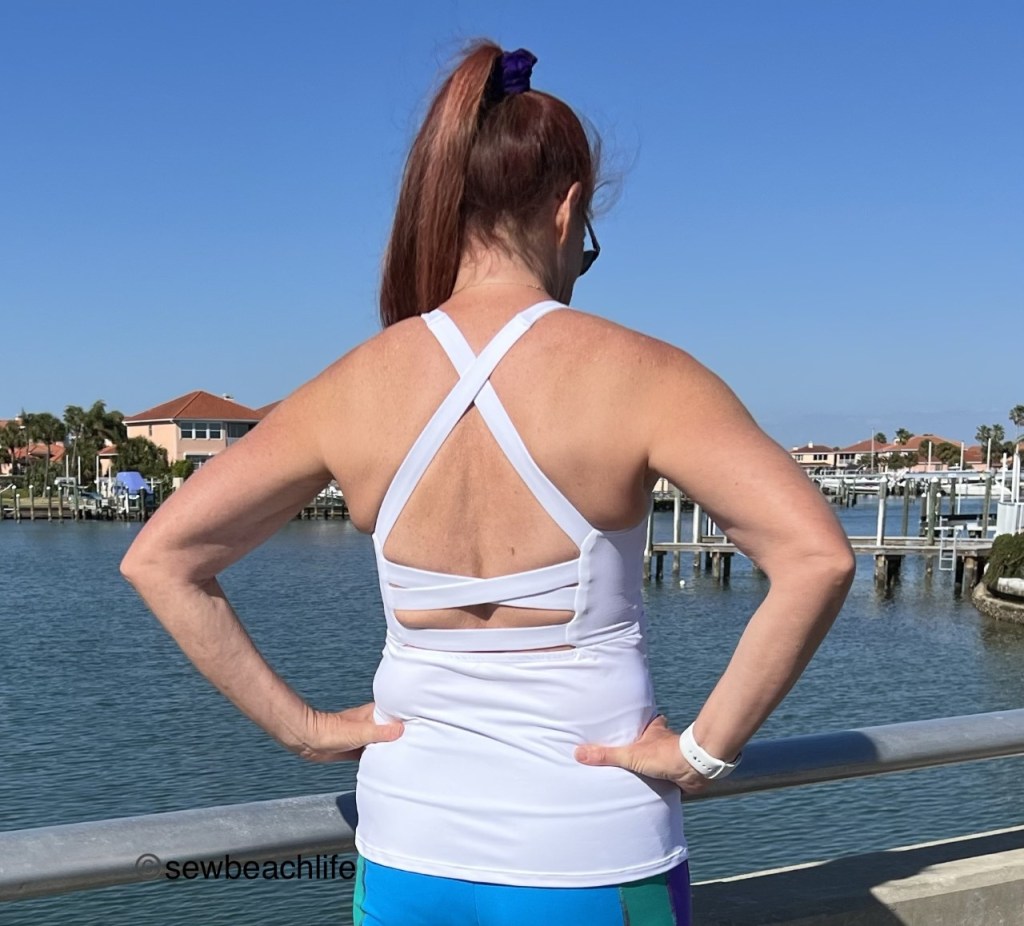
The criss-cross straps show just enough skin to look and feel sexy. Combined with the supportive front, it’s definitely a confidence boosting look for me.
Obviously one dress wasn’t enough for me, 😉 so I’ve already made two. I’m contemplating over what fabric I should try next. The turquoise dress is a nylon spandex tricot (swim) fabric. The purple dress is a nylon spandex circular knit. Both fabrics were purchased from Phee Fabrics a while back, so I don’t know if these particular colors are still in stock. It’s important to use fabric with good stretch and recovery (rebound factor) so that the bra fits well and stays somewhat firmly against the body. If you have a larger cup size, I also recommend using powernet. Though it is optional, I like the extra bust support it provides.
No matter how far forward I lean, I still feel supported.
I can wear my dresses to walk the beach, or go to the grocery store, or out to dinner. (If it’s at a restaurant that has gluten and dairy free food that’s safe for me to eat!) which is quite the challenge for me. My journey of food allergies deserve a discussion of their own on Sew Beach Life, and will probably be my next post.
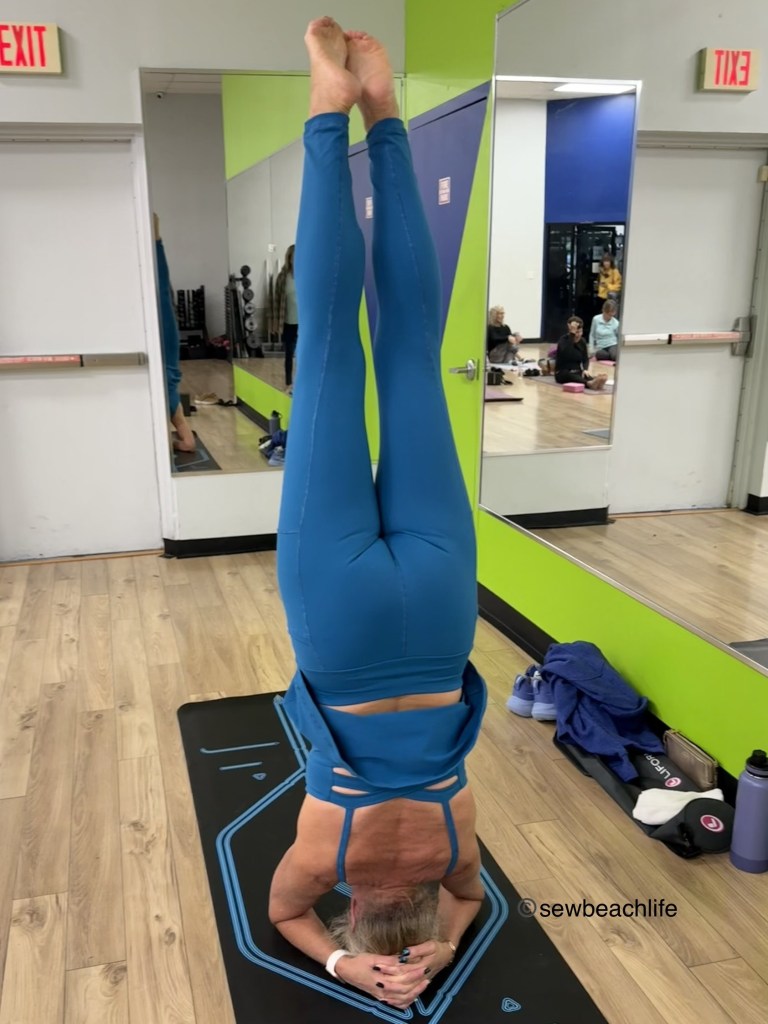
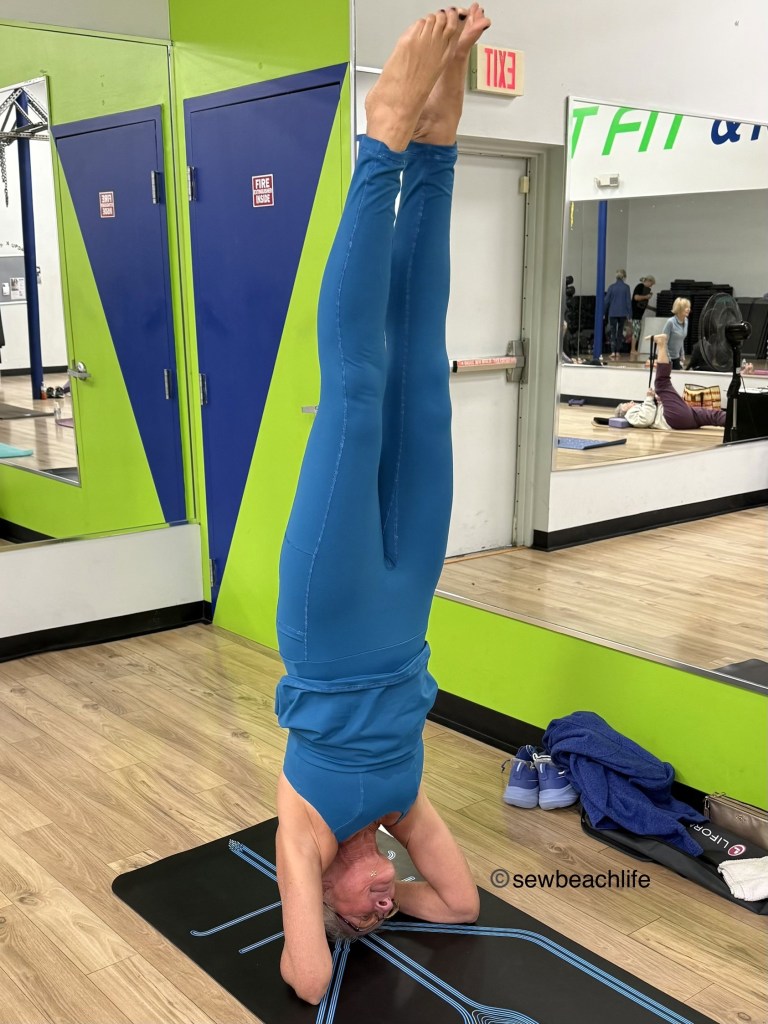
The Spellbound Bra and Dress is flattering whether I’m sitting or standing. Even on a windy day! 🙂 There is a peplum top cut line on the skirt that will turn the bra into a cute, casual top. But I go to yoga class four days a week, and a flowy top isn’t practical for forward folds and headstands! 🙂
If you follow my page, you know that I can never leave a pattern well enough alone. Especially a pattern that I love as much as this one! So I had to turn this bra into a workout top. I mashed it with the Versa Cami and came up with something fun.
I wanted the front to be one piece, without a seam between the bra and body of the top. The back of course, has to have a seam.
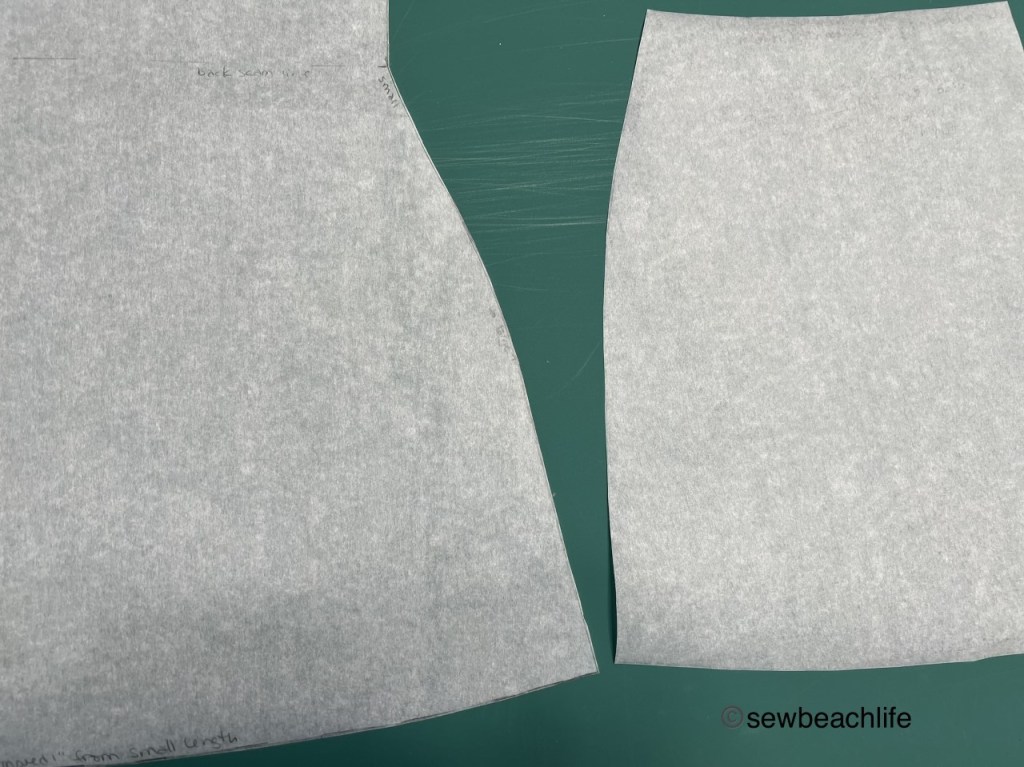
To get the front pattern piece, I lined up the front of the Spellbound at the lining cut line with the front of the Versa Cami at the shorten or lengthen here line on the pattern piece. Once I traced down to the bottom of the bra front piece, I started grading out for my hips. My grading went from small to large, and I removed one inch from the small length and large width at the hemline.
To get the back pattern piece, I started at the shorten or lengthen here line on the Versa Cami, and graded out for my hips. Originally, I just went straight across and cut on the shorten/lengthen line. But after sewing it up, I realized that the straight line gave me too much fabric at center back, and didn’t show the same amount of skin that the dresses show in that area. So I refined the pattern piece and used the curve from hem of the Spellbound skirt at the top of my back piece. In hindsight, I’ll probably just use the top curve of the skirt for the top curve of my top on the next one. My grading went from small to large, and I used the small length and large width at the hemline. You may be wondering why I shortened the front piece an inch but not the back. Two reasons: I like my workout tops to hit at hip level (the Versa is a bit longer than that); and because the back has a 1/2″ seam whereas the front doesn’t.
The pattern pieces I created to hack the bra into a workout top.
As always, I don’t show full pattern pieces out of respect for the designers hard work in creating a pattern. But I am showing enough for you to see the smooth curves of my grading. The front pattern piece is on the left, and the back pattern piece is on the right. A French curve ruler is a very helpful tool for grading and adjusting pattern pieces.
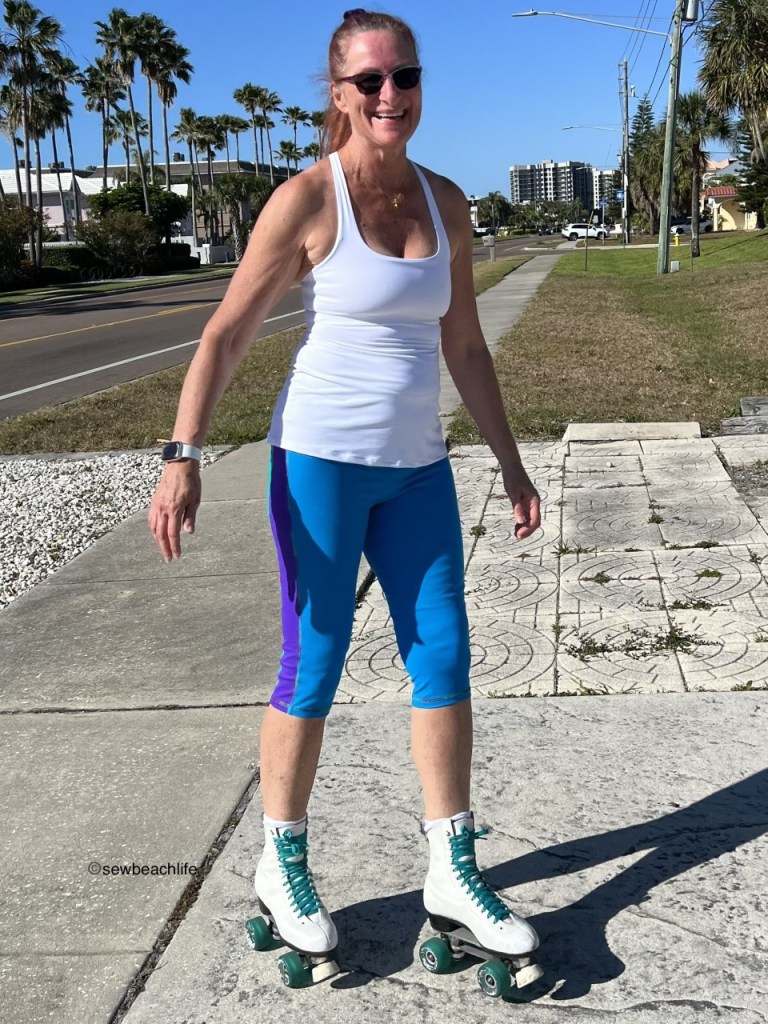
I wear my workout top to skate around the neighborhood as well as to yoga class.
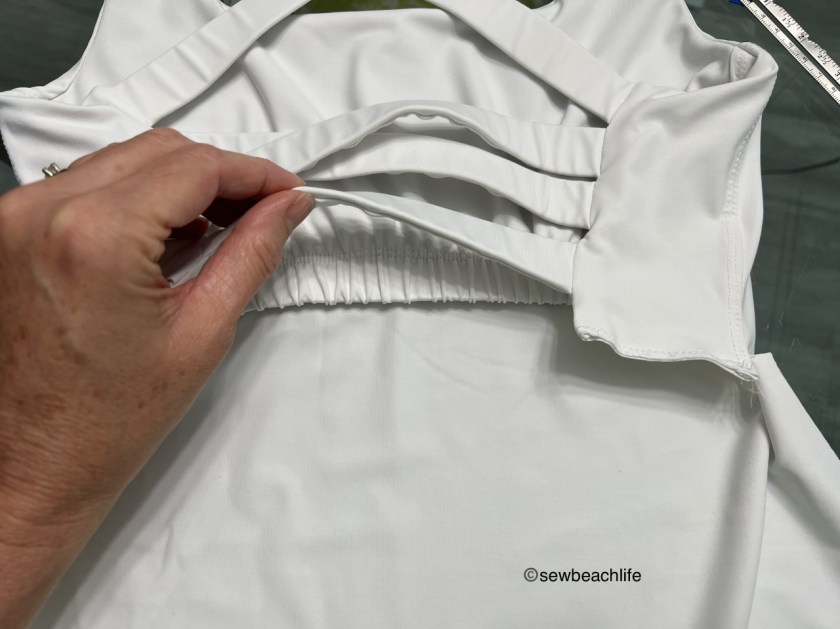
The top is sewn together by following the tutorial for the Spellbound bra up to the point of hemming, except for one thing. When sewing the bra front (turned into a workout top) piece to the bra side piece, don’t sew all the way to the bottom of the side piece. Stop 1/2″ from the bottom to leave yourself fabric for the back seam. Then snip tobut not through the stitching line. This will allow you to press the seam toward the back and top or coverstitch as per the tutorial. You’ll sew the bra lining front and side pieces together as per normal.
I changed the construction of the Spellbound bra lining piece a tiny bit to suit my preferences. I am longer than average from shoulder to bust point and needed to add 5/8″ in order for the elastic to land in the perfect spot under my bust. Although a higher cut line was added to the pattern, my unique body shape requires the elastic lower because I needed the entire bra to slide up, not just add height at the front. This is a common alteration I have to make on a lot of tops and dresses, not just this specific pattern. Just one more reason that I sew- I can make clothing that fits my body. Because I don’t like elastic touching my bare skin, I added another inch so that I could flip the elastic up and have fabric against my skin.
I cut my powernet at the original lining and powernet cut line and the bra main fabric is cut at the original bra cut line. The bra lining is the only piece that I lengthen.
As per the tutorial I basted the powernet to the wrong side of the lining piece. Here’s where I go rogue from the pattern tutorial: I serge the elastic to the wrong side of the lining, then flip it up to fully encase the elastic. Use plenty of pins to hold the elastic in place and coverstitch.
Notice how the serged elastic overlaps the bottom of the basted-in-place powernet?
After top or coverstitching the edge of the elastic in place, remove the basting stitches along the bottom of the powernet. I purposely don’t lengthen the powernet to the same length as the lining because I don’t want the bulk and stiffness of the powernet in the enclosed elastic. It just needs to be long enough to get caught in the topstitching.
My other tip involves the straps. Once you’ve threaded the elastic through the straps, zig zag both ends of the straps to ensure that the elastic stays aligned with the ends of the straps.
You’ll notice how helpful the zig zag basting is when you are pulling the top straps through the bra, and when you’re criss-crossing, pinning, and stitching all the straps at the back.
Here’s how the straps on the workout top hack look once they’re stitched in place.
There are a couple of things to notice in the photo above. First is the clean finish of the enclosed elastic on the liner if you choose to go rogue like I do. The second item of note is the snip on the side seam that will allow the back bottom piece I made be stitched in place.
I add 3/8″ knit elastic along the top of the back workout top or skirt piece. I don’t take the elastic all the way to the side seams, because I don’t want bulky seams. It’s just there to give a little stability to the top of the back of the skirt or workout top bottom back piece. Once the seam connecting the bra to the skirt or workout top back bottom is complete, I fold the elastic down, pin it in place and coverstitch it.
Coverstitching is probably trickier than topstitching in this small area, but I’m so used to working with my machine (I coverstitch a lot) that it isn’t a big deal to me. Either method works and will give nice results.
After that it’s just pinning and stitching the bottom half of the side seam and hemming your new top! You can wear it to the gym, to yoga class, or to skate around your neighborhood.
Even though I skate on a somewhat regular basis, it’s hard to keep from rolling when you’re trying to get photos on the slope of a bridge!
In case you’re wondering what capri length leggings I’m wearing, they are the Stitch Upon A Time Legend Leggings, posted about here. They’re getting a little too big, but I still like them. I should take them apart and make them in a smaller size.
Trying to get nice photos on the beach on a super windy day when it’s not even 60 degrees F makes for some interesting shots!
Luckily the next day was warmer and I got to go for a little skate around the neighborhood.
Whether you make the Spellbound bra, peplum top, or dress version, or play around with my idea of a Versa Cami hack, I’m pretty certain that you are going to love this pattern as much as I do!
Thank you for reading and sharing my love of creating, sewing, serging, great patterns, pattern hacking, fabric, and making beautiful, well-fitting garments! ❤
The links to Stitch Upon A Time may be affiliate links, which means that at no extra cost to you, I may receive a few pennies if you purchase through my link. As always, I only give my honest opinion. After all, it is my blog, which represents me!
It’s never a bad time to sew yourself some new workout wear, but losing some weight necessitates making new items that fit! My drawer full of workout wear is nearly all too big. Going to yoga class 4 times a week means that I need multiple outfits that fit.
Obviously making new workout wear is much more fun than seam-ripping apart your reverse triple coverstitched old outfits, cutting them down to a smaller size, and then re-sewing them! So I traced off a tried and true pattern (the GreenStyle Power Sports Bra) and tried a new pattern (the Sinclair Flex Leggings).
As a sewist, I always notice when someone in yoga class is wearing a new style. Several women had worn workout leggings with a deep V side panel with pocket, and I knew just the pattern to try. Sinclair Patterns is known for well drafted patterns that include petite, regular, and tall options in their files. There are quite a few Sinclair dresses, skorts, shorts, and tank tops in my wardrobe. They aren’t necessarily known for workout wear, but the Flex Leggings pattern is super cute, so I had to give it a try.
With no center front seam, the leggings fit smoothly across the abdomen and hips. The color-blocked V side inserts can include a pocket, which in my mind is a necessity. The pocket is deep, as in deep enough for even the largest phone to fit securely down into the pocket. I wore my leggings to Christmas dinner at my sister-in-laws house, and my phone never felt like it was going to fall out of my pocket. Of course I had my phone in and out of my pocket all day capturing moments with people that I love! (There’s one of us in every family 😉 and people sort of count on me to catch a few photos to share!)
Me, my sister-in-law, and niece.
This candid photo really highlights how much taller I am than my sisters-in-law. It also highlights the shenanigans present every time we get together! 🙂
The above photo also illustrates the only thing I disliked about the pattern. I need a contoured waistband, and always serge 1/4″ clear elastic into the top waistband seam in other patterns. The front and back waistband pieces on the Flex pattern are contoured, but fold-over. I added powernet to the front waistband piece, basting it to the wrong side of the fabric before sewing the waistband pieces together. Even with a double layer of powernet (since the piece is folded over) the waistband slid down all day long.
In all fairness, the tutorial does include optional directions to add narrow elastic threaded through buttonholes in the inner side of the waistband that could be tied to fit. I own one pair of Athleta leggings with an inner drawstring that in the past I have never bothered to tie. Since I’ve lost weight, I currently have the drawstring pulled tight and tied in a knot. But with a smooth front and smooth waistband, I didn’t really want a knot of elastic bumping out in the front. So I unpicked a small section of the waistband to leggings seam, inserted 1″ wide knit elastic, overlapped the ends by 1/2″ and zig-zagged the overlap, and serged the small section of waisband seam closed. I wore my new outfit to yoga class this week, and they stayed up perfectly! Problem solved!
Adding the 1″ wide elastic was the perfect solution! As always, I added a note to my pattern piece so I know exactly how long to cut the elastic (and remember to add it!) the next time I make these leggings!
As with every pattern, it is important to grade to fit your body. I have well developed calves (thanks to skating and yoga), so I knew I needed to grade my pattern pieces. The size chart doesn’t include calf measurements, but I’ve made enough workout wear and know my body shape well enough to estimate that my calves are about two pattern sizes larger than my hips. My knees are slender and I wanted to ensure that the leggings didn’t get baggy at the knee, so I started my grading just below the knee.
A french curve ruler is super helpful for making smooth transitions between sizes. The ruler helped me make a gradual curve on the outer seams of both the front and back pattern pieces from a size 8 out to a size 12 below the knee.
Since I couldn’t know for sure whether my grading was perfect or not, I basted the outer leg seam and tried the leggings on before serging the seam and reverse triple coverstitching. No one wants to have to seam rip that as an experiment! The grading ended up being just right, and now that I have the pattern perfected for my body, future pairs will sew up much more quickly!
These are the 7/8 length, and of course I want to make a pair with the lower leg color-blocking. So I’ll have to play around with transferring my changes to the color blocked pattern piece. What fun is sewing if you don’t challenge yourself, right? 🙂
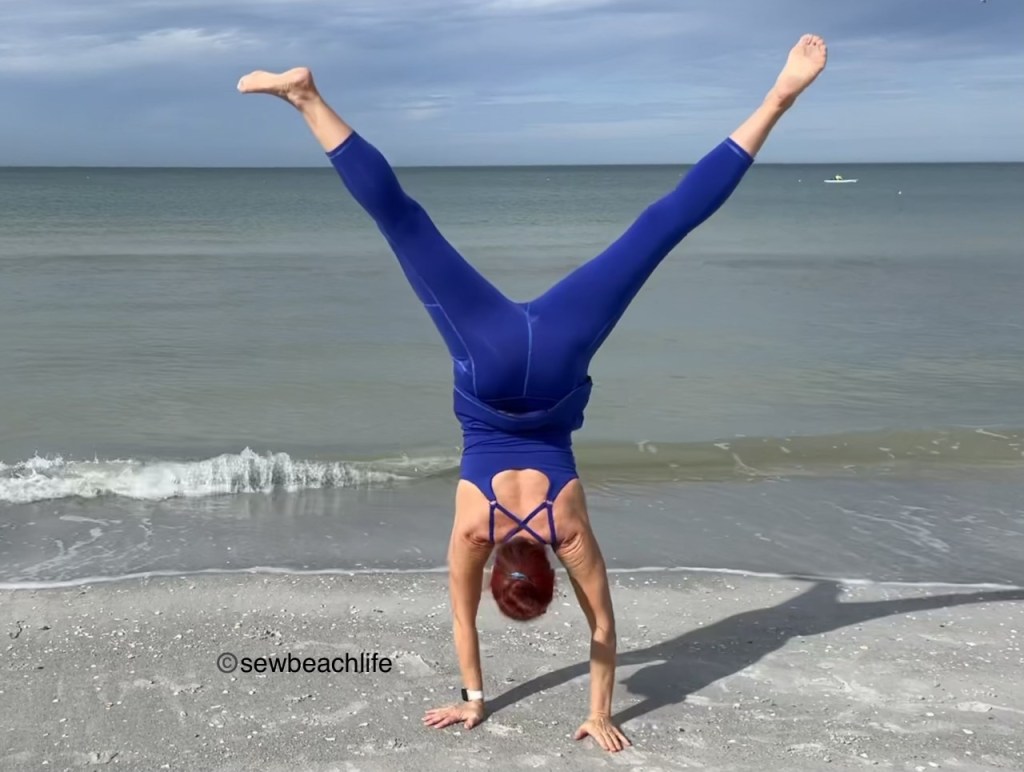
I also like to challenge myself to see if I can still do a cartwheel. Yoga has kept my body strong and maintained my balance. Apparently it is also amusing/fascinating to watch a Grandma do numerous cartwheels while being photographed. As my husband finished our photo session a young woman lounging nearby at the beach smiled, nodded, and gave me a thumbs up. 🙂
The Power Sports Bra is a staple workout and/or swim top pattern for me. Women with smaller cup sizes can get away with flat front bras/tops, but a fuller bust is curvy and princess seams are great for fitting smoothly over your bust projection. I love playing around with it and trying new hacks. Doing double narrow straps with a criss cross was a fun, easy hack. It’s important to take your measurements and compare them to the size chart on a regular basis. I started by tracing my pattern in a smaller size. Previously I’ve used the 34 band size in cups E/F. The F is a little too high in the armpits, so I blend the E and F. My current measurements put me in a 32F. But my bust is fuller at the bottom than at the top. So I take away a bit of the upper curve on the side cup piece. Customizing the pattern pieces to fit your body is the key to a perfectly fitted garment.
Perfectly fitted princess curves fit smoothly over the bust with no puckering at the seams.
Porcelynne has some really pretty rainbow finish rings and slides that I wanted to incorporate into my top. Generally I use wide straight straps on the U-back Power Sports Bra because I don’t like straps pulling on my traps or up near my neck. I’ve found that I need the 1″ wide (final size) straps to be about 13″ long with either elastic or powernet in them, as in this post.
After cutting my four 1.5″ wide straps longer than needed, I zig-zagged 3/8″ knit elastic into the seam as shown here. It’s important to press your straps after turning, so they are as flat and smooth as possible. Also, pressing as you sew gives your garments a much more polished and professional finish.
Extending the strap connection point on the strappy U-back pattern piece by 1/2″ gave room to add the 3/4″ rings to the back by folding the fabric over the ring and stitching it in place. Then two straps were folded over each ring and stitched in place. The two outer straps were kept straight and the two inner straps were criss-crossed.
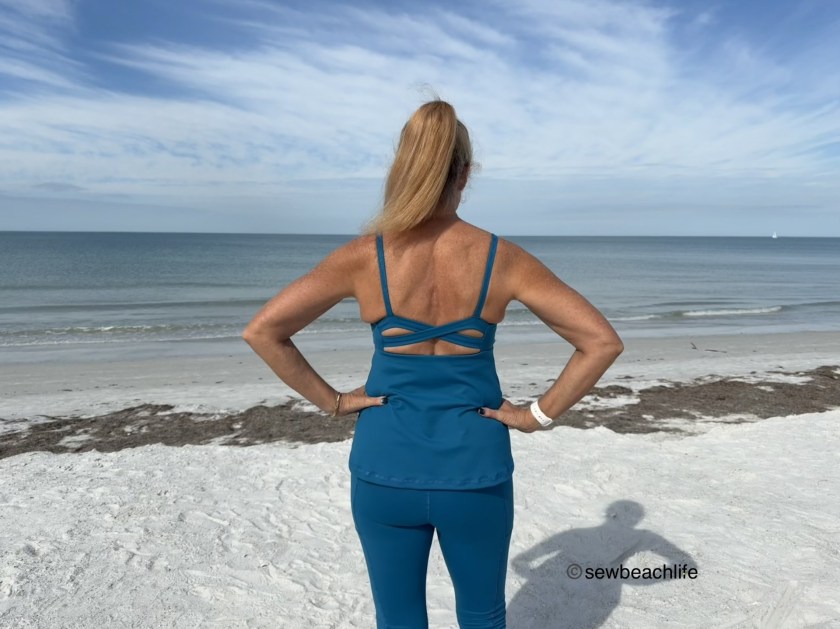
I love the fun shape the straight and criss-crossed straps form on the back. Kind of like a stylized W. I also like the muscles that I’ve developed over twenty years of doing yoga. 🙂 Not bad for a Grandma pushing 60, huh?
You control how close to the neck your crossed straps are by the placement of the 3/4″ slides. Slide them up, and the straps are pulled farther from the neck. Slide them down for maximum crossing. Once you’ve found the perfect placement for you, the straps get tucked into the bra front and stitched in place as per the pattern tutorial. My straight straps ended up 13″ long, and the crossed straps ended up 15″ long.
Using sliders not only adds a fun look, but gives you an option to slightly tighten or loosen the straps for comfort.
I’m definitely going to use rings and slides again because it’s just such a fun look! Making even a few small changes to a pattern is not only fun, it personalizes the pattern for your needs. I was also excited to try a new fabric called stretch eclon jersey from Mood Fabrics. Eclon is a brand name of nylon, and if you’ve read my blog before, you know that I am a big fan of nylon spandex. I avoid polyester, especially for workout wear because it doesn’t breathe and tends to absorb sweaty odors. Ewwww! Florida is usually hot, and my workout wear fabric needs to be moisture wicking.
I hope this inspires you to play with your patterns, and work towards a perfect fit as well as trying new looks.
I love the definition that reverse triple cover-stitching adds to accent the seam lines of well designed workout wear.
The details:
Sinclair Flex Leggings and GreenStyle Power Sports Bra, made of stretch eclon jersey from Mood Fabrics. This and several rayon spandex prints were my first purchase from Mood, so it’s a new supplier to me. I have to say that I liked all of the fabric that I ordered, except one (because it’s only a two way stretch instead of four way. Apparently I didn’t notice that in the fabric listing!)
The rings and slides were purchased from Porcelynne, along with some lovely nylon spandex fabric that I need to share. I made the cutest outfits for my granddaughters! Porcelynne isn’t new to me, I’ve purchased from her before but I don’t really think I’ve shared my makes using her findings before.
Seams were accented with a reverse triple coverstitch on my wonderful Babylock Triumph using Fantastico varigated thread #5028 Peacock Plume from Superior Threads in the looper using a stitch length of 3. Fantastico is one of my favorite threads to use for reverse coverstitching. It has such a beautiful sheen, and the short color repeat is perfect for adding a classy look to garments.
I’m very happy with my new favorite workout outfit, and will definitely be making more! Thank you for reading and sharing my love of creating, hacking, sewing, patterns, fabric, notions, thread, and making beautiful, well-fitting garments! ❤
I love pattern testing in the spring and summer, because I love summer clothes! This makes sense since I live in Florida, which has about eleven months of summer, and a month or so of cooler temperatures. 😉 Patterns that have multiple options mean I can make multiple looks with one pattern. I could have gone for the simple scoop or V-neck tops, but I gravitated to the cross-front tops.
Cross-front tops are such a fun, flattering look if they fit well. It’s important that the cross-over doesn’t cut across the bust, but rather, falls below it. Yet the cross-over needs to be high enough to cover your bra. I want to look a little sexy, but don’t want super revealing clothes. This can be a tricky balance, especially if you have a smaller ribcage and shoulders, but a larger bust size. Thankfully, the Max Crop, Top, and Dress patterns includes regular and FBA cross-over pieces.
I love how the cross-over hits at just the right spot!
Testing for designers that listen to feedback from the testers, and make changes accordingly gives me more confidence in their skills. Yeah, they may have made samples, and done some pre-testing, but nobody is going to come up with a “perfect” pattern that fits every unique body. And something that works in theory, may need a little bit of tweaking in the real world. I’m not saying that designers should change everything about their designs, but if a similar issue is noted by several people, it’s probably worth taking a look at.
That being said, it’s important to be a good tester. Take accurate measurements so that you can choose the proper size. Use fabric with the correct stretch requirements (if garment is for knits) and drape/weight (for knit or woven patterns). Be honest in your fit assessments. This doesn’t mean rude or demanding, because hey, the designer is a human being, worthy of respect and kindness. It just means pointing out any and all areas of concern in an appropriate manner. For example, explaining that your shoulders slope more or less than the pattern; or that the bust is too tight/loose/low/high, etc., but the waist fits perfectly. It’s important to take good fit photos so that the designer can see whether the side seams are vertical, whether it’s pulling to the front or back, how the shoulders and sleeves fit, etc. Every body is unique, and though we may fall into the same size, even if sewn exactly per directions, the garment may look different on you than it does on me. The best a designer can do (when designing for a mass market) is get the best possible look on the most bodies in each size range.
See the nice vertical side seams?
That’s why it’s important, (and something you’ll learn as you sew and grow) to know your body. For instance, my shoulders slope a bit, and I am longer than average from shoulder to bust point. Some designers use a more sloped shoulder seam than others, but when I see a shoulder seam that’s nearly square, I automatically know that I’m going to have to increase the slope by raising the seam at the neck edge. If I just angled down from the original shoulder point to the shoulder edge, then the armscye won’t be deep enough for me, and the garment is going to cut into my armpits. This fit issue is way more common than you’d think. It’s worth the time to make tiny tweaks to a pattern so that it fits your body.
The Stitch Upon A Time Max has sleeve options ranging from cap sleeves, short sleeves, mid sleeves, to long sleeves. It doesn’t however, have a sleeveless option. When you live in a tropical climate, sleeveless is a favorite choice, and it’s not hard to hack to be sleeveless. You can do this to your pattern piece, but if you think you may want to use your pattern for a sleeved version later, it’s easy enough to do to with your garment already cut and sewn. Simply make marks around the armscye 1/2″ in from the raw edge. Trim off that 1/2″ of extra fabric.
A rotary cutter and self-healing mat make cutting and trimming so much easier!
I chose to finish my sleeveless looks with a faux facing. First, measure the new edge of your armscye and multiply that number by .95. I know that sounds weird, since bands and bindings are generally 87.5% of a raw opening. But keep in mind that this pattern was designed for sleeves, which have a much closer fitting armscye that doesn’t need to be “brought in”. The faux facing is just to keep the opening from stretching out of shape. Cut two strips of fabric 7/8″ high, with a width of 95% of the length of your armscye. (In other words, cut the strips so the greatest stretch of the fabric will be going around the opening.)
Using a four thread overlock with a stitch width of M, stitch length of 2, and the differential up to 1.3, serge along one long edge of each strip. Sew the short ends of each strip together with a 1/4″ seam allowance, and mark the quarter points of the raw edge. Mark the quarter points of each armscye and pin the facing to the armscye, only slightly stretching the facing to fit. Add additional pins as needed, then serge, right sides together with the same settings as above, using a 1/4″ seam allowance. Fold the seam allowance to the inside, slightly rolling it so that the facing will be completely hidden, and pin the facing in place. Then coverstitch from the right side.
Notice how you can see just a little bit of the bodice along the top edge of the pinned armscye at the bottom of the photo, while the facing is completely hidden in the coverstitched armscye at the top of the photo? It looks even better once it’s pressed!
One of my favorite looks from the pattern was the cross-front ruffle crop top. But I’m not comfortable wearing cropped length tops. And the height of the waistband piece was a bit too long on my body, looking more like a dropped waist. So I decided to shorten the waistband height so it would end at my natural waist. Then I added length to the ruffle so that it would fall at my high hip, rather than be a crop top. Of course I also made it sleeveless #becauseflorida, and it turned out so cute!
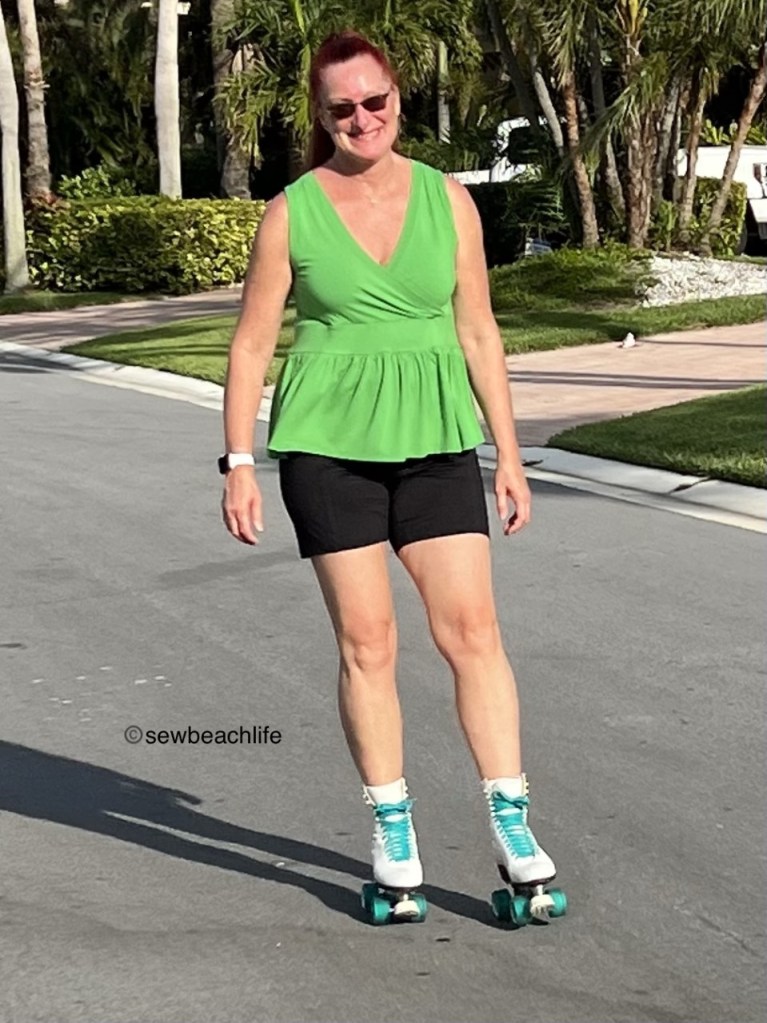
I immediately wore it out skating, and love the fun, flirty ruffle!
Besides yoga, skating is my favorite exercise. It’s great cardio, burns plenty of calories, and is just so fun! My neighborhood doesn’t have sidewalks except for out at a main road with busy traffic. So everyone walks, runs, rides bikes, or skates in the street. My skating route is determined by which streets have newer asphalt, and are therefore smoother to skate on. 🙂
Cul-de-sacs are always fun!
My husband usually rides his bike while I skate. He did a good job of snapping photos while riding! He keeps commenting on how fast I skate lately. I think I’ve gained confidence in skating on rough outdoor surfaces after only having (mostly) skated indoors on a smooth maple wood floor at the skating rink I grew up in. Although I recall skating in more than a few outdoor parades back in the day, the parade pace was definitely slow. I had forgotten how freeing it feels to have the wind in your face, listening to music and flying along like I used to fly around the rink as a child and teen.
Sleeveless tops are more comfortable when skating on a hot day.
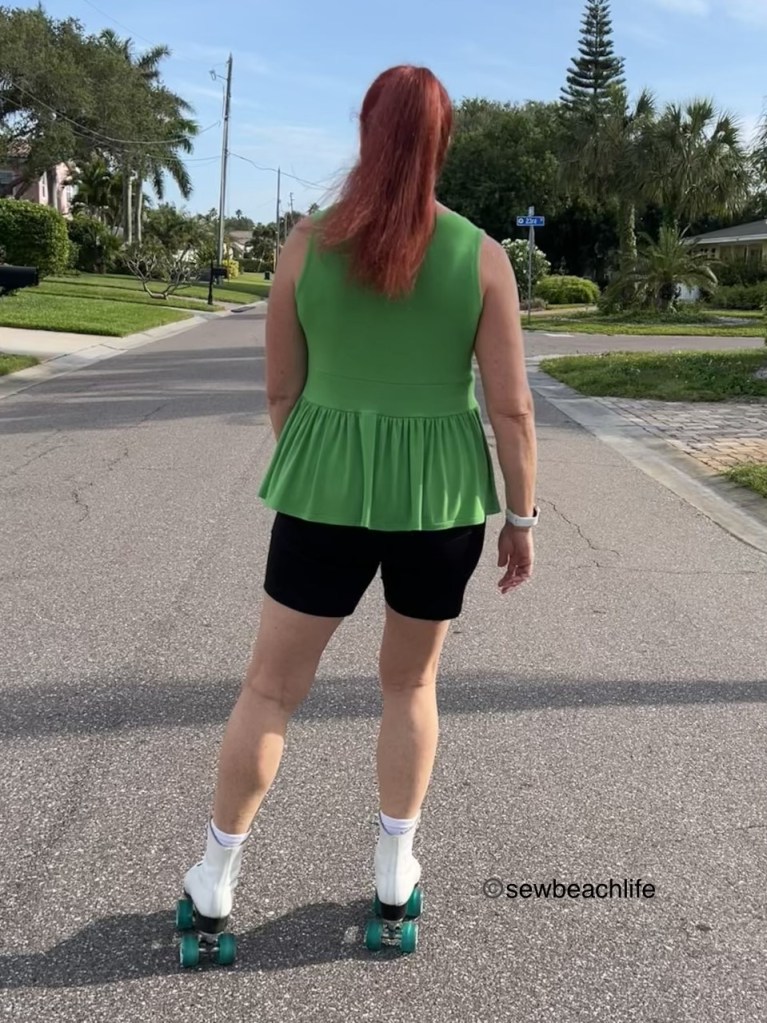
The back view of the Max top is just as good as the front. It’s such a nice, smooth fit. I’m quite pleased with the bodice shaping on these tops. Adjusting the shoulder slope to fit my body means the back lays smooth with no wrinkles or pulling.
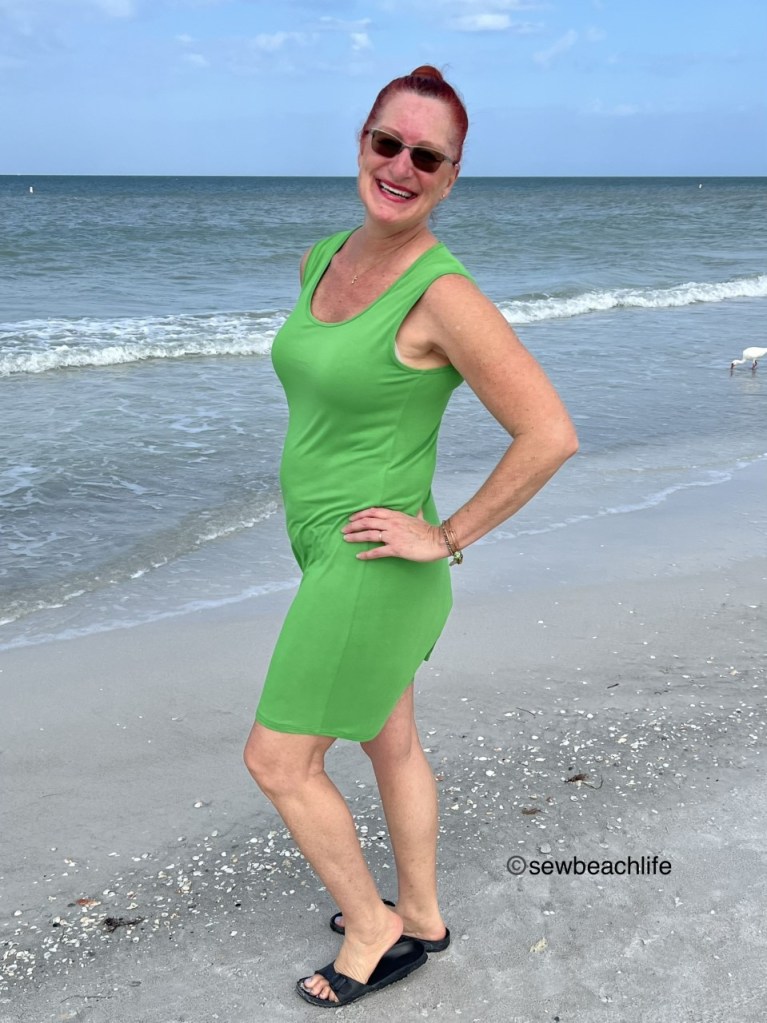
I am loving the sleeveless look!
My next hack idea is to add a skirt to the cross front bodice without adding the waistband. I think it would look super cute too, although I’d probably serge clear elastic into the seam line when attaching the skirt to help keep it pulled in against the weight of a longer skirt. And perhaps a tiered skirt… Ah, so many ideas swirling in my head with this cute pattern! Which I guess sums up my feelings about the pattern. It’s a great base pattern with so many options, from simple V-neck or scoop neck, to cross-front, with cap, short, half or long sleeves. (Although it’s obviously easy to hack into sleeveless) 🙂 With lengths from crop, top, and ruffle crop, to dress.
Obviously I need more fabric to try all my pattern hack ideas!
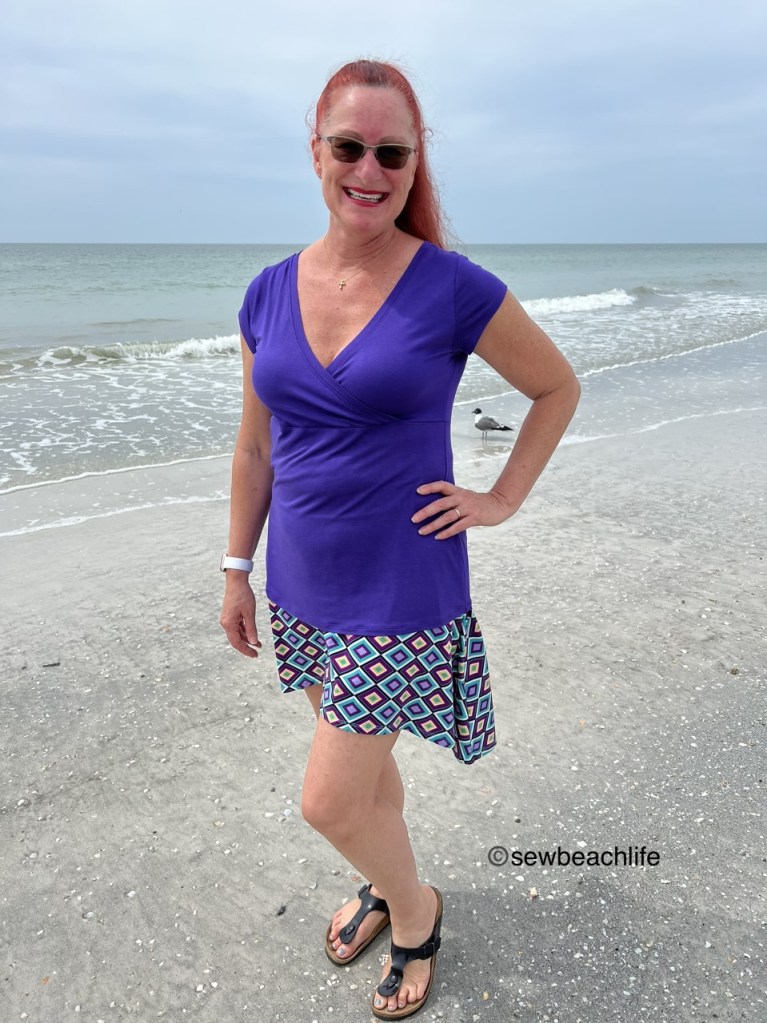
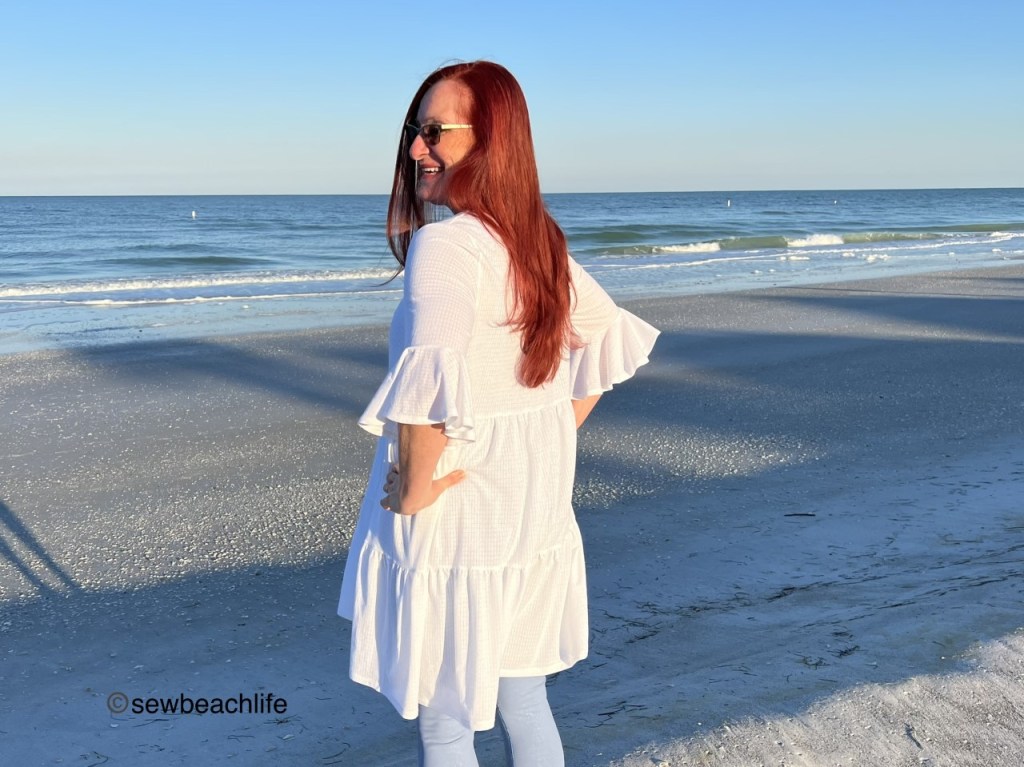
Even the bird approves of my Max Top and Treasure Hunt Skirt! 🙂
The details: The Max Crop, Top and Dress pattern from Stitch Upon A Time includes sizes XXS-6X. For reference, my hacked green ruffle crop top is size Large, using the Large FBA bodice. My purple cross-front top is a blend of Medium and Large FBA bodice with size Large lower top. The purple top is worn with the Treasure Hunt Skirt, which is blogged about here.
The lime green (and plum shown in my sleeveless hack photos) rayon spandex was purchased from Phee Fabrics. The purple rayon spandex is a lighter weight from my stash. It was probably purchased at JoAnn Fabrics years ago. Can you tell that I love bright, fun colors?
Thank you for reading and sharing my love of creating, sewing, patterns, pattern hacking, fabric, and making beautiful, well-fitting garments! ❤
The links to Stitch Upon A Time may be affiliate links, which means that at no extra cost to you, I may receive a few pennies if you purchase through my link. As always, I only give my honest opinion. After all, it is my blog, which represents me!
I go to yoga class four days a week, so workout wear is an important part of my wardrobe. Roller skating has made it’s way back into my life as well, and I’m here to tell you, you can’t skate without smiling. I seem to break out into a grin every time I put my skates on. Having these two forms of exercise in my life brings a certain balance that just feels right.
It makes me happy that I was able to complete two workout outfits as part of the GreenStyle Fit Capsule Challenge. Even though both outfits are Spark Tights and Power Sports Bras hacked into workout tops, they’re very different looks. My first purchase of GreenStyle fabric was this super cool Super Nova Power Flex. It’s a nylon/spandex blend, and I love how colorful it is. Scraps of grape supplex (a color no longer available) from Phee Fabrics was the perfect accent fabric to pair with it, so I decided to go wild and color-block the bodice and then accent everything with a reverse triple coverstitch using MaxiLock radiant turquoise.
Coverstitching in turquoise really accented the fun colors and contrasted with the grape pockets and panels and cool Super Nova print.
I added a panel of white powernet to the back of my top for extra airflow during sweaty workouts. If you’re like me, and dislike straps near your neck, doing straight straps is such a game changer. There’s no need to ever adjust your straps again! To see how to do straight straps and add panels, check out this post.
I love using bra strapping and doing straight straps with the U-back.
My other Power Sports Bra workout top and Spark Tights combination is completely solid. I used a shimmery, almost glittery nylon spandex athletic fabric from JoAnn Fabrics. Since the fabric was shimmery I kept everything one color and achieved an extra pop of color by reverse triple coverstitching with Superior Threads Fantastico #5028 Peacock Plume. I just love their variegated threads!
The rising sun really picks up the sparkle in the fabric, and the beautiful sheen of the thread.
Once again I chose the U-back of the Power Sports Bra and used straight straps. Can you tell that these are well-loved patterns? 🙂 The straps were cut along the edges of the fabric where it wasn’t shimmery, just for a bit of accent. And to not waste that couple inches of fabric! 😉
My non-shimmery straight straps.
The Valerie Dress, another well-loved pattern, hacked to be sleeveless and made in green rayon spandex will get a lot of use. I wear my Valerie Dresses all the time. Sometimes as a dress, sometimes as a nightgown or loungewear. I’ve also mashed it with the Staple Tank for a slightly different look, seen here.
It was a windy day, which made the dress cling to my body.
If it gets chilly, I can slide on my new Sunday Cardigan, hacked to have tiers, butttons, and a sleeve flounce. You can read about that here.
The cardigan works over dresses, shorts or pants, swimwear or workout wear. I love it!
Last but not least, I had to make another Staple Tank! You can never have too many of these tanks. I was gifted some pretty fabric scraps by a woman in one of my Facebook sewing groups. And this fun crocodile skin rayon/spandex print was actually large enough to eek out a new tank! It makes me smile to have such a fun printed tank!
I like using binding to finish my Staple Tanks. It gives it such a clean look.
Whew! That was a lot of sewing and posing for photos. 🙂 I was pretty inspired by the Fit Capsule Challenge this year, and I’m excited to have made so many cute things. It speaks volumes about how I feel about GreenStyle patterns and the way they fit my body so well. I may have plans to make myself another workout outfit. 😉 I bought some navy supplex, and have some pretty fabric scraps to coordinate with it. But I need to make a few things for other people first.
Thank you for reading and sharing my love of creating, sewing, patterns, pattern hacking, fabric, and making beautiful, well-fitting garments! ❤
The links to GreenStyle may be affiliate links, which means that at no extra cost to you, I may receive a few pennies if you purchase through my link. As always, I only give my honest opinion. After all, it is my blog, which represents me!
This idea for hacking the GreenStyle Sunday Cardigan has been floating around in my mind for a while. Finally, I took the time to make a plan, get it done, and I love it! It’s exactly what I wanted. It’s fun and flouncy, lightweight and flowy, and super comfortable. It looks cute with a dress, is easy to toss on when I need a layer, and elevates a simple outfit.
Windy days make photography challenging. And sometimes, not super attractive! 🙂
I suppose I should start with my sketch. Obviously, I’m a sewist, not an artist! 🙂 But sketching out my ideas helps me clarify exactly what I want to do, and it’s helpful to note how I plan to do it! A well-fitting pattern with the basic shape you want is always a great place to start. Set-in sleeves are a must, since dropped shoulders and boxy shapes are not particularly flattering on my body. Clean edges, rather than bands were also important. The GreenStyle Sunday Cardigan met all my requirements, and, I know it fits well since I’ve made several. See here and here.
Noting dimensions really helps when you’re planning to start cutting into your fabric.
The tiers needed to start below the bust, because it’s much more attractive than having a seam slice through the bustline. A bit higher than my natural waistline, almost an empire look was the plan. Since the average side waist is 8″, I figured 6″ would work well. Keep in mind that if you have a very large or full bust, or a longer than average side waist, you may want the top section of your cardigan to be a bit longer. I marked my pattern pieces 6″ down from the armscye on the side seam, and folded the excess pattern under. The sleeves were also shortened to 6″ below the armscye.
It may have been easier if I had just cut the bottom of the patterns off rather than folding, but I didn’t want to have to tape them back together or retrace the pattern pieces the next time I want to use it!
Since I was looking for a knee length cardigan, I measured down to the knee length mark on the pattern, and figured I needed another 23″ or so from my 6″ mark on the side seam. Since I wanted two tiers, I made them each 12″ high to give me a seam and hem allowance. To figure out the width of the first tier, multiply the bottom of the bodice (where you folded or cut off the bottom of the pattern) by 1.5, and multiply that number by 1.5 to give you the width of the second tier. My first tiers ended up being 12″ high by 20″ wide for the front, and 40″ wide for the back. My second tiers are 12″ high by 30″ wide for the front, and 60″ wide for the back. Since my fabric was only 58″ wide, this was a case of “close enough is good enough”!
See? There’s no way to tell that the back bottom tier isn’t quite as wide as it “should have” been.
Cutting the tiers was pretty easy using my quilting ruler and rotary cutter. I use a ruler and rotary cutter all the time when cutting out bands, bindings, cuffs, or any other rectangular piece. It’s so much faster and easier, and much more precise than cutting around a pattern piece. Making the sleeve flounce was much less precise! 😉
My fancy method of making the flounce pattern piece involved tracing around the largest bowl in my cupboard. You know the big bowl you use when hosting a large backyard party and you make a huge taco/pasta/(insert your favorite) salad? Yeah, that bowl. That’s the outside of your circle. Then measure across the bottom of the (folded under or cut off) sleeve piece, and subtract the seam allowance. That’s how big you want the seam line of the circle to be. Since I used a 1/4″ seam allowance to attach the flounce to the bottom of the sleeve, the cutting line needs to be 1/4″ inside the seam line. I’m sure there is a math whiz who could tell me how to arrive at the proper inner circle circumference, but I just found a mug in the cupboard that was the same circumference as my seam line circle, and used a compass to make my cutting line circle 1/4″ inside the seam line circle.
My super scientifically designed sleeve flounce ended up 15″ across, and the inner cut line 3-3/4″ across. This gave me a flounce depth of 5-3/4″.
With all the pieces cut out, it was time to sew everything together. Gather each first tier piece and attach the front tiers to the bodice fronts, and the back tier to the bodice back. Gather the second tier pieces and attach the front tiers to the bottom of the front top tiers. Attach the back tier to the bottom of the back top tier.
The cardigan is really starting to take shape!
With right sides together, sew the shoulder seams and side seams. Sew the sleeves together, and mark the quarter points on the sleeve bottom and the quarter points of the flounces. Match up the quarter points and serge the flounce onto the sleeve. Set in the sleeves and get ready to hem. My best hemming tip for circle sleeves, skirts, or anything with a steeply curved bottom is to four-thread overlock the hem using a stitch length of 2, stitch width of M, and up the differential to 1.5. This will slightly gather the hem so that when you fold it under it will lay nice and flat for you. Pin up your sleeve hems and cover or top-stitch.
Once everything is cover-stitched and pressed, the flounce hem will be smooth and hang perfectly.
Now it’s time to finish the front edges of the cardigan. I do this little trick on every Sunday Cardigan I make. Cut 3/8″ wide strips of feather-weight fusible interfacing. Press the strips along the wrong side of the entire front edge of the cardigan. Snip the interfacing strips almost all the way through to help it curve when going around the neckline. Then press the edges under 3/8″ and cover-stitch.
Using interfacing along the front edges of your cardigan makes finishing it so easy! It helps the fabric stay perfectly smooth and flat, and keeps it from getting stretched out when you top-stitch.
All that’s left to do is hem the bottom edge. I use the same four-thread overlock settings as above, except I only up the differential to 1.3. Then pin the hem up and coverstitch. You can leave the cardigan with an open front, add buttons and loops at the top bodice, or go as far down the front as you want. I decided on 4 buttons and loops to hold the bodice closed when desired.
I love the dreamy look of the buttoned bodice with the ruffled tiers and flounce sleeves.
This is a super fun and super useful cardigan. It’s pretty over a dress when you want a fancier look, and simple enough to throw on over workout wear. It’s a lightweight cover-up at the beach, and would work as a bathrobe too. I could see it made in a stretch mesh or a soft rayon spandex. My version is made from a pointelle knit that I’ve had in my stash since the ’90s. The store it was purchased from has been out of business for decades, so who knows the exact fabric content. I’m usually pretty good at identifying fabric content by look and feel, and my best guess is that it’s a cotton/maybe a bit of rayon?/spandex blend. I just know that I’m super happy with my pattern hack, and am dreaming about another one!
Floaty, flowy, and fun. What more can you ask for?
The details: the Sunday Cardigan is one of the older patterns that hasn’t been updated to the extended size chart yet. It includes sizes XXS-3XL, and has an optional hood and pockets.
Workout wear makes up a large portion of my wardrobe, so I like trying out new patterns and styles. Porcelynne is known for their bra making books and extensive bra making supplies. Their current warehouse is somewhat local to me, and that is how I stumbled across the Jackie pattern. Jennifer (the designer, author, and owner of Porcelynne) is in a Florida sewing group that I’m in on Facebook. She hosted a shopping event that included fabric from an estate sale at her warehouse. I chatted with her while shopping, and commented on the sports bra she was wearing, asking her which pattern it was. She told me it was a new pattern that would be releasing soon. Once the Jackie Sports Bra pattern dropped, I bought it, and the Tankini Add-On pattern.
Sewing workout wear is fun, and ensures that I have unique, colorful outfits to wear to yoga class.
Since Christmas was right around the corner, I spent the next month sewing for others and put off sewing anything for myself. January rolled around, and with it, time to sew for myself. The Jackie is marked as a more advanced pattern, so, as suggested in the tutorial, I decided to make the “simple” pullover version, rather than the zip up front to ensure that I had chosen the correct size. The size chart is extensive and includes fitting tips for uneven breast sizes, compression fit, etc. Knowing that I planned to workout in my bra, including upside down poses in yoga class, I sized down one size for the band, and used powernet in the bra. I did not size down in the cups, because I know powernet has a strong rebound factor. Snug but not not tight is the name of the game in comfortable workout wear! This meant that instead of making the 34F that I measured, I went with the 32F.
I always baste powernet to the wrong side of the main fabric before serging the pieces together, then pull all the basting stitches. In retrospect, I should have trimmed the powernet back 3/16″ around all the edges before serging to reduce bulk in my seams.
The Tankini Add-On is based on your band size and has some cool overlapped pockets on the front side panels. Although I like the looks of the pocket panels, all of my workout tights have pockets, so pockets on my top were redundant. Skipping the pockets meant a little more work to figure out the length on the side panels, but it wasn’t really that challenging to mark a new cutting line. The curving lines on the front panels of the tankini are super cool, but the curves on the side seams are not designed for my body shape. The tankini side seams were too “hippy” on me, with bulges on the sides, then a bit snug at the bottom, which makes the bottom want to slide up to a narrower point on the body. Part of this is probably due to the shape of my booty, which I frequently adjust for when making tops or dresses. Have you ever had a top or dress hem be too short in the back (shorter in the back than the front)? Even on a flowy dress, so you know it’s not because it’s too tight in the hips? Yeah, it’s super annoying, but there is an easy solution as long as it’s done at the “tracing the pattern” stage.
Whenever I’m tracing off a top or dress pattern and the back hem is straight across from center back to side seam, I know it’s going to be a problem if I don’t make an adjustment. Booties protrude from your back, and you need adequate fabric to cover them. Obviously you need adequate hip width, so do any grading out to the appropriate size first. In case you haven’t read my previous posts on the importance of grading, I am a stickler about grading to fit your body. Designers make patterns to fit an average of measurements, and they provide size charts for a reason. Just because your bust measurement falls into size x, it doesn’t mean that your waist and hips do too. Maybe they fall into the measurement range for a size y or z. It’s worth taking the time to grade to your size(s). Now back to the booty issue. If you’ve noticed the “too short in the back” issue on your makes, you need to add length at the hemline in the center back of your pattern, curving up to meet the side seam. Adding 1.5″ at the center fold line seems to be the perfect amount for me.
Notice that more length is added at the center back fold line to about the center of the pattern piece, then it curves somewhat sharply up from there.
Using a curved ruler can help you draw smooth even lines, but you can do this by eye. I do this adjustment on every fitted workout top I make. It’s helpful on more fitted tank and tee shirt patterns as well. Many flowy top patterns seem to include a curved hem. Occasionally after making a pattern with a slightly curved hem, I find that I need to add just a little bit more length to the curve at center back.
The hand on the hip is kind of pulling the fabric, but the top is the same length in the back as it is in the front.
Although I generally followed the tutorial directions when sewing the bra (which is a good idea when trying a pattern for the first time!), I’ve made enough workout wear to feel comfortable making a few changes. Since I had used powernet on all of the front and back pieces, using elastic along the top seam wasn’t necessary. The caveats to this being: first and foremost, having chosen the proper size; using a high quality powernet (not a flimsy powermesh); and using the differential on my serger. When sewing knits, always up the differential (to 1.3 generally speaking) to keep the fabric from stretching out of shape while serging.
Since the neckline has a somewhat squared shape where the center front meets the side front, I found it helpful to sew with a stretch stitch first, then go back and serge to ensure nice crisp corners.
The interior of the bra and modified band.
The bra pattern includes a normal rectangular band with 1-3/8″ wide elastic. The tutorial for the Tankini Add-On recommends serging narrow elastic into the seam when attaching the bra bodice to the tankini. I much prefer a nice solid 1″ wide elastic enclosed in a band on my workout tops. After all, I’m going to be upside down in headstands during yoga class and want a very secure band! On most tops the seam between the bra and bodice is relatively straight, but the Jackie bra has an interesting upward curve at center front. Rather than just using a simple rectangular band, I hacked mine to have a curve matching the curve on the center front of the tankini bodice.
The finished band has enclosed elastic.
Since I don’t like loose elastic floating around inside of a band, I always serge one long edge of the band into the seam when attaching the bra and bodice. Since I’m using 1″ wide elastic, my band is 2-1/4″ high (except for the top center, which is shaped to match the bodice). Here’s what works for me: have the bodice inside out; slide the bra down inside the bodice with the right side out (the bra and bodice will be RST); place the band (sewn into a loop) inside the bra, with the right side of the band facing the lining of the bra, matching all quarter points. Serge from the inside of the top, with the band on top. I like to use plenty of pins to ensure that all layers stay perfectly aligned. Just be sure to pull the pins before they get up to the blade so you don’t hit them! If you’re nervous about this, just baste the layers together, then go over to your serger.
Since different brands of elastic can be more or less stretchy than others, I like to pre-stretch my elastic 8 or 10 times, then wrap it around my body where the band will fall (just under the bust) and pull it to a snug, yet comfortable tightness with a 1/2″ overlap. (Using the 1″ elastic from Wawak, mine ends up 27-1/2″ long.) Overlap the ends 1/2″, and zig-zag together, securing the ends. Mark the quarter points on the elastic (I just use a pencil). Pin the elastic to the wrong side of the unfinished long edge of the band, matching the quarter points, and serge, stretching the elastic to match the band. Then fold the elastic up inside the band, overlapping, and just matching the top of the seam. Pin, then coverstitch in place. This will keep the smooth side of the band against your skin, with the seam on the side against the bodice.
No matter how you bend, the band will lay comfortably against your body.
The wrap-up: I like that the Jackie bra is unique, and different from other sports bra patterns. It’s rated as a more advanced pattern, and I’m glad that I have plenty of experience sewing workout wear. It would probably be intimidating to a beginner sewist, but Porcelynne has a pattern discussion and a sew-along group on Facebook, as I recently discovered. It can be helpful to have a group of people to refer to and ask questions of who are familiar with a pattern. When people ask questions in a pattern or sewing group, and I’m familiar with the pattern or problem, I always try to help. Share your experience to help others who are still learning. That’s how we learn and grow, by doing, and seeking help from those with more experience. And I want people to love sewing, not get frustrated with it and give up.
The contrasting inserts on the side back are fun, and give you more seams to accent with a reverse triple coverstitch!
Rather than the padded adjustable straps the pattern calls for, I chose to add fixed double straps of 5/8″ wide plush bra elastic. If I were going to wear the bra as just a bra, those padded adjustable straps would probably be quite comfortable. I really should make a version with adjustable straps even if only to show off the pretty rainbow rings and sliders and plush bra elastic I bought from Porcelynne!
The details: the Porcelynne Jackie Sports Bra and Tankini Add-On patterns are available in .pdf format as well as paper patterns.
The charcoal gray supplex, powernet, and plum nylon spandex were purchased from Phee Fabrics. This particular purple is from my stash and no longer available, but there is a very pretty purple nylon spandex tricot on the site. It’s easier to sew when you use high quality fabric, and moisture-wicking nylon/spandex fabrics are your best bet for workout wear!
When reverse triple coverstitching, I used Superior ThreadsFantastico #5154 High Society in the looper. I just love the sheen, and how prettily it accents my fabric. Their variegated threads are fabulous!
Thank you to Ashley @coastalyoga for taking photos while at the studio after a sweaty Ashtanga class!
And thank you to my sweet husband for taking photos at home. Sadly it’s too cold and windy for outdoor photos right now!
Thank you for reading and sharing my love of creating, sewing, patterns, fabric, and making beautiful, well-fitting garments!
The new Corset Bra and Top from GreenStyle Creations is so fun! The princess seaming gives it shaping, the pattern design is clean finished, and it includes small, medium, and large cup options in every size.
According to the measurement chart, I need the large cup option, so those are the pattern pieces I printed. I’m so glad that the high hip length was added during testing. It’s not like the bra length wouldn’t get used, but why hide a pretty new make? And that leads me to the corset or crop length and my rant about tankinis.
Have you ever been super excited about the idea of buying a tankini because hey, a tankini will cover more skin than a regular bathing suit top. And you’ll feel more confident in a tankini. Until you try it on. How come tankinis and crop tops look so cute on some people, but when I put one on, all it does it highlight the bit of no-longer-flat belly between the bottom of the top and the top of my bottoms? 😦 I’m sure it has something to do with the combination of my size, height, and/or body shape, but let’s get real. I’m not going to be rocking a crop top. Ever. I make and wear two piece swimsuits because they are much more flattering on my body.
Which brings me back to my excitement about the hip length top being added to the pattern. First off, I could wear it as a tankini because it’s actually long enough to cover the top of my swim bottoms. 🙂 It’s a versatile top and looks cute with Warrior Pants.
A slim, fitted top is a great contrast to flowy Warrior Pants.
I love that the straps of the Corset Top easily cover even the wide straps of my bras. The clean finish of the bra and top is so professional looking, and is accomplished by using either the included shelf bra or lining pattern pieces. The pattern tutorial has clear instructions on how to do the “burrito roll” finish. By the time you make a top or two, you’ll feel quite accomplished using the finish!
I love that my bra straps are hidden, front and back.
You can insert clear elastic in the neckline and around the arms, and it would probably be helpful if you were making a bra for the gym. In which case, I’d probably add powernet too. But since mine is just a casual top, simply upping the differential on my serger to 1.3 was enough to keep the neck and arms from being baggy. (Having the correct fit also helps!) Another tip I figured out is that if you have the main fabric on top while sewing the neckline and “burrito roll” the fabric is less likely to roll outward and show the lining. You can under-stitch if you want, but by serging with the main fabric on top I didn’t feel the need to do so.
I must have been talking with my hands when my husband took this photo.
Another thing to consider when making the Corset Bra, crop or top is that fabric will make a difference in the fit. Fabric with a lot of spandex, and excellent rebound properties will fit tighter to the body, and will be super helpful when making the bra. Fabric with a lighter weight, but still a decent amount of spandex (at least 5-10%) will be less form fitting (which may be preferable in the hip length) then something like supplex or swim fabric will be.
The flattering fit of this top makes me happy. And taking plenty of yoga classes made it easy for me to balance on the railing without falling backwards into the seagrass!
Can we just talk about the beautiful princess seaming on this pattern? It’s a great opportunity to color-block, but I really wanted to bring out the lines a different way. I figured that a reverse triple cover-stitch would almost give the illusion of boning channels, which seems appropriate on the corset style. I recently ordered some Fantastico variegated thread from Superior Threads, and I am super impressed with it! It has a beautiful sheen, and the color repeat is only one inch. That means that you get see all of the colors in the thread cycle through frequently.
I love how the thread highlights the seamlines and makes them pop!
I know a pattern is good when I start dreaming about how I can hack it. And the Corset Bra and Top was just begging to be made into a top and/or dress. I’ve seen some advertisements for knit tanks with a chiffon “skirt” and I knew that it would be an easy hack. I had made a corset length top during testing, and it was easy to trim off the bottom so that it would end at my natural waist. I find tops and dresses most flattering if the narrowest part falls at the natural waist.
Then I cut a strip of chiffon 12″ high by the width of the fabric (approximately 58″ wide). You want the width of your strip to be between one and a half to two times the width of the bottom of your top. Depending on the width of your fabric and the size you are making, you may need to cut two strips, giving you a front and a back to get the width you want. Serge the two short ends of the strip together as a side seam, then serge the bottom edge to help prevent fraying. Fold the hem up 3/8″ then another 5/8″ so that the serged edge is completely enclosed. Cover or top stitch the hem. Gather the top edge of the skirt, and match the quarter points up with the quarter points of the bodice. Baste the skirt to the bodice and adjust any gathers as needed before serging.
The simple gathered chiffon skirt gives the top a whole new look!
The fun floaty look of the chiffon combined with the fitted bodice of the Corset Top looks great over a skirt. Lengthening or adding a second (one and a half times wider) tier of chiffon would totally change the look. As would making the skirt out the same knit as the bodice. I’ve got so many top and dress ideas floating through my brain!
It’s such a fun hack!
And that’s the beauty of a pattern like this. It’s a bra, it’s a top, it’s a swim top, it’s the bodice of a dress. I’ve got some GreenStyle Power Flex fabric just waiting to be sewn into Spark Tights and a cute new workout top. It’s time to sew all the things!
The fully lined purple top is a lightweight nylon/spandex circular knit from Phee Fabrics. It is accented with Fantastico #5154 High Society. The chiffon in my stash came from an estate sale. Worn with a Pace Skirt.
The links to GreenStyle are affiliate links, which means that at no extra cost to you, I may receive a small commission if you purchase through my link. As always, I only give my honest opinion. After all, it is my blog, which represents me! Thank you for reading and sharing my love of creating, sewing, patterns, fabric, and making beautiful, well-fitting garments! ❤